When you take a medication like levothyroxine for hypothyroidism or phenytoin for epilepsy, your life depends on consistency. A tiny change in how your body absorbs the drug - even a 5% difference - can mean the difference between staying stable and having a seizure, a heart rhythm problem, or a thyroid crash. These are NTI drugs - narrow therapeutic index drugs. And yet, many insurers still treat them like any other prescription, forcing patients through layers of paperwork just to get the brand-name version they need.
What Makes NTI Drugs Different?
| Drug Name | Use | Therapeutic Risk |
|---|---|---|
| Levothyroxine | Hypothyroidism | Small changes in absorption can cause TSH spikes, leading to fatigue, weight gain, or heart issues |
| Phenytoin | Epilepsy | Minor fluctuations can trigger breakthrough seizures |
| Carbamazepine | Epilepsy, nerve pain | Levels must stay within 1-12 mcg/mL; outside this range, seizures or toxicity occur |
| Warfarin | Blood thinning | Too little = clot; too much = bleeding |
| Cyclosporine | Organ transplant rejection | Underdosing leads to rejection; overdosing damages kidneys |
Why does this happen? Generic drugs are required to be bioequivalent to the brand, meaning they must deliver the same amount of drug into the bloodstream. But for NTI drugs, “equivalent” isn’t good enough. A patient stabilized on brand-name levothyroxine might switch to a generic and suddenly see their TSH level jump 300%. That’s not a glitch - it’s a pharmacological reality. The body doesn’t care if the pill is labeled “generic” or “brand.” It only cares about how much active drug enters the bloodstream, and even minor differences in fillers, coatings, or manufacturing can alter absorption.
Why Do Insurers Even Require Prior Authorization for NTI Drugs?
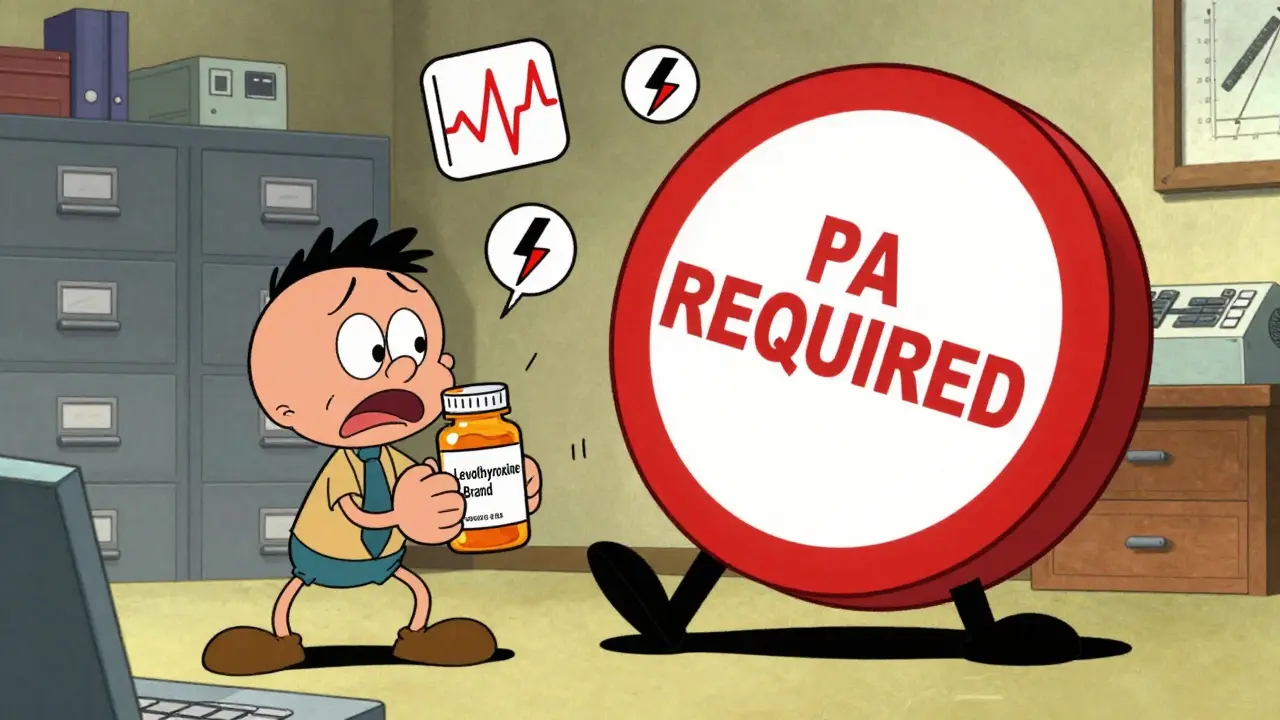
Most insurance plans operate on a simple rule: if a generic exists, use it. It saves money. But NTI drugs break that rule. Still, many insurers haven’t caught up. Some still require prior authorization (PA) before approving a brand-name NTI drug, even when the patient has been stable on it for years.Why? Because it’s easier to apply blanket policies than to track nuanced clinical needs. A pharmacy benefit manager (PBM) might have a rulebook that says “no brand-name drugs without PA,” and they don’t always have the systems - or the training - to recognize that NTI drugs are different. The result? A neurologist in Texas spent 11 hours in a single week just filling out PA forms for levothyroxine, carbamazepine, and warfarin. That’s 11 hours a doctor could’ve spent seeing patients.
Insurers argue that PA helps prevent unnecessary spending. But here’s the twist: the same insurers that demand PA for brand-name NTI drugs often have no problem switching patients to a different generic version every few months. That’s not cost control - that’s guesswork with real health consequences.
How NTI Drug Prior Authorization Actually Works
The process isn’t simple. When a doctor prescribes a brand-name NTI drug, the pharmacy submits a claim. If the insurer’s system flags it as “non-preferred,” the pharmacy notifies the doctor. Then comes the paperwork.Typical PA requirements include:
- Proof of prior generic failure (even if the patient has never been on a generic)
- Lab results (TSH levels, INR, drug blood levels)
- Documentation of previous adverse events (seizures, hospitalizations)
- Physician letter explaining why the brand is medically necessary
Some states, like North Carolina, let providers submit these requests via fax, phone, or their NCTracks portal. Others, like Mississippi, require a universal form. The process can take 2-5 business days. For someone on levothyroxine, that’s enough time for their TSH to climb and symptoms to worsen. For someone on phenytoin, it could mean a seizure.
Electronic prior authorization (ePA) has cut processing times by 42% overall, but NTI requests still take 22% longer than standard ones because they require extra clinical data. That delay isn’t just inconvenient - it’s dangerous.

Who’s Doing It Right?
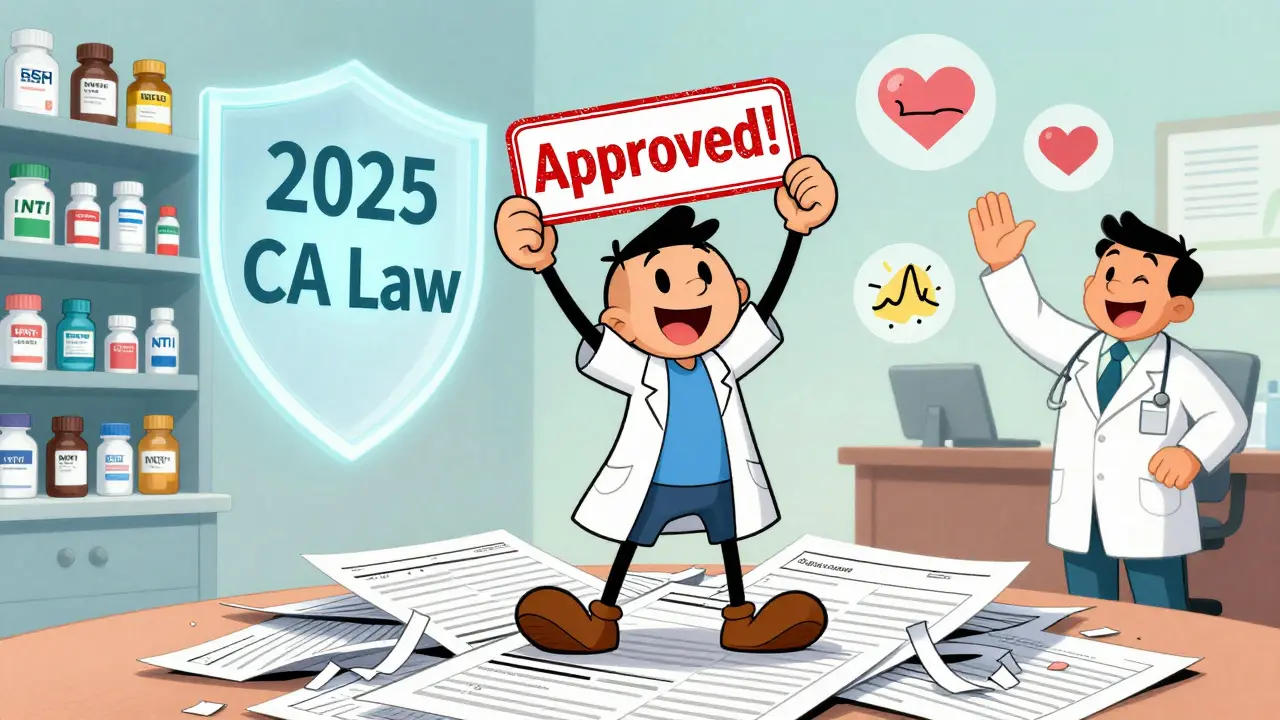
Some insurers have figured it out. Health Net, for example, explicitly states in its 2023 policy that NTI brand-name drugs “may be listed on the Formulary at a higher tier and do not require prior approval.” That’s the gold standard. California’s AB-1428, effective January 1, 2025, goes even further: if a patient has been stable on a brand-name NTI drug and their condition hasn’t changed, insurers can’t require PA again.Medicaid programs are also evolving. Federal law requires them to respond to urgent PA requests within 24 hours and provide a 72-hour emergency supply. But enforcement varies. In states like New York and Washington, NTI drugs are now automatically exempt from step therapy - meaning patients don’t have to try and fail on a generic first.
The Improving Seniors’ Timely Access to Care Act, passed in April 2024, will require Medicare Advantage plans to give real-time electronic decisions for NTI drugs. That’s huge. Right now, many seniors wait days just to refill a thyroid med - a delay that’s medically indefensible.
The Human Cost of Delays
Behind every PA denial is a real person. A Reddit user named u/NeuroDoc2020 shared that 73% of their levothyroxine brand requests were initially denied - even when patients had TSH levels so unstable they were hospitalized. The Patients Rising survey found that 29% of NTI drug users experienced adverse health events directly tied to PA delays. That’s not just a statistic. That’s someone who missed work because they couldn’t think straight. Someone who went to the ER because their heart started racing. Someone who had a seizure because their medication wasn’t there when they needed it.And yet, approval rates are high - 82.4% after initial denial. That tells you something: most of these denials aren’t clinical. They’re administrative. The system isn’t broken because doctors are prescribing wrong. It’s broken because it’s designed to say no first, ask questions later.
What You Can Do
If you’re on an NTI drug and your insurer is giving you trouble:- Ask your doctor to write a detailed letter of medical necessity - include lab results, history of seizures or instability, and references to FDA guidance.
- Check your state’s laws. As of 2025, 18 states require automatic approval if the insurer doesn’t respond within the mandated timeframe.
- Use your pharmacy’s ePA portal. It’s faster than fax or phone.
- Appeal immediately. The average time to approve after a denial is 3.2 business days - but appeals can move faster if you’re persistent.
- Join advocacy groups like Patients Rising. They track insurer patterns and push for policy change.
Don’t assume your doctor will handle it all. Many physicians are overwhelmed. If you’re the one taking the drug, you’re the best advocate for your own safety.
The Future Is Changing - But Not Fast Enough
Industry analysts predict that by 2026, 75% of commercial insurers will eliminate prior authorization for established NTI drug categories. Why? Because the data is clear: forcing patients to switch generics increases hospitalizations, ER visits, and long-term costs. The $2.3 billion insurers claim they’re saving annually through PA on NTI drugs is likely offset by the $5-7 billion in avoidable healthcare costs from preventable complications.Regulators are catching on. The 21st Century Cures Act pushed insurers to make their PA criteria public. As a result, 37% more NTI drug requests are approved on the first try. That’s progress.
But until every insurer treats NTI drugs like the life-or-death medications they are - not just another line item on a spreadsheet - patients will keep paying the price in seizures, fatigue, hospital stays, and lost time.
It’s time to stop treating medical necessity as a paperwork problem. For NTI drugs, consistency isn’t a preference - it’s a requirement for survival.
What are NTI drugs?
NTI drugs, or narrow therapeutic index drugs, are medications where small changes in dose or blood concentration can cause serious side effects or treatment failure. Examples include levothyroxine for thyroid conditions, phenytoin for seizures, and warfarin for blood thinning. Even minor differences in how the body absorbs the drug - like switching from brand to generic - can be dangerous.
Why do insurers require prior authorization for brand-name NTI drugs?
Many insurers apply generic-first policies to all drugs, assuming cost savings. But for NTI drugs, this logic fails. Insurers often lack systems to recognize NTI exceptions, so they default to requiring prior authorization to control spending - even when clinical evidence shows brand-name stability is safer. Some plans still require PA because their policies haven’t been updated to reflect FDA guidance or recent research.
Can I switch from brand to generic for an NTI drug?
Technically, yes - but it’s risky. The FDA says generics must be bioequivalent, but for NTI drugs, “equivalent” doesn’t mean interchangeable. Studies show that switching can cause TSH spikes, seizures, or unstable INR levels. If you’re stable on a brand-name NTI drug, staying on it is often the safest choice. Talk to your doctor before switching.
How long does prior authorization take for NTI drugs?
The average processing time is 3.2 business days, though some plans take up to 5 days. Electronic submissions are faster than fax or phone. For urgent cases, Medicaid must respond within 24 hours and provide a 72-hour emergency supply. If your insurer delays beyond state-mandated timelines, you may qualify for automatic approval - check your state’s laws.
What states protect NTI drug access?
As of 2025, 22 states have laws limiting prior authorization for NTI drugs. California prohibits PA for stable patients on brand-name NTI drugs. Eighteen states require automatic approval if insurers don’t respond within mandated timeframes. New York, Washington, and Massachusetts have exempted NTI drugs from step therapy. Check your state’s health department website for current rules.