
When your child is sick, the last thing you want is a battle over medicine. You’ve got the prescription in hand, but now you’re staring at two options: a sweet-tasting liquid or a tiny pill. Which one really works better? The answer isn’t as simple as "liquids are for babies" anymore. In fact, the science has shifted - and what you’ve always assumed might be holding you back from a safer, cheaper, and more effective choice.
Why Liquids Used to Be the Default
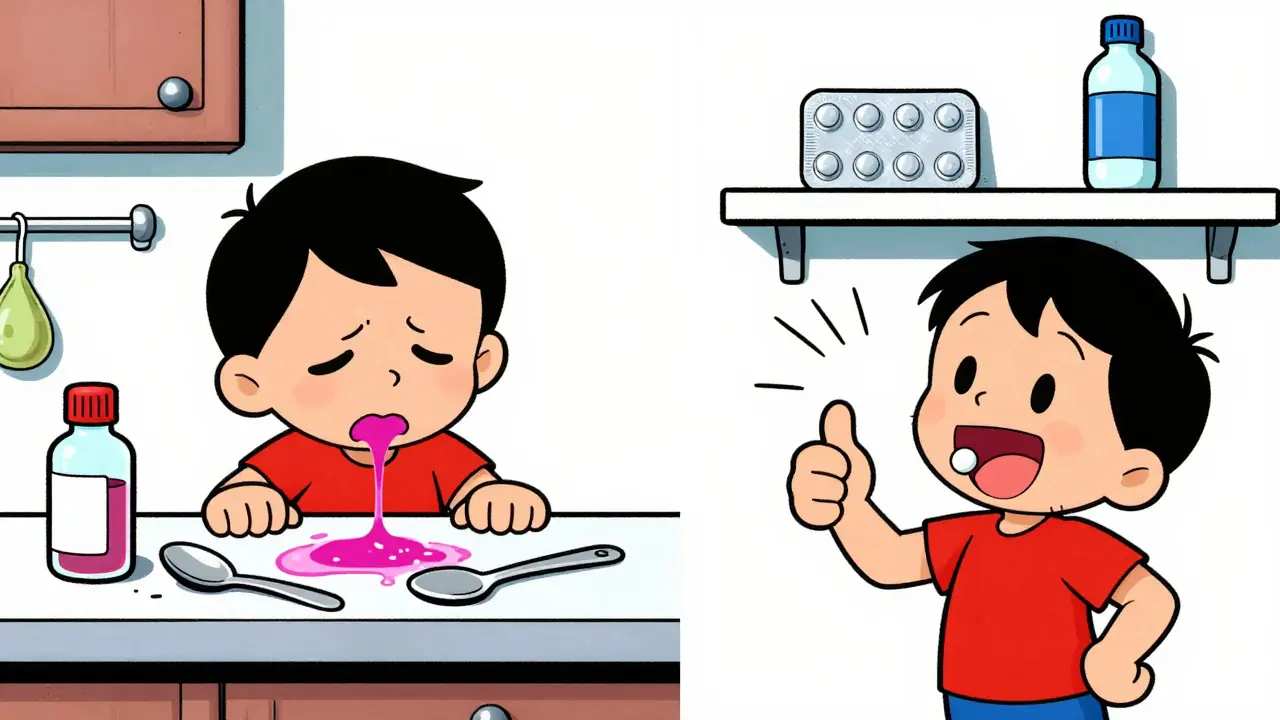
For decades, doctors and parents turned to liquid medications because it seemed obvious: kids can’t swallow pills. It made sense. Infants and toddlers don’t have the coordination or experience to take a solid tablet. So pharmacies stocked syrups, suspensions, and flavored drops. Parents appreciated the flexibility - you could give half a teaspoon or a full one, depending on weight. But that flexibility came with hidden costs.Studies show that 15-20% of parents mismeasure liquid doses - using kitchen spoons, eyeballing it, or misreading the syringe. The FDA found that these errors lead to underdosing or overdosing, especially with antibiotics and pain relievers. And taste? Many "strawberry-flavored" liquids don’t taste like real fruit. One parent on Reddit put it bluntly: "My 4-year-old would rather swallow a mini-tablet than take the 'strawberry' antibiotic that tasted like chemicals."
Tablets Aren’t Just for Big Kids Anymore
The biggest myth? That tablets are too hard for young children. Modern pediatric tablets are nothing like the big, bitter pills adults take. Mini-tablets as small as 2mm across - smaller than a grain of rice - are now available. They’re coated to mask bitter tastes, designed to dissolve quickly, and safe to swallow whole. In a 2012 study of 60 children aged 6 months to 6 years, mini-tablets were accepted just as well - or better - than liquids, especially in babies under 1 year. Why? Because liquids often come with a strong chemical aftertaste, while modern tablets are nearly flavorless.Even toddlers can learn to swallow them. The "pop-bottle method" - placing the tablet on the tongue, then sipping water from a bottle - works for kids as young as 3. A 2023 report from BC Children’s Hospital found that over 90% of children who practiced this technique could swallow tablets reliably by age 4. And if they’re nervous? Start with mini-marshmallows or bread balls. Practice makes it normal.
Stability, Storage, and Waste
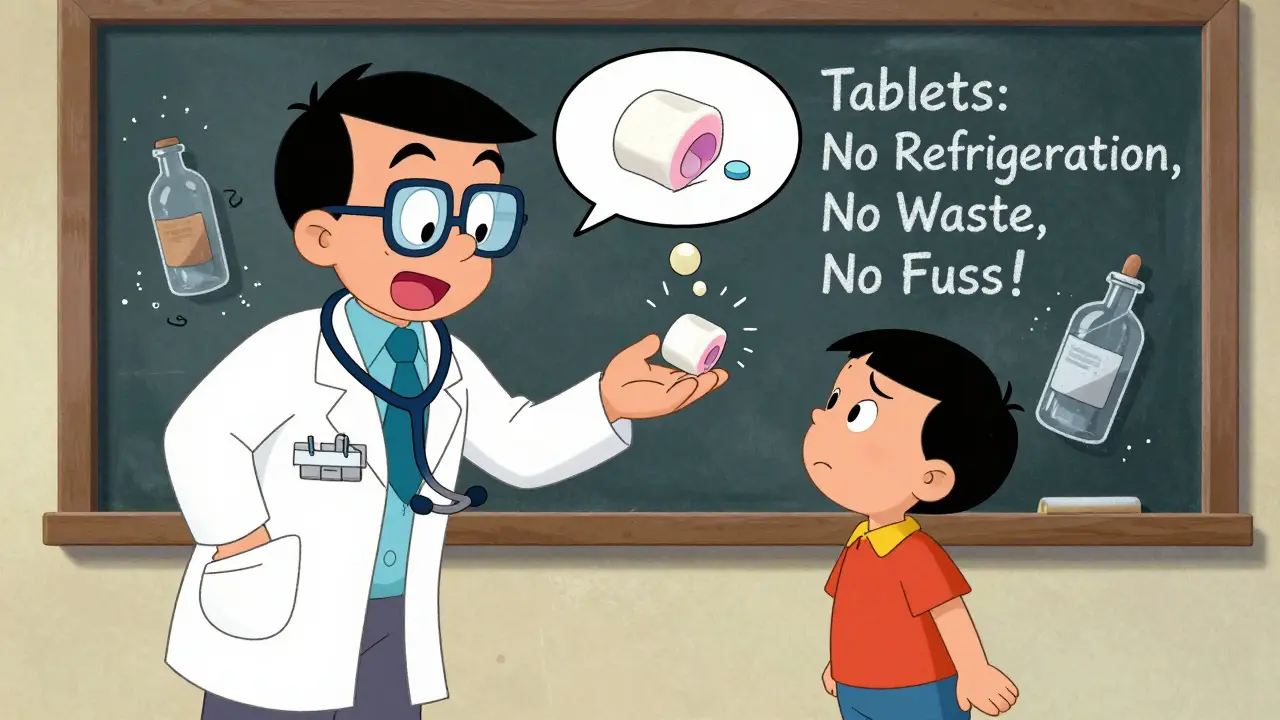
Liquid medications have a shelf life - and not a long one. Once opened, most require refrigeration and expire in 14 to 30 days. If your child doesn’t finish the bottle? You throw it out. That’s money wasted. And if you forget to refrigerate it? The medicine can degrade, losing effectiveness.Tablets? They last 2 to 3 years at room temperature. No refrigeration. No spoilage. No guesswork. A 2018 study showed that solid forms have 3 to 5 times lower degradation rates than liquids. That’s not just convenient - it’s safer.
Cost Matters - Even for Parents
It’s not just about what’s in the bottle. It’s about what you pay - and what the system pays. In the UK, the NHS found that switching from liquid to tablet forms for common pediatric prescriptions saved £7,842 per 10,000 prescriptions. For a hospital serving thousands of kids, that adds up to over £50,000 a year. In the U.S., where out-of-pocket costs are higher, families pay more for liquids because they’re often branded, require special packaging, and come with extra administration tools (syringes, measuring cups).Plus, when you buy a 100mL bottle of liquid amoxicillin and only use 30mL, you’re paying for 70mL you’ll never use. A tablet pack of 10 doses? You take what you need. No waste. No extra cost.
When Liquids Still Win
This isn’t about banning liquids. There are real cases where they’re the best - or only - option.- Infants under 6 months: Still too young to swallow safely. Liquids are necessary.
- Medications needing precise titration: Like levothyroxine (for thyroid) or warfarin (for blood thinning). Even a 0.1mL error can matter. Liquids allow exact dosing.
- Children with swallowing disorders: Neurological conditions, severe reflux, or developmental delays may make tablets unsafe.
For most common illnesses - ear infections, strep throat, allergies, fevers - tablets are just as effective. And often better.
What the Experts Say
The European Medicines Agency has been clear since 2013: Children should be trained to swallow pills from age 3-5, especially for chronic conditions. The American Academy of Pediatrics updated its 2022 guidelines to say kids as young as 2 can learn to swallow tablets with proper coaching.Dr. Jane Standing, a pediatric pharmacologist at Great Ormond Street Hospital, put it plainly: "The automatic preference for liquid formulations in children is not evidence-based and often counterproductive to long-term medication adherence."
Why So Many Doctors Still Prescribe Liquids
If the science supports tablets, why are so many doctors still writing prescriptions for liquids? A 2021 survey of 500 U.S. pediatricians found that 62% still default to liquids for kids under 8. Why?- Parental pressure: "I don’t want to fight with my child."
- Lack of training: Only 18% of pediatricians feel confident teaching tablet-swallowing techniques.
- Labeling gaps: 42% of pediatric medications don’t have official dosing instructions for solid forms in children under 6.
It’s not that doctors are wrong - they’re working with outdated systems and limited resources. But change is coming. The FDA’s 2023 draft guidance now encourages drugmakers to develop "age-appropriate solid formulations" instead of defaulting to liquids. The EU has approved 47 new pediatric tablets since 2008 - and only 12 new liquids.
What You Can Do Today
You don’t need to wait for the system to catch up. Here’s how to make a smarter choice:- Ask your doctor: "Is there a tablet form available for this medication?" Don’t assume it’s not an option.
- Check the pharmacy: Some pharmacies can order mini-tablets or orodispersible tablets even if they’re not on the shelf.
- Practice at home: Start with soft foods - mini-marshmallows, bread balls - before moving to real tablets.
- Use the pop-bottle method: Place the tablet on the tongue, take a sip from a water bottle, and swallow.
- Look for flavor-matched products: If you must use liquid, choose ones that actually taste like real fruit, not artificial candy.
For a child with a chronic illness - asthma, epilepsy, ADHD - switching to tablets can improve adherence by 22%, according to a 2022 JAMA Pediatrics meta-analysis. That means fewer missed doses, fewer flare-ups, fewer ER visits.
Final Thought: It’s Not About Age - It’s About Readiness
Your 3-year-old might swallow a tablet like a pro. Your 7-year-old might gag at the sight of one. There’s no one-size-fits-all. But the old rule - "liquids for kids, pills for adults" - is outdated. Today’s pediatric medicines are designed with children in mind. And that means tablets are no longer a last resort. They’re often the smarter, safer, and more cost-effective choice.Don’t settle for what’s familiar. Ask. Try. Practice. Your child - and your wallet - will thank you.
Can my 2-year-old swallow a tablet?
Yes - with proper training. Modern pediatric tablets are as small as 2mm and designed for young children. The American Academy of Pediatrics says kids as young as 2 can learn to swallow tablets using techniques like the "pop-bottle method." Start with practice using soft foods like mini-marshmallows before moving to real medication. Supervision and patience are key.
Are liquid medications less accurate than tablets?
Yes, often. Studies show 12-18% of liquid doses are mismeasured by parents - using kitchen spoons, guessing, or misreading syringes. Tablets come in fixed doses, so you give exactly what’s prescribed. No measuring errors. No risk of overdose from a spilled bottle.
Why do some liquids taste so bad?
Many "flavored" liquids use artificial sweeteners and masking agents that don’t mimic real fruit. A "strawberry" flavor that doesn’t taste like actual strawberries often triggers rejection. Look for products labeled "real fruit flavor" or ask your pharmacist for alternatives. Some pharmacies can compound medications with better-tasting bases.
Is crushing tablets safe for kids?
No - not without checking with your doctor or pharmacist. Crushing can destroy time-release coatings, change how the drug is absorbed, or make it unsafe. Some medications become toxic when crushed. Always ask if the tablet can be crushed or split before doing it.
Do tablets cost more than liquids?
Usually, no. Tablets are often cheaper per dose because they don’t require special packaging, refrigeration, or flavoring. A 2021 UK NHS analysis found that switching to tablets saved £7,842 per 10,000 pediatric prescriptions. You also avoid waste - if your child doesn’t finish a 100mL bottle, you lose the rest. With tablets, you only use what you need.
What’s the safest way to give a tablet to a child?
The "pop-bottle method" is the most effective: Place the tablet on the tongue, have your child take a sip of water from a bottle (not a cup), and swallow. The water flow helps carry the tablet down. Practice with soft foods first. Never force a tablet - stay calm, be patient, and praise success. Most kids learn within a few tries.
When should I stick with liquid medication?
Stick with liquid if your child is under 6 months, has a swallowing disorder, or is on a medication that requires very precise dosing - like levothyroxine or warfarin. Also, if your child refuses tablets after trying multiple times and techniques, it’s okay to use liquid - but always ask if a better-tasting or more stable version is available.
Oren Prettyman
January 23, 2026 AT 08:35The notion that tablets are somehow superior for children is a dangerous oversimplification fueled by pharmaceutical marketing and poorly understood pharmacokinetics. Liquid formulations allow for precise titration based on weight, which is critical in pediatrics where a 5% dosing error can mean the difference between therapeutic and toxic. The FDA’s own data shows that even with syringes, parents consistently misread volumes-yet tablets introduce a whole new set of risks: choking, incomplete dissolution, and erratic absorption due to inconsistent gastric emptying in young children. And let’s not pretend that ‘mini-tablets’ are universally available or approved for every drug. Most pediatric prescriptions still only come in liquid form for a reason: science, not convenience, dictates the route. This article reads like a corporate white paper disguised as public health advice.
Tatiana Bandurina
January 23, 2026 AT 17:49Let’s be honest-this whole tablet push is just another way for Big Pharma to eliminate the need for pharmacies to compound medications, which is where the real profit margin is. Liquid suspensions require special stabilizers, flavorings, and packaging-all of which cost more and generate higher margins. Tablets? They’re cheap to mass-produce, shelf-stable, and easy to distribute. The ‘cost savings’ argument is a distraction. What about the children who gag, choke, or develop phobias because they were forced to swallow something they weren’t ready for? This isn’t about efficacy-it’s about corporate efficiency disguised as parental empowerment. And don’t get me started on how ‘practice with marshmallows’ ignores developmental delays, sensory processing issues, and trauma from past medication experiences. This is dangerous advice wrapped in a bow.
Jasmine Bryant
January 24, 2026 AT 09:49I’m a pediatric nurse and I’ve seen both sides. The truth is, it depends on the kid. My 3-year-old nephew swallowed a 3mm tablet like a pro after we practiced with mini-marshmallows for a week. But my patient with cerebral palsy? Still needs liquid. The key is offering choice and training-not pushing one solution on everyone. Also, a lot of parents don’t know that some tablets can be split or crushed (with pharmacist approval), which gives more flexibility than liquids in some cases. And yes, the taste of some liquids is awful-I’ve had kids cry before even opening their mouth. But don’t assume tablets are flavorless-some have coatings that taste like chalk. Ask your pharmacist for the best option for your child’s specific needs. It’s not black and white.
Liberty C
January 25, 2026 AT 23:21Oh, sweet summer child, you think this is about medicine? No. This is about the slow, quiet colonization of parenting by bureaucratic efficiency. They want your child to swallow pills because it’s cheaper, faster, and easier for the system-not because it’s better for your child. The ‘pop-bottle method’? That’s not a technique, it’s a trauma-inducing ritual disguised as parenting advice. Who gave the FDA the right to dictate how a 2-year-old should ingest their medicine? The same people who told us vaccines caused autism and that low-fat diets were healthy. You’re being sold a lie wrapped in peer-reviewed studies and NHS cost-savings charts. The real villain isn’t the liquid-it’s the institutional arrogance that believes children should adapt to the system, not the other way around. And if you’re still using kitchen spoons? You’re not a bad parent-you’re a victim of a broken system.
shivani acharya
January 27, 2026 AT 02:55ok so let me get this straight-big pharma wants us to give kids tablets because they don’t wanna pay for refrigerated liquids anymore? and now we’re supposed to be proud we ‘trained’ our 3-year-old to swallow pills like a lab rat? lol. i’ve seen kids gag on tablets so bad they threw up blood. you think that’s ‘readiness’? nah. that’s negligence. and who’s paying for the ER visits when the tablet gets stuck? not you, right? you’re just the one who ‘practiced with marshmallows.’ meanwhile, the same companies that make these tablets also make the syringes and the liquids. they’re not giving up anything. they’re just shifting the burden to you. and don’t even get me started on how ‘age-appropriate’ means ‘cheap for corporations.’ this isn’t progress. it’s exploitation dressed up as science.
Hilary Miller
January 28, 2026 AT 07:19My 4-year-old swallowed her first tablet yesterday. No drama. No tears. Just a high-five and a gummy bear. We practiced for 3 days with mini-marshmallows. It’s not magic-it’s patience. And honestly? The liquid tasted like regret. The tablet? Barely there. No refrigeration. No waste. No measuring. Just… done. I wish I’d known this sooner.
Margaret Khaemba
January 30, 2026 AT 06:21I love that this article actually gives practical steps instead of just saying ‘tablets are better.’ I tried the pop-bottle method with my 3.5-year-old after reading this and it worked on the third try. We started with mini-marshmallows, then moved to M&Ms, then the real thing. The key was making it a game-not a battle. Also, my pharmacist actually had a flavorless tablet version of amoxicillin that wasn’t even on the website. Just asked. No one told me it existed. So yeah-ask. Try. Don’t assume. And if your kid hates it? Go back to liquid. No shame.
Malik Ronquillo
January 31, 2026 AT 03:55Look I get it liquids are messy and expensive but come on. My kid gagged on a tablet so hard he threw up and cried for an hour. Now I’m terrified every time I open the pill bottle. This article makes it sound like you’re a bad parent if you don’t force it. Newsflash-some kids aren’t ready. And no amount of marshmallows changes that. You want to save money? Fine. But don’t turn a medical decision into a parenting competition. My kid’s health isn’t a budget spreadsheet.
Brenda King
February 1, 2026 AT 17:39Just wanted to add-many pediatric tablets are now enteric-coated or orodispersible, which dissolve on the tongue. No swallowing needed. And if your child has sensory issues, ask about flavor-matched compounds. I’ve seen kids who refused liquids for years take tablets without issue once we found the right texture. It’s not about age-it’s about matching the delivery to the child. Also, always check with your pharmacist before crushing. Some meds become dangerous. But yes, tablets are often the better option. Just don’t rush it. 🙏