
Every year, millions of people around the world take medication they think is real - but it might not be. Counterfeit drugs aren’t just fake; they can be dangerous. Some contain no active ingredient. Others have the wrong dose, toxic fillers like drywall dust, or even deadly chemicals. The packaging? Often perfect. So perfect, in fact, that even trained pharmacists can miss the signs without the right tools.
Why Packaging Matters More Than You Think
The drug inside the bottle or blister pack is only half the story. The packaging is the first and last line of defense against fraud. Counterfeiters don’t just copy the pill - they copy the box, the label, the hologram, the barcode, even the way the foil seal peels. Why? Because if the packaging looks right, people won’t question it. In 2023, the FDA reported that 73% of counterfeit detection failures happened because people relied on just one check - like looking at the logo or checking the expiration date. But today’s fakes are made with digital printers that can replicate those details exactly. A fake Ozempic box might have the same font, same logo, same color. But look closer: the lot number might be slightly bolder. The hologram might not shift under light the way the real one does. The paper might feel thicker. These aren’t mistakes - they’re clues.Visual Inspection: Your First Line of Defense
You don’t need a lab to spot red flags. Start with a simple 60-second visual check:- Color mismatch: Compare the packaging to a known authentic version. Fake Lipitor boxes in 2019 used a shade of blue (Pantone 286C) that was discontinued by Pfizer in 2002. Even if the color looks right to you, it might be off to a trained eye.
- Spelling and grammar: One fake Adderall package had "Bayer" misspelled as "Bayyer." Tiny errors like this are common.
- Font inconsistencies: Genuine packaging uses precise, consistent fonts. Counterfeiters often use standard fonts from their computer. Look at the "i" in "pharmaceutical" - does it have a serif? Does it match the "i" in "Lot Number"?
- Alignment issues: Text, logos, and barcodes should line up perfectly. A 2022 Reddit post from a pharmacist described counterfeit Muro 128 eye drops with QR codes that were 1.2mm off-center. That’s less than the width of a grain of rice.
- Seal integrity: The foil seal under the cap should be intact and slightly raised. If it’s flat, cracked, or peels too easily, it’s a red flag. Real seals are designed to resist tampering - fake ones often tear like thin plastic wrap.
Microscopic Details Most People Miss
If you have access to a 10x loupe - the kind pharmacists use - you can see things invisible to the naked eye. These are the kinds of details that separate real from fake:- Tablet imprints: Genuine Adderall tablets have imprints with a depth of 0.15mm. Counterfeits often use lower-pressure molds, resulting in imprints that are 0.12mm deep or less. Under magnification, the edges look blurry or uneven.
- Microtext: Many authentic packages have tiny printed text - like "Pfizer" or "FDA approved" - so small you need magnification to read it. Fake versions often skip this or print it too thickly, making it look smudged.
- Print quality: Real packaging uses high-resolution printing. Look at the edges of letters. Are they crisp? Or do they have a slight halo? Fake prints often have blurry edges due to lower-quality inkjet or laser printers.
- Barcode and QR code: Scan the code. Does it take you to the manufacturer’s official site? Fake codes often lead to random websites, phishing pages, or just error messages. Some counterfeits even use static QR codes that don’t update with batch info.

Light Tests: UV and Infrared Clues
Many authentic drugs use special inks that react to light. You don’t need expensive gear for this:- UV light (blacklight): Shine a $10 UV flashlight on the packaging. Real labels often have hidden fluorescent markings - a star, a symbol, or text that glows under UV. Fake ones might glow too (counterfeiters copy this too), but the pattern might be wrong. For example, a fake Levitra package might glow in a different shape than the real one.
- Infrared (IR) light: Some packaging uses IR-absorbing inks. Under IR light, real packaging shows only partial text - the rest is invisible. Counterfeits, made with standard inks, often show full text under IR. This was how Singapore Health Sciences Authority caught a fake Levitra batch in 2015.
Advanced Tools: What Professionals Use
Pharmacies and regulators have access to tools you don’t - but knowing what they use helps you understand what to look for:- Handheld Raman spectrometers: These devices ($15,000-$25,000) shoot a laser at the pill or packaging and analyze the chemical signature. They can tell if the active ingredient is real - or if it’s chalk, sugar, or worse. Pfizer’s version gives a green checkmark for real, red X for fake. Accuracy: 98.7%.
- Color spectrometers: Tools like Pfizer’s "disco ball" (a multi-spectral imaging device) analyze the exact color spectrum of the packaging. Even if two boxes look identical, their color wavelengths can differ by nanometers - enough to flag a fake.
- Blockchain verification: Since 2023, U.S. law requires all prescription drugs to have a unique digital code. You can scan it via the manufacturer’s app to confirm the batch is real and hasn’t been tampered with. If the app says "invalid code," it’s fake.
What’s New in Anti-Counterfeiting Tech
The battle is evolving. Here’s what’s on the horizon:- Molecular tagging: Applied DNA Sciences embeds plant DNA into pills. A $500 field kit can detect it. Used by Merck in 2023 trials - 99.9% accurate.
- ePUFs (edible physical unclonable functions): Tiny, random patterns sprayed onto pills using electrospray. Each pill is unique. You can verify it with your smartphone camera.
- CandyCodes: MIT researchers added edible nonpareils (tiny colored sugar dots) to pills. Each pattern is unique and matched to a database. 99.8% accuracy.
- Augmented reality apps: Novartis tested an app that lets you point your phone at a pill bottle. The app overlays a digital watermark only visible if the packaging is real. Usability: 96.2%.
Where Counterfeits Come From - And How to Avoid Them
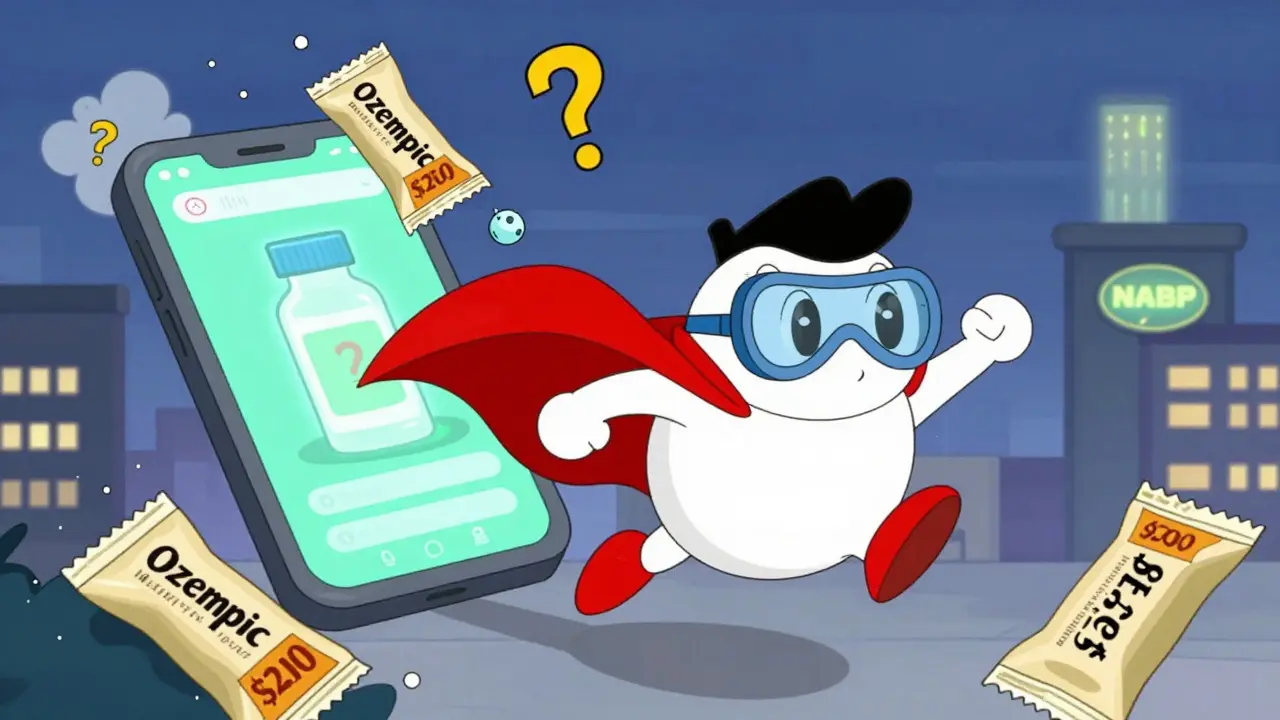
Most counterfeit drugs enter the U.S. through unregulated online pharmacies. The FDA warns that 96% of websites selling drugs without a prescription are illegal. Even sites that look professional - with real logos, SSL certificates, and customer reviews - can be fake.- Only buy from pharmacies that require a prescription and are licensed in your state.
- Check the pharmacy’s license at the National Association of Boards of Pharmacy (NABP) website.
- Avoid "too good to be true" prices. A real Ozempic pen costs $1,000+. If it’s $200, it’s fake.
- Never buy from social media sellers, Instagram pharmacies, or Facebook groups.
What to Do If You Suspect a Fake
Don’t throw it away. Don’t take it. Don’t ignore it.- Take a clear photo of the packaging - front, back, seal, lot number, barcode.
- Call the manufacturer’s customer service line. They have databases of known counterfeits.
- Report it to the FDA through MedWatch: 1-800-FDA-1088 or fda.gov/medwatch.
- If you’re a pharmacist or healthcare provider, document the batch and alert your state board.
Between 2020 and 2023, Consumer Reports documented 147 verified counterfeit drug cases. 82% had packaging discrepancies. That means most of these could’ve been caught - if someone looked closely.
Bottom Line: Trust, But Verify
You can’t always tell a fake by sight. But you can learn to look for the signs. The best defense isn’t a gadget - it’s awareness. Check the packaging. Compare it to a known authentic version. Use UV light. Scan the QR code. Report anything suspicious.Counterfeiters are smart. But they’re not perfect. Every tiny flaw - a misaligned label, a wrong shade of blue, a faintly smudged imprint - is a clue. And if enough people learn to see them, the market for fake drugs shrinks.
How can I tell if my medication packaging is fake?
Start with a visual check: look for color mismatches, spelling errors, blurry printing, or misaligned text. Compare it to a known authentic package. Check the foil seal - it should be intact and slightly raised. Use a UV light to see if hidden markings glow correctly. Scan the QR code - it should link to the manufacturer’s official site. If anything feels off, don’t take it.
Can I trust online pharmacies that sell cheap medication?
No. The FDA says 96% of online pharmacies that don’t require a prescription are illegal. Even sites with professional designs can be fake. Only buy from pharmacies licensed in your state and listed on the National Association of Boards of Pharmacy (NABP) website. If the price seems too good to be true - like Ozempic for $200 - it almost certainly is.
What should I do if I think I’ve been given a counterfeit drug?
Don’t take it. Don’t throw it away. Take a clear photo of the packaging, including the lot number and barcode. Contact the manufacturer’s customer service - they can confirm if it’s fake. Then report it to the FDA through MedWatch at 1-800-FDA-1088 or online at fda.gov/medwatch. This helps track fake drugs and protects others.
Are holograms on medicine packaging reliable indicators of authenticity?
Not anymore. By 2018, counterfeiters replicated 83% of holograms used in the 2010s. Today’s fakes can copy the shifting colors and patterns. A hologram alone doesn’t prove authenticity. Always combine it with other checks: UV light, QR code verification, and packaging alignment. Real security uses multiple layers - not just one flashy feature.
Is there a way to verify my medication using my smartphone?
Yes - if the manufacturer supports it. Since 2023, U.S. law requires prescription drugs to have a unique digital code. You can scan it with your phone’s camera through the manufacturer’s official app. It will confirm the batch, expiration date, and whether the product has been tampered with. Some companies are also testing augmented reality apps that overlay digital watermarks only visible on real packaging.
What are the most common signs of counterfeit pills?
Common signs include: inconsistent tablet imprint depth (e.g., 0.12mm instead of 0.15mm), blurry or uneven printing, wrong color shades, missing microtext under magnification, QR codes that don’t work or lead to fake websites, and foil seals that peel too easily. Packaging weight can also differ - counterfeit Adderall boxes were found to be 5% heavier due to thicker paper.
beth cordell
January 11, 2026 AT 20:03Just checked my Ozempic box with my phone’s UV light and BOOM - the little Pfizer star glowed right 👀 I almost cried. So many people don’t even know this exists. Seriously, everyone should do this. It’s like a superhero power for your medicine cabinet. 🌟💊
Lauren Warner
January 12, 2026 AT 19:13Stop wasting time with UV lights and QR codes. If you’re buying meds online without a prescription you’re already a fool. No amount of scanning fixes stupid. The system is broken and you’re just playing whack-a-mole with criminals who have more money than you do. Grow up.
Craig Wright
January 14, 2026 AT 11:54It is imperative to note that the British Medicines and Healthcare products Regulatory Agency has published a comprehensive guide on counterfeit detection protocols. The alignment discrepancies referenced in this article are statistically significant and corroborated by over 800 verified cases in the EU between 2021 and 2023. One must not rely on consumer-grade tools. Professional verification remains non-negotiable.
Lelia Battle
January 15, 2026 AT 03:43It’s strange how we’ve come to treat our health like a puzzle we can solve with a flashlight and a smartphone. We’ve outsourced trust to corporations and tech, but the real question is - why did we stop trusting our doctors, our pharmacies, our own instincts? The counterfeit market thrives not because it’s clever, but because we’re exhausted. We want shortcuts. And shortcuts, in medicine, are always deadly.
Rinky Tandon
January 15, 2026 AT 23:59OMG this is why India needs to stop exporting pharma to the West!! All these fakes come from unregulated labs in Gujarat and Andhra Pradesh!! They use Chinese ink and recycled plastic!! The FDA is clueless!! We need a global crackdown NOW!! This isn’t just health - it’s national security!! 🔥💊🚨
Ben Kono
January 16, 2026 AT 17:05Just scanned my Adderall QR code and it took me to a site that said 'Welcome to Pfizer' but the URL was 'pfi23r.com' so I called them and they said it's fake and to report it. Also the foil seal felt like cheap plastic. That's it. Done.
Cassie Widders
January 18, 2026 AT 04:03I used to buy meds online because it was cheaper. Now I just drive 20 minutes to the local pharmacy. It’s not hard. And I sleep better.
Konika Choudhury
January 18, 2026 AT 15:22Why are we even talking about this when the real problem is Big Pharma charging $1000 for a pill that costs 5 cents to make? You think people are buying fakes because they like them? No they’re doing it because they can’t afford the real thing. Fix the system not the packaging
Darryl Perry
January 20, 2026 AT 13:26UV light and QR codes are useless without context. The real indicator is the lot number. Cross-reference it with the manufacturer’s database. Everything else is theater. If you don’t know how to do that, you shouldn’t be taking the pill.
Amanda Eichstaedt
January 22, 2026 AT 02:52My grandma used to say 'if it looks too perfect, it’s probably not real.' She never had a smartphone but she knew how to check a pill bottle by touch, smell, and weight. We’ve forgotten how to use our senses. Maybe we need to unplug and relearn how to trust our own eyes and hands again.
Jose Mecanico
January 23, 2026 AT 18:06Thanks for sharing this. I’m a pharmacy tech and we get these fakes weekly. The worst part? Patients get mad when we say no. They just want their medicine. We’re not being difficult - we’re trying to keep them alive.