
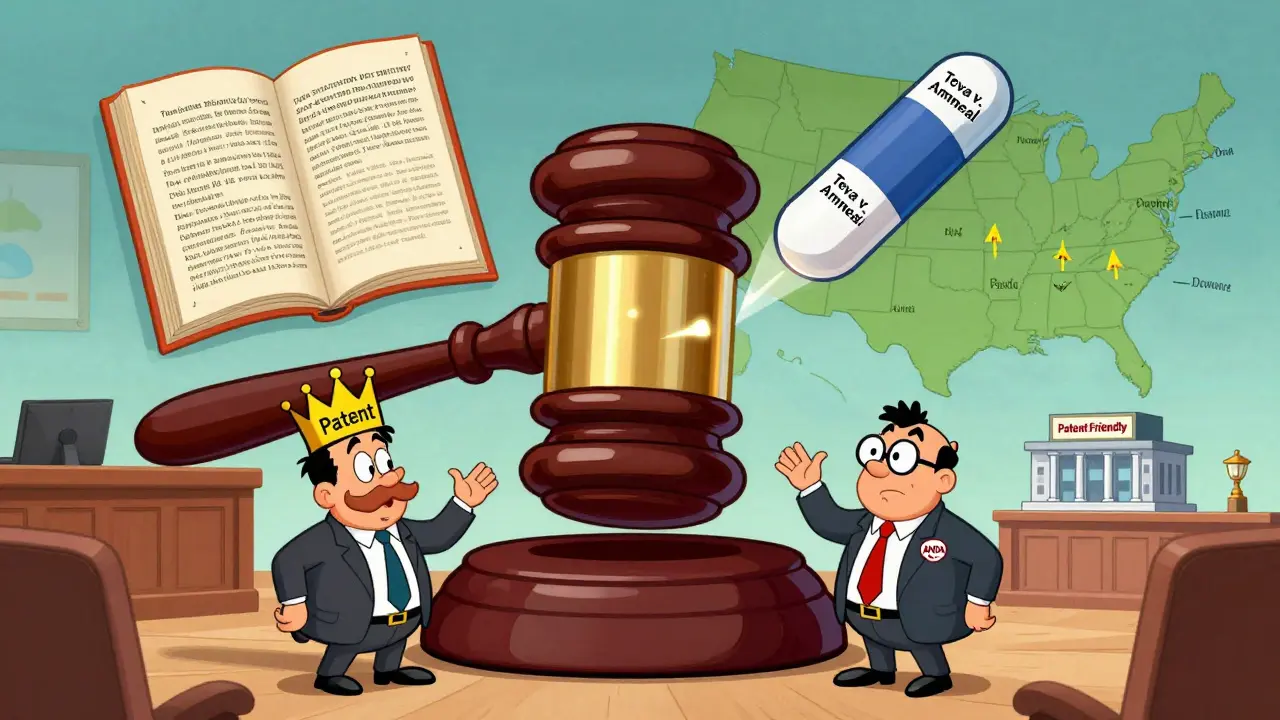
The Federal Circuit Court doesn’t just hear appeals-it decides whether a generic drug can hit the market, how long a brand-name drug keeps its monopoly, and who gets to sue where. For anyone involved in pharmaceuticals-whether you’re a generic manufacturer trying to launch a cheaper version of a drug or a big pharma company protecting your patent-this court is the single most important player in the U.S. legal system.
Why the Federal Circuit Has All the Power
Unlike other federal courts that split cases across regions, the U.S. Court of Appeals for the Federal Circuit is the only court in the country that hears every patent appeal. That includes every single pharmaceutical patent case. No matter where a lawsuit starts-Delaware, New Jersey, or California-it ends up here. This wasn’t always the case. Before 1982, patent cases were scattered across 12 different circuit courts, leading to wildly different rulings on the same patents. Congress created the Federal Circuit to fix that. The result? Predictability-for better or worse.For drug companies, that predictability matters. If you’re spending $2 billion to develop a new medicine, you need to know if your patent will hold up. The Federal Circuit’s rulings give you that answer. But for generic drug makers, it’s a different story. The court’s strict standards make it harder to challenge patents, which delays cheaper drugs from reaching patients.
The Hatch-Waxman Act and the Orange Book
The Hatch-Waxman Act of 1984 created the system that lets generic drugs enter the market faster. It’s a delicate balance: brand companies get extended patent protection if they’re the first to file a new drug. Generic companies get a shortcut to approval by proving their version is the same. But the system only works if the patents listed in the FDA’s Orange Book are valid and correctly tied to the drug.The Federal Circuit made it clear in December 2024: if a patent doesn’t actually claim the drug being sold, it can’t stay in the Orange Book. In Teva v. Amneal, the court ruled that listing a patent for a drug it doesn’t cover is illegal. That forced companies to stop gaming the system by listing every possible patent-even ones that had nothing to do with the actual medicine. Now, patent portfolios must be precise. If you can’t prove your patent claims the drug, you lose your 30-month delay on generic entry.
ANDA Filings Create Nationwide Jurisdiction
One of the biggest shifts came in 2016, in a case called Mylan v. Allergan. Before then, brand companies could only sue generic makers in states where they actually sold their products. After Mylan filed an ANDA (Abbreviated New Drug Application) with the FDA, the Federal Circuit ruled that filing an application to sell a drug across all 50 states meant the company had “minimum contacts” everywhere. That gave patent holders the power to pick the court they wanted-often Delaware, which is known for being friendly to patent owners.Since then, 68% of all ANDA lawsuits have been filed in Delaware. That’s up from just 42% in the decade before. Generic companies now have to defend themselves in a state they may never do business in. Legal costs have jumped from $5.2 million to $8.7 million per case on average. For small generic firms, that’s often more than their entire annual budget.
Dosing Patents Are Harder to Get-and Harder to Defend
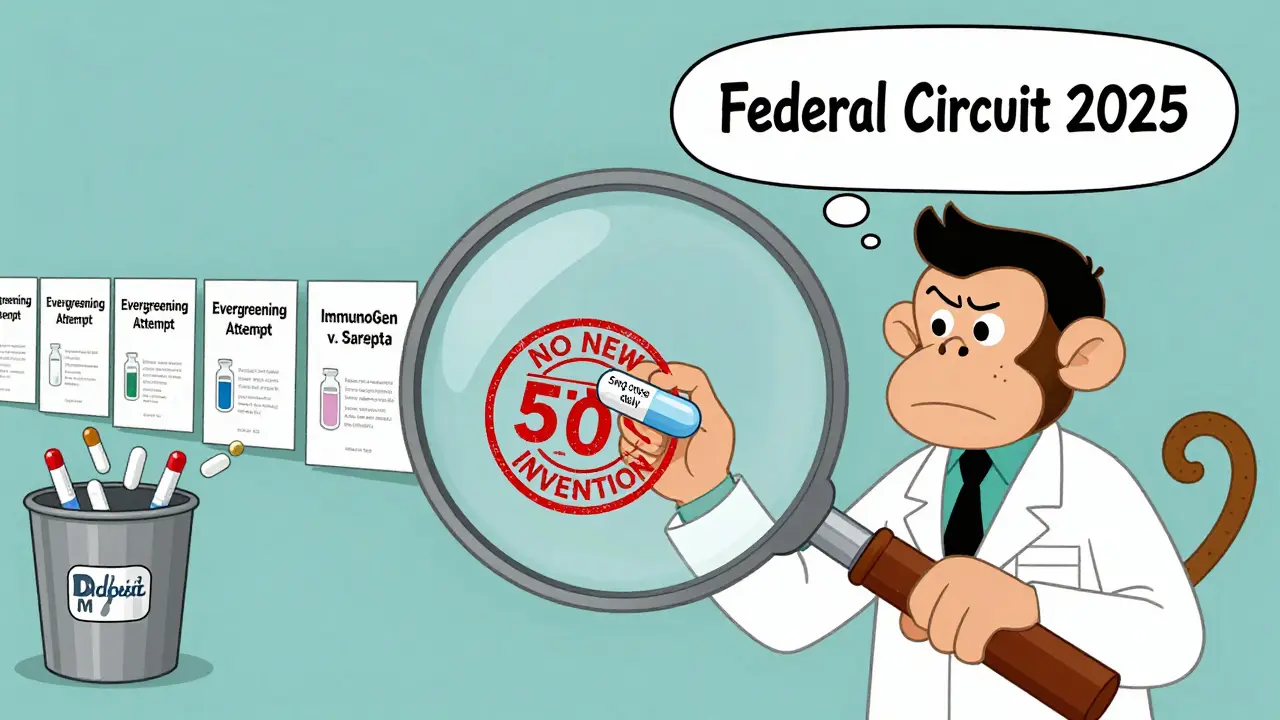
A lot of pharmaceutical patents aren’t for new drugs. They’re for new ways to take old ones: “Take 5 mg once daily instead of 10 mg twice a day.” These are called dosing regimen patents. For years, companies used them to extend monopolies-what critics call “evergreening.”In April 2025, the Federal Circuit shut that door wide open in ImmunoGen v. Sarepta. The court said: if the drug itself is already known, changing the dose doesn’t make it patentable unless you can prove something unexpected happened. The judges didn’t buy arguments like “we tested it differently” or “patients responded better.” They asked: would a skilled scientist have expected this result based on what was already out there? If yes, the patent is invalid.
That decision sent shockwaves through the industry. A Clarivate analysis showed pharmaceutical companies cut their dosing patent filings by 37% after the ruling. Instead of spending millions on secondary patents, they’re investing more in truly new compounds. That’s good for innovation-but bad for companies that relied on patent extensions to keep prices high.
Standing: Can You Even Sue?
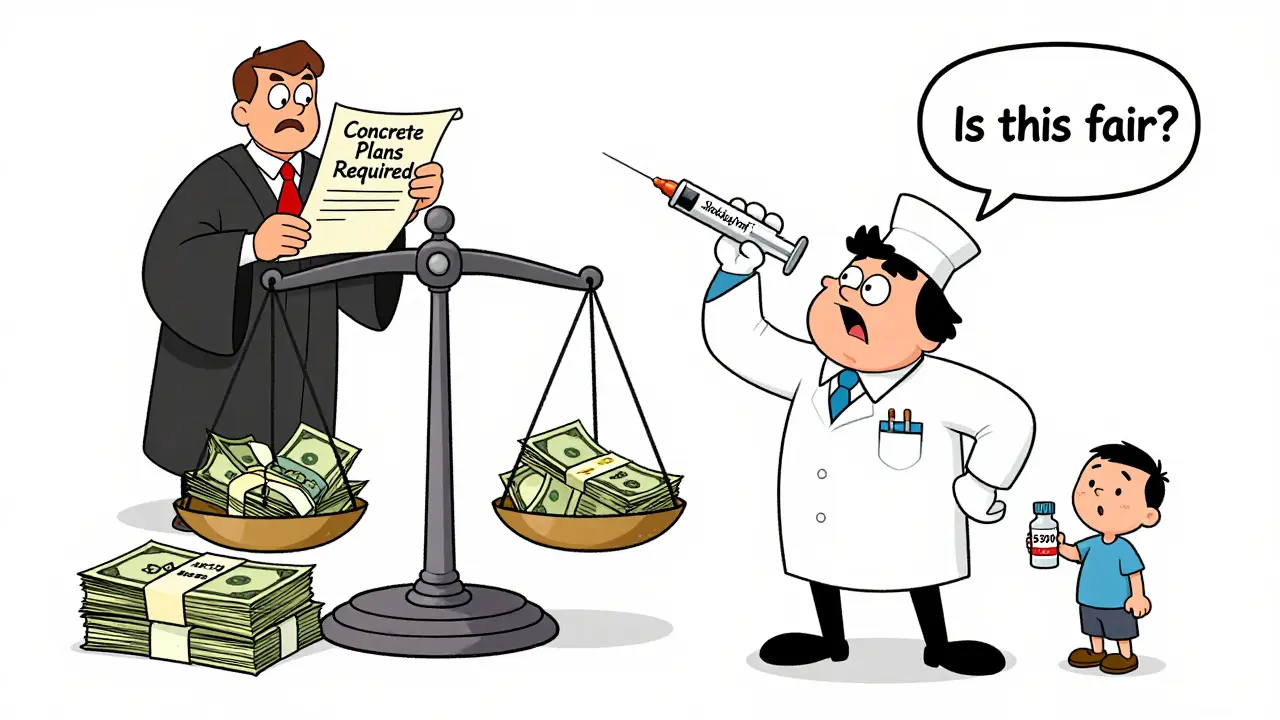
Here’s a twist: sometimes, the Federal Circuit says you can’t sue at all-even if you’re ready to launch a generic drug. In May 2025, in Incyte v. Sun Pharma, the court dismissed a challenge because the generic company hadn’t yet started clinical trials. The court said you need “concrete plans” and “immediate development activities” to have legal standing. Just wanting to make a drug isn’t enough. You need to show you’ve spent money, hired staff, or run tests.That’s a big problem for generic manufacturers. To prove standing, many now have to start Phase I trials before they even know if the patent will hold up. That’s expensive. And risky. If the patent is later found invalid, they’ve already spent millions. Some industry insiders say this is intentional-making it harder for generics to challenge patents before investing.
How This Affects Real People
All of this isn’t just legal jargon. It affects whether a cancer patient can afford their treatment. It determines if a diabetic gets insulin at $25 or $300 a vial. The Federal Circuit’s rulings delay generic drugs by months or years. Between 2016 and 2023, patent litigation against generic manufacturers rose 22%. The average drug stayed exclusive 14 months longer than before.On the flip side, the court’s clarity has helped some companies avoid pointless lawsuits. Biogen’s patent counsel said in a 2024 webinar that the dosing patent standards actually made settlement talks easier. When both sides know the court will reject weak patents, they’re more willing to negotiate.
What’s Next?
The pressure is building. Judge Hughes, in his concurrence in Incyte, openly worried that the court’s standing rules are hurting competition. In response, Senators Tillis and Coons introduced the Patent Quality Act of 2025 to lower the bar for challenging pharmaceutical patents. If it passes, generic companies could challenge patents earlier-without having to spend millions first.Meanwhile, the court continues to refine its rules. In February 2025, it ruled that even expired patents can still be challenged in the Patent Trial and Appeal Board for validity-just not for damages. That keeps the door open for future litigation.
The Federal Circuit isn’t going away. It’s the gatekeeper. And as long as it holds this power, the price of medicine, the speed of innovation, and the fairness of the system will all depend on its next decision.
Why does the Federal Circuit handle all pharmaceutical patent cases?
The Federal Circuit was created by Congress in 1982 to centralize patent appeals. Before that, different circuit courts made conflicting rulings on the same patents, creating confusion for companies. By giving one court exclusive authority over all patent cases-including those involving drugs-the system became more predictable. Now, every pharmaceutical patent appeal, no matter where it starts, goes to the Federal Circuit.
What is an ANDA, and why does it matter for patent lawsuits?
An ANDA, or Abbreviated New Drug Application, is the form a generic drug company files with the FDA to get approval to sell a copy of a brand-name drug. Filing an ANDA is considered an act of patent infringement under the Hatch-Waxman Act. That means the brand company can sue the generic maker-even before the generic drug is sold. The 2016 Mylan decision ruled that filing an ANDA creates jurisdiction nationwide, so patent holders can sue in any federal court, often choosing ones that favor them.
Can a patent for a new dosage be valid?
Yes-but it’s much harder now. Before 2025, companies often patented new dosing schedules to extend monopolies. The Federal Circuit’s 2025 ImmunoGen decision changed that. Now, if the drug itself is already known, changing the dose isn’t enough. You must prove the new dosage produces an unexpected result, like significantly fewer side effects or a major boost in effectiveness. Simple changes like “take once daily instead of twice” won’t pass.
Why are so many patent lawsuits filed in Delaware?
Because the Federal Circuit’s 2016 ruling allows patent holders to sue anywhere a generic company filed an ANDA. Since ANDA filings imply intent to sell nationwide, companies can choose any court. Delaware is popular because its judges have deep patent expertise, its procedures are fast, and it’s historically been favorable to patent owners. Since 2017, 68% of ANDA lawsuits have been filed there.
What’s the impact of the Federal Circuit’s rulings on drug prices?
The rulings slow down generic drug entry. Between 2016 and 2023, litigation against generic manufacturers rose 22%, and the average time before a generic could launch increased by 14 months. That delays price drops. In some cases, a drug stays expensive for years longer than it otherwise would. The court’s strict rules on standing and dosing patents make it harder and costlier for generics to challenge patents, which keeps brand-name prices high.
Is the Federal Circuit biased toward big pharma?
Critics say yes. The court has reversed district court rulings in favor of generics in 38.7% of pharmaceutical cases-much higher than the 22.3% average across all patent cases. Its strict standing rules and narrow view of dosing patents make it harder for generics to challenge patents before investing. Judge Hughes himself admitted in 2025 that the court has disproportionately dismissed cases from companies trying to develop drugs. That’s led to new legislation in Congress aimed at fixing the system.
How do companies prepare for litigation under Federal Circuit rules?
Brand companies now carefully map which patents to list in the Orange Book to match the drug exactly-after the 2024 Teva ruling, listing the wrong patent can get you kicked out of the system. Generic companies, on the other hand, are starting clinical trials earlier to prove they have standing to sue. Patent attorneys spend 25-40% more time developing evidence of unexpected results for dosing claims. Legal teams now run nationwide jurisdiction assessments before even filing an ANDA.




Pawan Chaudhary
December 16, 2025 AT 11:56This is actually really encouraging news for patients who need affordable meds. I’ve seen friends struggle to pay for insulin, and knowing the courts are finally cracking down on patent tricks gives me hope.
Anu radha
December 18, 2025 AT 11:54So if the patent is not about the actual drug, they can't block generics? That makes sense. I’m not a lawyer but this sounds fair.
Philippa Skiadopoulou
December 19, 2025 AT 23:03The Federal Circuit’s consolidation of patent jurisdiction was a necessary correction to the chaos of pre-1982 jurisprudence. While critics decry its pro-patent bias, the consistency it provides is indispensable for R&D investment. The dosing patent standard articulated in ImmunoGen v. Sarepta aligns with longstanding principles of non-obviousness under 35 U.S.C. §103.
Josh Potter
December 21, 2025 AT 14:25Delaware is just a corporate playground for big pharma lol. Meanwhile real people are choosing between rent and their meds. This system is broken.
Sam Clark
December 23, 2025 AT 11:09The structural design of the Federal Circuit ensures uniformity in patent interpretation, which is essential for a national innovation ecosystem. The jurisdictional expansion following Mylan v. Allergan is a logical extension of the Hatch-Waxman framework. While litigation costs are high, they reflect the complexity of pharmaceutical IP, not systemic bias.
Michael Whitaker
December 23, 2025 AT 22:28Of course the court favors big pharma. They’re the ones with the $10M legal teams. Meanwhile, small generics can’t even get a hearing unless they’ve already burned through half their funding. This isn’t justice-it’s a rigged game.
Kent Peterson
December 24, 2025 AT 00:40Oh here we go again... ‘patent trolling’ this, ‘evergreening’ that. Wake up. Patents are property. If you don’t like the system, move to a country where innovation is punished. The Federal Circuit is doing its job-unlike Congress, which can’t even pass a budget without a shutdown.
Linda Caldwell
December 24, 2025 AT 05:12Let’s be real-this isn’t about law, it’s about who gets to live. If a company can stretch a patent by 14 months just by changing the dosage, they’re not innovating-they’re exploiting. I’m tired of hearing ‘it’s complicated’ while people die waiting for cheaper drugs. Time to fix this.
Brooks Beveridge
December 26, 2025 AT 04:15It’s easy to get angry, but let’s not lose sight of the bigger picture. The court’s rulings are forcing companies to innovate, not just extend. That’s progress. And yes, it’s expensive-but real innovation always is. We’re moving from gaming the system to building better drugs. That’s worth the pain.
amanda s
December 28, 2025 AT 03:31THIS IS WHY AMERICA IS LOSING THE RACE! THEY’RE GIVING AWAY OUR PHARMA SECRETS TO INDIA AND CHINA! WE NEED TO BAN ALL ANDA FILINGS AND PUT THE FEDERAL CIRCUIT UNDER MILITARY CONTROL!!
Peter Ronai
December 28, 2025 AT 22:36You all miss the point. The Federal Circuit isn’t the problem-it’s the only thing standing between us and regulatory anarchy. If you think this is bad, wait until you see what happens when the PTAB starts invalidating patents retroactively. That’s the real nightmare. And yes, I’ve read every single Federal Circuit opinion since 2010. You haven’t.