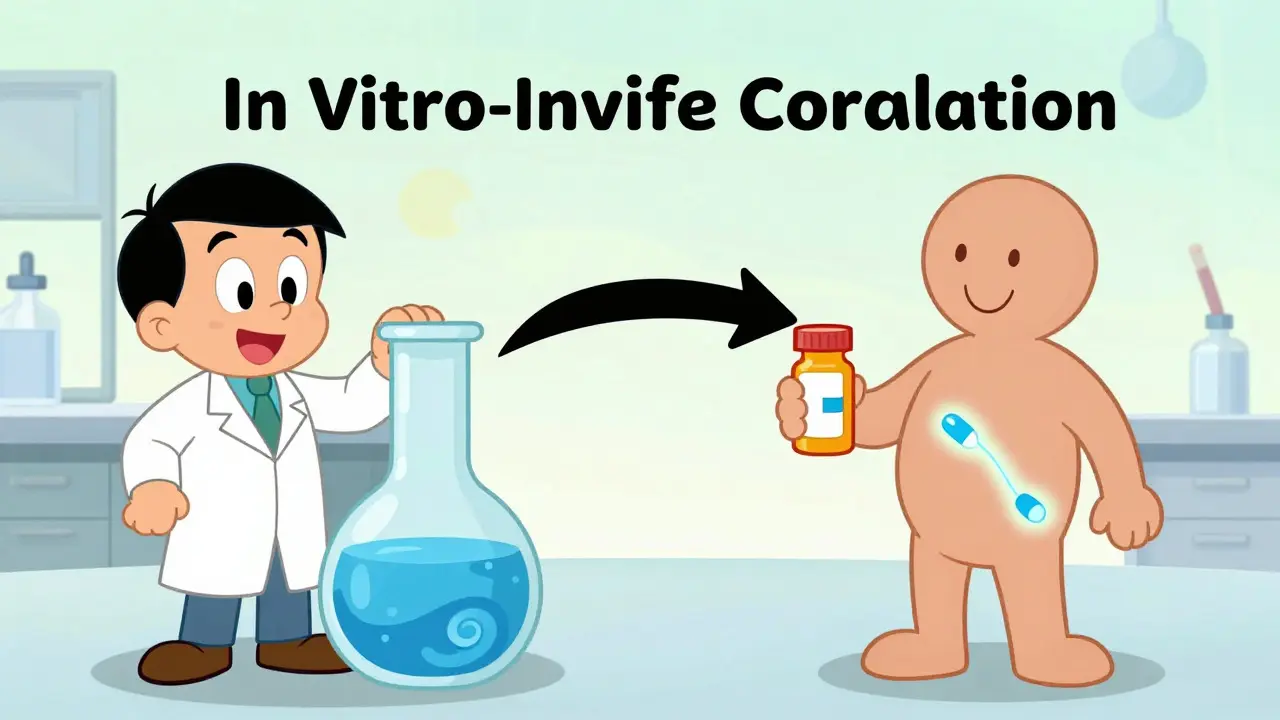
Imagine skipping a six-month clinical trial with 30 healthy volunteers just because your lab test proved the drug works. That is the promise of In Vitro-In Vivo Correlation (IVIVC). It is a mathematical bridge that links how fast a pill dissolves in a beaker to how fast it enters your bloodstream. For years, this was theoretical. Today, it is a practical tool that saves generic manufacturers millions of dollars and months of development time.
The core problem IVIVC solves is simple but expensive: proving that a generic drug performs exactly like the brand-name original. Traditionally, you had to run full bioequivalence (BE) studies on humans. Now, if you can build a strong correlation between dissolution data and human response, regulators may allow you to waive those human trials for certain changes or approvals. This article breaks down how IVIVC works, when it applies, and why it remains one of the most challenging yet valuable tools in modern pharmaceutical development.
What Is IVIVC and Why Does It Matter?
In Vitro-In Vivo Correlation (IVIVC) is a predictive model that establishes a quantitative relationship between an in vitro property (like dissolution rate) and an in vivo response (like blood concentration). Think of it as a translation service. The "in vitro" side speaks the language of chemistry-how much drug releases over time in a controlled environment. The "in vivo" side speaks the language of biology-how much drug appears in the plasma after ingestion. IVIVC translates between them.
This concept gained formal recognition from the U.S. Food and Drug Administration (FDA) in the 1990s, specifically with a guidance document released in September 1996. The goal was never to replace all human testing, but to create a scientifically valid surrogate for specific scenarios. If the correlation is strong enough, you can predict the entire pharmacokinetic profile (how the body handles the drug) using only lab data. This reduces the need for costly clinical trials, potentially cutting development timelines by 6 to 12 months and saving approximately $1-2 million per avoided study.
The Four Levels of Correlation: From Simple to Complex
Not all correlations are created equal. The FDA classifies IVIVC into four distinct levels based on their predictive power. Understanding these levels is crucial because they determine what kind of waiver you might qualify for.
- Level A: The gold standard. It establishes a point-to-point relationship between dissolution and input rate. If you know the dissolution curve, you can predict the exact blood concentration curve at every time point. This requires high statistical precision, typically with R² values exceeding 0.95.
- Level B: Uses population averages. It correlates mean dissolution time with mean residence time. It’s useful for understanding general behavior but lacks the precision to predict individual profiles.
- Level C: Single-point correlation. It links one specific dissolution parameter (e.g., % dissolved at 1 hour) to one pharmacokinetic parameter (e.g., Cmax). It’s simpler to build but less robust.
- Multiple Level C: Expands Level C by correlating multiple dissolution time points with multiple PK parameters. It offers more insight than single-point Level C but still falls short of Level A’s predictive depth.
For biowaiver applications, regulators strongly prefer Level A correlations. While Multiple Level C might be acceptable with extra supporting evidence, Level A is the safest bet for avoiding human trials.
| Level | Type of Relationship | Predictive Capability | Regulatory Preference |
|---|---|---|---|
| Level A | Point-to-point (Dissolution vs. Input Rate) | Full PK Profile Prediction | Highest (Preferred for waivers) |
| Level B | Population Mean (MRT vs. MRT) | Average Behavior Only | Moderate (Supporting evidence) |
| Level C | Single Point (e.g., Q1hr vs. Cmax) | Specific Parameter Only | Low (Limited use) |
| Multiple Level C | Multi-Point (Several Q vs. Several PK) | Enhanced Specific Parameters | Moderate (With caveats) |
When Can You Actually Use a Biowaiver?
Just having an IVIVC model doesn’t automatically grant you a waiver. The application depends heavily on the type of drug product. For immediate-release products, the Biopharmaceutics Classification System (BCS) often provides a simpler pathway for waivers, especially for Class I drugs (high solubility, high permeability). However, IVIVC becomes essential for complex modified-release products where BCS principles don’t apply well.
According to the FDA’s SUPAC-MR Guidance, IVIVC can support waivers for post-approval changes in extended-release products. These include scale-up, minor formulation adjustments (within ±5% for non-critical excipients), and manufacturing site transfers. The key condition? The dissolution profiles must remain similar, typically measured by an f2 similarity factor greater than 50. Without a validated IVIVC, each of these changes would require a full bioequivalence study. With it, you might get away with just rigorous lab testing.
However, IVIVC isn’t a magic wand. Its predictive capability diminishes for drugs with narrow therapeutic indices, non-linear pharmacokinetics, or complex absorption mechanisms. In these cases, traditional in vivo testing remains mandatory. Regulators are cautious because a failed prediction here can lead to therapeutic inequivalence in real-world use.
The Cost-Benefit Reality Check
Let’s talk numbers. A traditional bioequivalence study involving 24-36 healthy volunteers costs between $500,000 and $2 million. Add in the 6-12 month timeline, and you have a significant resource drain. IVIVC-supported biowaivers offer a clear advantage in efficiency. But building the IVIVC itself has a cost.
Developing a robust Level A IVIVC typically takes 12 to 18 months. This includes 3-6 months for dissolution method development, 6-9 months for pharmacokinetic studies across multiple formulations, and 3-6 months for model building and validation. You need extensive characterization of reference products (usually 3-5 formulations with varying release rates) and substantial PK data (minimum of 3 studies with 12-24 subjects each).
So, is it worth it? For companies planning to make multiple post-approval changes, yes. Teva Pharmaceutical noted that developing a robust IVIVC for their extended-release oxycodone generic took 14 months and three formulation iterations. But it saved them from conducting five additional bioequivalence studies later. For a one-off approval without future changes, the upfront cost of IVIVC development might outweigh the savings from skipping a single BE study.

Common Pitfalls and Why Submissions Fail
Despite its value, IVIVC implementation is tricky. Data from the FDA’s Office of Generic Drugs shows that while IVIVC submissions increased by 35% from 2018 to 2022, approval rates rose from 15% to 42%. That means nearly 60% still fail. Why?
Industry surveys highlight three main culprits:
- Insufficient Formulation Characterization (76% of failures): Companies often don’t test enough variations of their formulation to build a reliable model. You need to cover the "formulation space" adequately.
- Inadequate Dissolution Method Discrimination (63% of failures): The lab test must be sensitive enough to detect meaningful differences. If the method can’t distinguish between good and bad batches, the correlation will be weak.
- Insufficient Physiological Relevance (82% of failed submissions in 2023 review): Traditional dissolution methods often use simple buffers. Modern regulators expect "biorelevant" conditions that mimic the actual gastrointestinal environment, including pH gradients and bile salts.
Dr. Jennifer Dressman of Goethe University Frankfurt cautioned that "Multiple Level C correlations, while easier to develop, often fail to capture the full complexity of drug release and absorption." This leads to potential therapeutic inequivalence. The lesson? Don’t cut corners on the science just to save time on the model.
The Future: AI, Biorelevance, and Broader Applications
The landscape is shifting. The FDA recently released draft guidance extending IVIVC principles to topical drug products, signaling a move beyond oral medications. There is also growing interest in applying IVIVC to implantable and injectable products, though acceptance rates remain low (19% for ophthalmic, 32% for injectables compared to 58% for oral extended-release).
Machine learning is entering the picture. A 2024 EMA-FDA joint workshop highlighted ML-enhanced IVIVC models as an emerging trend. Both agencies are open to these approaches, provided they maintain scientific transparency. Meanwhile, biorelevant dissolution testing is becoming the standard. The American Association of Pharmaceutical Scientists forecasts that 75% of new IVIVC submissions will use biorelevant methods by 2025, replacing older compendial methods for complex products.
McKinsey & Company projects that IVIVC-supported biwaivers will account for 35-40% of all modified-release generic approvals by 2027, up from 22% in 2022. This growth is driven by regulatory harmonization and improved modeling techniques. For developers, the takeaway is clear: invest early in high-quality data and physiological relevance, and the payoffs in speed and cost will be significant.
Can IVIVC replace all bioequivalence studies?
No. IVIVC is primarily used for modified-release products and specific post-approval changes. For immediate-release drugs, the BCS approach is often preferred. Also, drugs with narrow therapeutic indices or non-linear kinetics usually still require full in vivo testing.
How long does it take to develop a Level A IVIVC?
Typically 12 to 18 months. This includes time for developing discriminatory dissolution methods, conducting multiple pharmacokinetic studies, and validating the mathematical model.
What is the difference between Level A and Level C IVIVC?
Level A is a point-to-point correlation that predicts the entire pharmacokinetic profile. Level C is a single-point correlation linking one dissolution parameter to one PK parameter. Level A is far more powerful and preferred for waivers.
Why do many IVIVC submissions fail?
The top reasons are insufficient formulation characterization, lack of physiological relevance in dissolution methods, and inadequate model validation. Regulators want to see that the lab conditions truly mimic human physiology.
Is IVIVC only for generic drugs?
While widely used in generics, IVIVC is also applicable to new molecular entities during Phase 2 development and for innovator brands managing post-approval changes. The principle is universal: linking in vitro performance to in vivo response.