
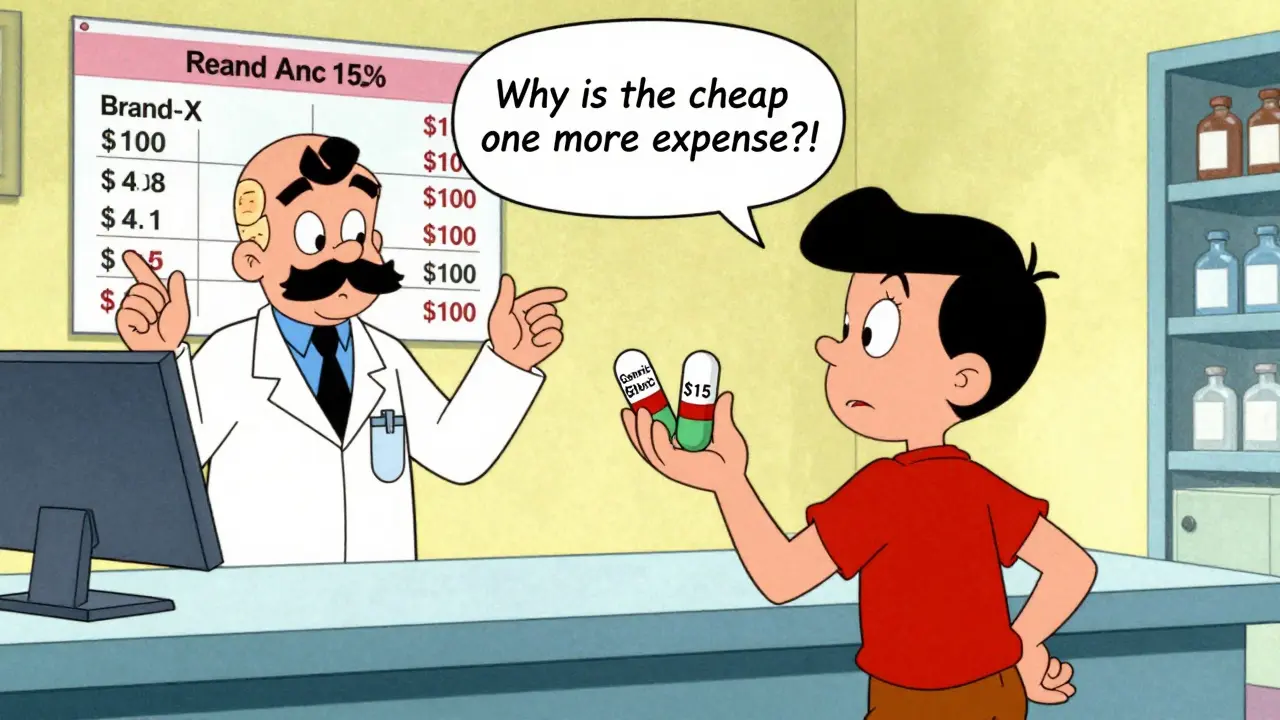
When you pick up a prescription, do you ever wonder why two pills that do the same thing cost so differently? One might be a well-known brand-name drug, and the other looks almost identical but costs a fraction of the price. That’s the generic version. But here’s the twist: out-of-pocket costs don’t always follow the logic you’d expect. Sometimes, the cheaper generic costs you more. And sometimes, the expensive brand-name drug ends up being the better deal - especially if you’re on Medicare.
Generics are cheaper - usually
Most of the time, generics cost 80 to 85% less than their brand-name equivalents. Nine out of every 10 prescriptions filled in the U.S. are for generics. That’s not because people are trying to save money - it’s because doctors prescribe them, and pharmacies stock them. They work the same way. The FDA requires them to have the exact same active ingredient, strength, and dosage form as the brand. They’re just made by a different company, often with different fillers or coatings that don’t affect how the drug works. But here’s what most people don’t realize: even though generics make up 90% of prescriptions, they only account for about 18% of total drug spending. Why? Because brand-name drugs are priced so high. A single pill of a brand-name drug can cost $10, $20, even $50. The generic version? Maybe 50 cents. That gap is massive. And it’s why generics saved the U.S. healthcare system nearly $338 billion in 2020 alone.Insurance design changes everything
Your out-of-pocket cost isn’t just about the drug’s price. It’s about how your insurance works. There are three main ways insurance handles prescriptions: copay, coinsurance, and deductible.- Copay: You pay a fixed amount - say $10 - no matter what the drug costs. If the brand-name drug goes from $100 to $120, you still pay $10. Your insurance picks up the rest.
- Coinsurance: You pay a percentage - say 30% - of the drug’s price. If the drug costs $100, you pay $30. If it jumps to $120, you pay $36. You feel every price hike.
- Deductible: You pay 100% until you hit a certain amount (like $1,500). After that, copays or coinsurance kick in.
The Medicare Part D trap
If you’re on Medicare Part D, things get even weirder. There’s a gap in coverage called the “donut hole.” Once you and your plan have spent a certain amount on drugs, you enter this gap - and you pay more out of pocket until you hit catastrophic coverage. Here’s the twist: brand-name drug manufacturers give discounts during the donut hole. Those discounts count toward your out-of-pocket spending. So if you’re taking a brand-name drug, you hit catastrophic coverage faster - and then you only pay 5% of the drug’s cost. Generic drug manufacturers? They don’t give those discounts. So if you’re on a generic, you have to spend way more before you get to catastrophic coverage. In 2019, a patient on brand-name drugs needed to spend $982 to reach catastrophic coverage. Someone on generics? $3,730. That’s almost four times more. And in 2020, the threshold jumped from $5,100 to $6,350. That made the gap even worse. So yes - sometimes, a $100 brand-name drug costs you less than a $10 generic because of how the system is built. It’s not about the drug. It’s about the rules.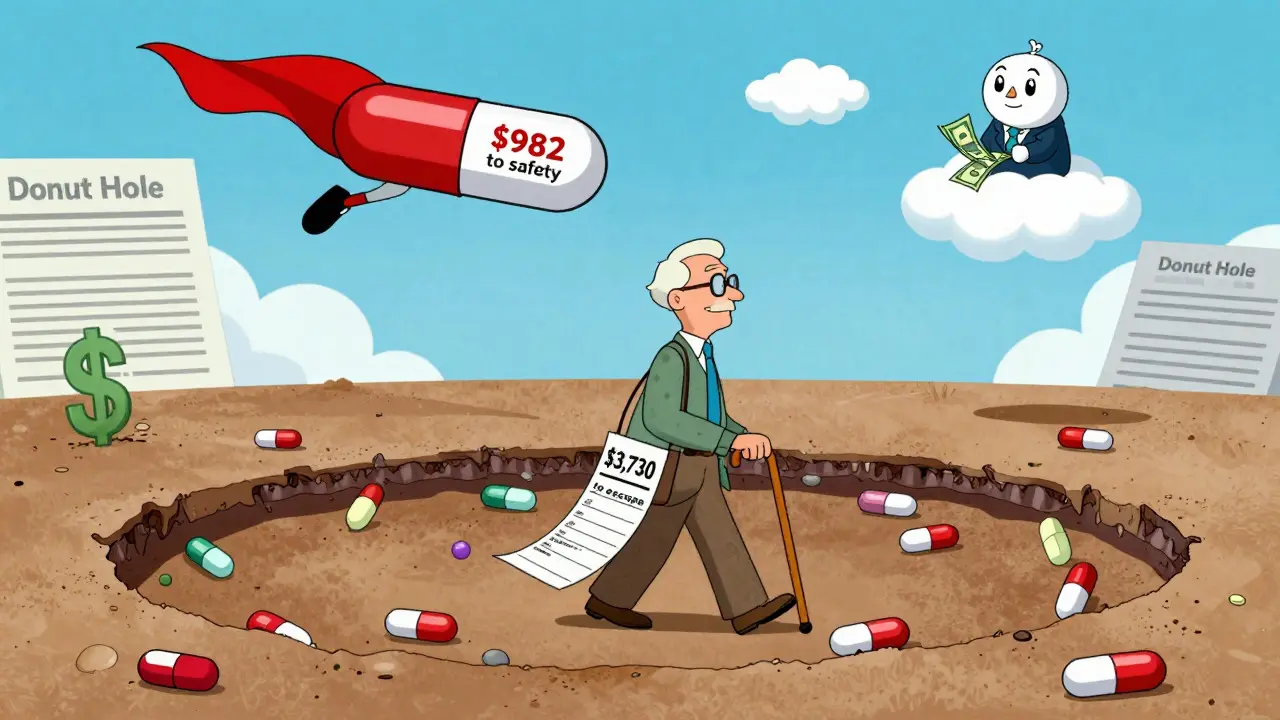
What about cash prices?
If you’re uninsured, or if your insurance is making you pay too much, paying cash might be smarter. Companies like Mark Cuban Cost Plus Drug Company (MCCPDC) and Blueberry Pharmacy sell generics at transparent, low prices - no insurance needed. A 2024 study found that for 11.8% of generic prescriptions, patients saved money by paying cash instead of using insurance. The median savings? $4.96 per prescription. For some drugs, it was over $20. Uninsured patients saved the most. Medicaid patients? No savings - because their plans already set fixed prices. And here’s the kicker: 97% of all cash payments for prescriptions in 2020 were for generic drugs. Why? Because that’s where the real savings are.Why are generics still expensive?
You’d think with so many companies making generics, prices would be rock bottom. But that’s not always true. A 2022 analysis from the USC Schaeffer Center found that patients were overpaying for generics by 13 to 20% - not because of manufacturing costs, but because of middlemen. Pharmacy Benefit Managers (PBMs) - the hidden middlemen between insurers, pharmacies, and drug makers - often take a cut based on the list price. So if a generic drug’s list price is inflated, even if the manufacturer sells it cheap, the PBM keeps more. And patients pay more at the counter. That’s why a $5 generic might cost you $15. It’s not the drug. It’s the system.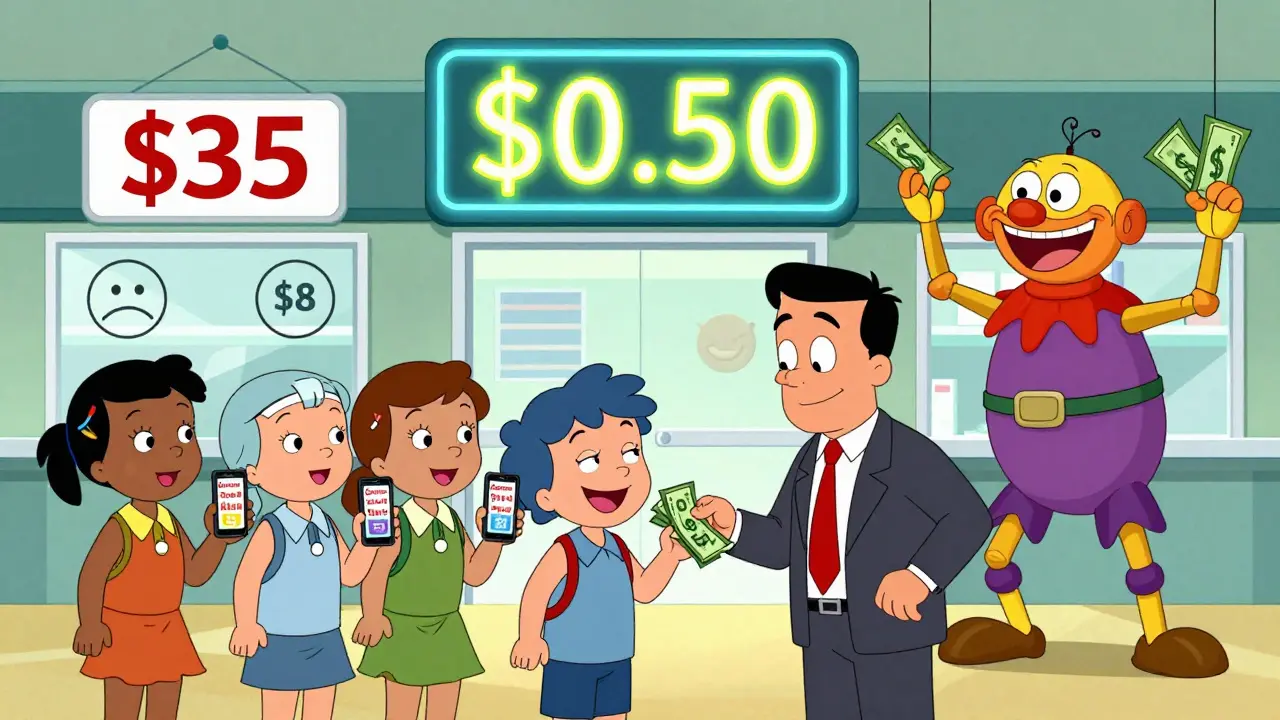
What can you do?
You can’t control drug prices. But you can control how you pay.- Ask your doctor: “Is there a generic version?” If they say no, ask why. Sometimes, they just default to brand-name because it’s easier.
- Check if your plan uses copays or coinsurance. If it’s coinsurance, generics are almost always better.
- If you’re on Medicare Part D, look at your drug list. If you’re taking high-cost generics, compare your out-of-pocket spending to what you’d pay if you switched to a brand-name version. It sounds backwards - but it might save you money.
- Try GoodRx or MCCPDC. Enter your drug and zip code. See what cash price is lower than your insurance copay. Pay cash. Skip the insurance.
- Ask your pharmacist: “Can I get this drug through a 90-day mail-order program?” Sometimes, bulk pricing lowers your cost.
It’s not about quality - it’s about cost structure
Let’s clear up one myth: generics are not inferior. They’re not “second-rate.” They’re chemically identical. The FDA tests them. They’re just made by different companies. Dr. Eric D’Agostino, a pharmacist at Brown University Health, says it plainly: “Generic medications are just as safe and effective as branded medications and will most likely cost less money out of pocket.” The problem isn’t the drug. It’s the system. The system rewards high list prices. It hides discounts. It punishes patients who use generics. And it lets middlemen profit from confusion. The good news? You have power. You can shop. You can ask. You can pay cash. You can save.Are generic drugs as effective as brand-name drugs?
Yes. The FDA requires generics to have the same active ingredient, strength, dosage form, and route of administration as the brand-name version. They must also prove they work the same way in the body - called bioequivalence. Differences in fillers or coatings don’t affect how the drug works. Millions of people take generics every day with the same results as brand-name drugs.
Why does my generic cost more than my brand-name drug?
This usually happens if you’re on Medicare Part D and taking a high-priced generic. Because generic manufacturers don’t provide discounts during the coverage gap (donut hole), you have to spend much more out of pocket to reach catastrophic coverage. Meanwhile, brand-name manufacturers give discounts that count toward your spending, helping you reach lower-cost coverage faster. In some cases, switching back to the brand-name version could lower your total out-of-pocket cost.
Should I use insurance or pay cash for generics?
It depends. If your insurance has a low copay (like $5 or $10), stick with it. But if your copay is high - or if you’re in a deductible phase - check cash prices through GoodRx or Mark Cuban Cost Plus Drug Company. In 2024, 11.8% of generic prescriptions cost less when paid in cash. For uninsured patients, cash is almost always cheaper. For Medicaid patients, cash offers no savings.
Can my doctor force me to take a brand-name drug?
Yes. If your doctor writes “dispense as written” or “do not substitute” on the prescription, the pharmacy must give you the brand-name version. This is usually done if there’s a medical reason - like a patient who had a bad reaction to a generic filler. But it’s also sometimes done out of habit. Always ask: “Is there a generic alternative?”
Why do generic drug prices vary so much between pharmacies?
It’s because of how the supply chain works. Pharmacies get drugs from distributors, who get them from manufacturers. Pharmacy Benefit Managers (PBMs) negotiate prices behind the scenes, and those deals aren’t transparent. One pharmacy might have a contract that gives them a better rate. Another might be paying full list price. That’s why the same generic drug can cost $8 at one pharmacy and $35 at another. Always compare prices before you pay.

Simon Critchley
February 7, 2026 AT 04:52Bro, this whole system is a goddamn circus 🤡. PBMs are the real villains here-middlemen siphoning cash like it’s a leaky faucet at a 3am Waffle House. I saw a $3 generic for lisinopril cost me $22 with insurance. Cash price? $4.79. The FDA says they’re identical, but the system says ‘pay up or suffer.’ It’s not healthcare-it’s a casino where the house always wins. And don’t get me started on Medicare’s donut hole… it’s not a hole, it’s a black hole. 🕳️
John McDonald
February 8, 2026 AT 14:37Really appreciate this breakdown. I’ve been on coinsurance for my statin and didn’t even realize I was paying more when the brand price went up. Switched to the generic last year and my bill dropped from $87 to $12. But then I found out my local CVS had it for $6 cash via GoodRx. I’m just glad I didn’t keep paying the insurance markup. The system’s broken, but we’ve got tools to fight back. Keep pushing for transparency!
Chelsea Cook
February 9, 2026 AT 23:25Oh honey, you think this is wild? Wait till you hear how PBMs negotiate rebates behind closed doors and then charge YOU the inflated list price so they can ‘save’ you money. It’s like your dentist charging you $500 for a filling, then giving you $450 back and saying ‘you’re welcome!’ 🤦♀️ I had a friend on Medicare who paid $180 for a generic blood pressure med… switched to the brand because the discount counted toward catastrophic coverage. Her total out-of-pocket dropped by $400/year. The system is designed to confuse people into paying more. It’s not incompetence-it’s exploitation.
Joshua Smith
February 10, 2026 AT 01:02Thanks for sharing this. I’ve been wondering why my pharmacy kept telling me the generic was more expensive. I didn’t realize it was because of coinsurance and the donut hole. I’m on Medicare Part D and took your advice-checked both cash and insurance prices. The brand-name version actually cost me less this month. I felt weird about it, but now I get why. It’s not about the drug. It’s about the math. Still weird though.
Jessica Klaar
February 10, 2026 AT 07:17I’m a nurse in rural Ohio, and I see this every single day. Elderly patients choosing between insulin and groceries because their ‘generic’ copay is $45. Meanwhile, the same drug is $12 cash at the Walmart pharmacy. I’ve started handing out GoodRx cards like candy. One woman cried because she’d been paying $70/month for metformin-switched to cash, now pays $8. We don’t talk enough about how the system punishes the most vulnerable. This isn’t about ‘smart shopping.’ It’s about survival. And if we’re going to call this healthcare, we need to fix the plumbing.
Kathryn Lenn
February 11, 2026 AT 12:35So let me get this straight… the government lets drug companies jack up prices, then gives discounts to brand-name manufacturers so patients on Medicare can ‘escape’ the donut hole… but generics? No discounts. That’s not a loophole. That’s a full-on conspiracy. Who benefits? Big Pharma + PBMs. Who pays? Us. And the FDA? They’re just the middleman with a stamp. I’m not paranoid-I just read the receipts. The whole thing is a pyramid scheme wrapped in a white coat. Someone’s making bank while grandmas skip doses. Wake up, people. This isn’t medicine. It’s a tax on being sick.
Camille Hall
February 12, 2026 AT 12:29Just wanted to say thank you for writing this so clearly. My mom just got on Medicare last year and was devastated because her ‘cheap’ generic cost her $38 a month. I showed her how to use GoodRx and now she pays $5.50. She didn’t know she had options. We need more of these guides-especially for older folks who don’t trust the internet. You made it feel possible. And yes, the system is rigged. But we can still outsmart it. One prescription at a time.
Ritteka Goyal
February 12, 2026 AT 19:19OMG I just found out this!! I live in India and my cousin in US told me about this and I was like WHAT?? I thought generics are always cheap!! But now I know why my friend in Chicago was paying more for generic than brand!! It's because of Medicare donut hole and PBMs!! I mean like in India we have generics at 10 rupees but in US they make it so complicated!! I think Americans are too nice and just pay without asking!! I would have gone to 5 different pharmacies and paid cash and shouted at pharmacist!! Also why no one tells this?? This is criminal!! I think US system is broken because they love profit over people!! I am so angry now!!