
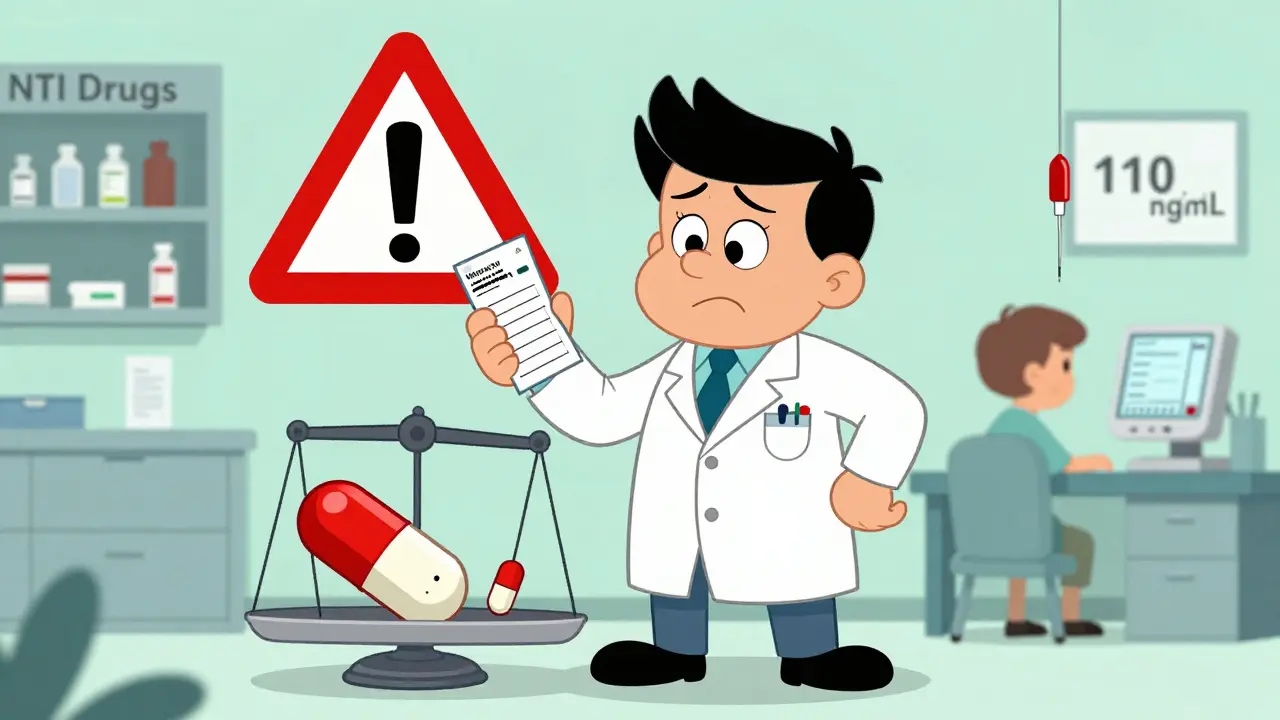
When a doctor writes a prescription for a drug like warfarin, levothyroxine, or tacrolimus, they’re not just choosing a medication-they’re choosing stability. These are Narrow Therapeutic Index (NTI) drugs, where a tiny change in dose can mean the difference between effective treatment and serious harm. Even a 10% shift in blood levels might trigger toxicity or treatment failure. That’s why prescribers don’t treat them like any other drug.
What Makes NTI Drugs So Sensitive?
NTI drugs have a razor-thin margin between the dose that works and the dose that harms. The FDA defines them as medications where the ratio between the minimum toxic concentration and the minimum effective concentration is 2 or less. For comparison, most drugs have a ratio of 10 or higher. This means if a patient’s blood level drops from 100 to 90 ng/mL, they might not get enough benefit. If it rises to 110, they could suffer organ damage.
Think of it like driving a car with no speedometer. You know you need to stay between 55 and 60 mph, but you can’t see the needle. That’s what it’s like for patients on NTI drugs. Small changes-switching brands, different fillers in pills, even food interactions-can throw off their balance. That’s why many prescribers worry about automatic generic substitution.
Prescribers Are Divided
Not all doctors feel the same way. A 2018 survey of 710 pharmacists found that 87% believed physicians saw generic NTI drugs as equally effective. But that doesn’t match what prescribers actually do. In reality, 57% of internists told a 2023 American College of Physicians survey they’d still prescribe the brand-name version when starting a high-risk patient on an NTI drug. Why? Stability.
Transplant specialists are especially cautious. A 1997 survey of 59 transplant pharmacists showed 92% believed bioequivalence tests done on healthy volunteers didn’t reflect how these drugs behave in sick patients. Tacrolimus, for example, has a 32% brand-name retention rate in Medicare Part D data-even though generics have been available for years. Prescribers aren’t being stubborn. They’re reacting to real clinical experience.
State Laws Are Creating a Patchwork
As of 2023, 28 U.S. states have laws that affect how NTI drugs can be substituted. Some require prescriber consent before switching. Others demand that pharmacists notify the doctor. States like Texas and Florida keep official NTI lists that block automatic substitution. Meanwhile, states without these rules see higher substitution rates.
A 2022 study found that states with “affirmative patient consent” laws-where the patient must agree to the switch-had 23% fewer generic substitutions. That’s not because generics are unsafe. It’s because prescribers and pharmacists are trying to reduce uncertainty. When a patient’s INR (a blood test for warfarin) suddenly spikes after a switch, it’s not just a lab result-it’s an emergency room visit, a week of monitoring, and a loss of trust.
What Happens When Substitution Goes Wrong?
The Institute for Safe Medication Practices recorded 1,247 NTI-related medication errors between 2015 and 2020. Thirty-seven percent of those involved substitution. Eight percent led to patient harm. That might sound low, but for someone on lithium or phenytoin, even one bad reaction can be life-changing.
Doctors report real consequences. Forty-one percent said patients got confused after a switch-thinking they got a different drug, or worrying they weren’t getting the same treatment. Twenty-nine percent saw more office visits for monitoring. Each incident cost an estimated $127 in time, tests, and follow-up care. That’s not just a financial burden. It’s emotional. Patients start asking: “Is this the same pill?” “Will I feel different?” “Should I call my doctor?”
Communication Is the Missing Link
Most prescribers don’t want to stop substitution. They want better communication. A 2021 study found that 63% of physicians preferred electronic notifications over phone calls when a pharmacist substituted an NTI drug. Primary care doctors got about 2.7 notifications a month. Psychiatrists managing lithium got over five.
Dr. Michael Cohen of ISMP said it plainly: prescribers need clearer labeling and standardized alerts. Right now, NTI status isn’t always flagged on prescriptions or in pharmacy systems. A pharmacist might not know they’re switching a critical drug. A doctor might not even know a switch happened.
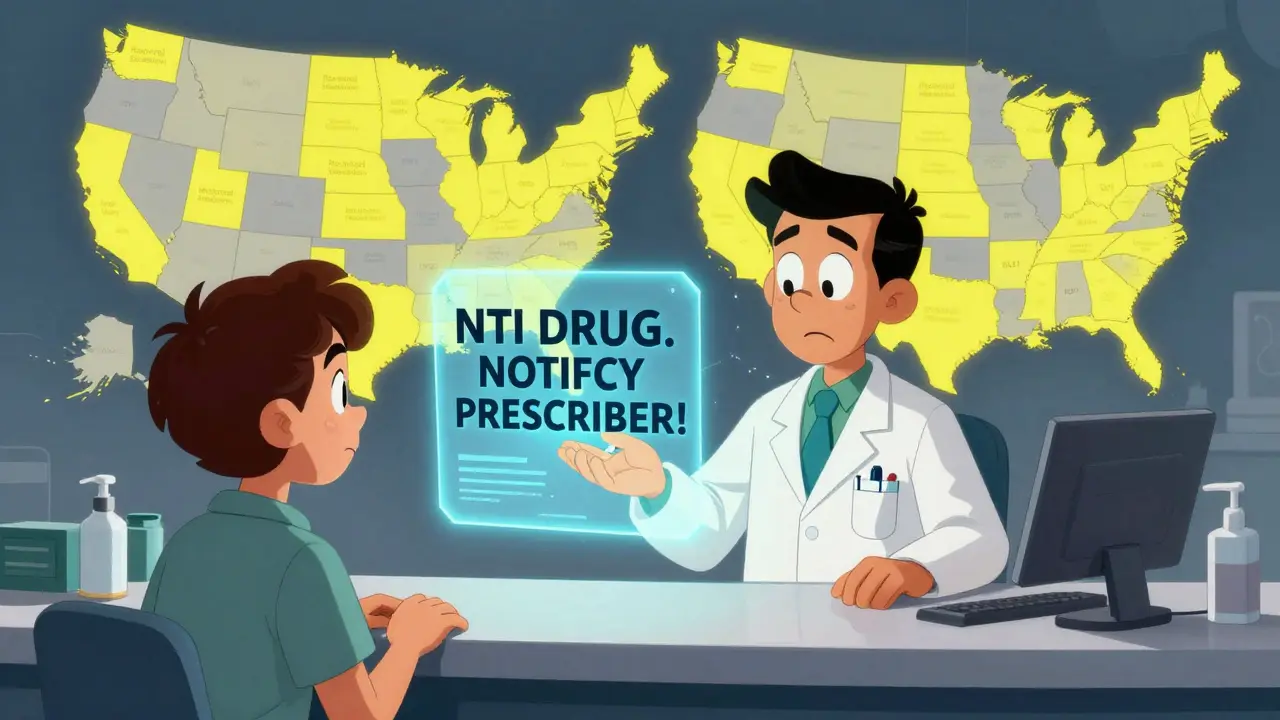
Some hospitals now use automated alerts in their electronic records. When a pharmacist tries to substitute tacrolimus, the system pops up: “NTI DRUG. NOTIFY PREScriber.” That’s the kind of solution that works. Not bans. Not assumptions. Just better information.
The FDA’s Stance vs. Real-World Experience
The FDA says 98% of generic NTI drugs perform within 3-4% of their brand-name counterparts. That’s based on post-market data. It sounds reassuring. But real patients aren’t lab rats. They have other medications, different metabolisms, kidney issues, or fluctuating diets. What works in a controlled trial doesn’t always translate to someone juggling five pills a day.
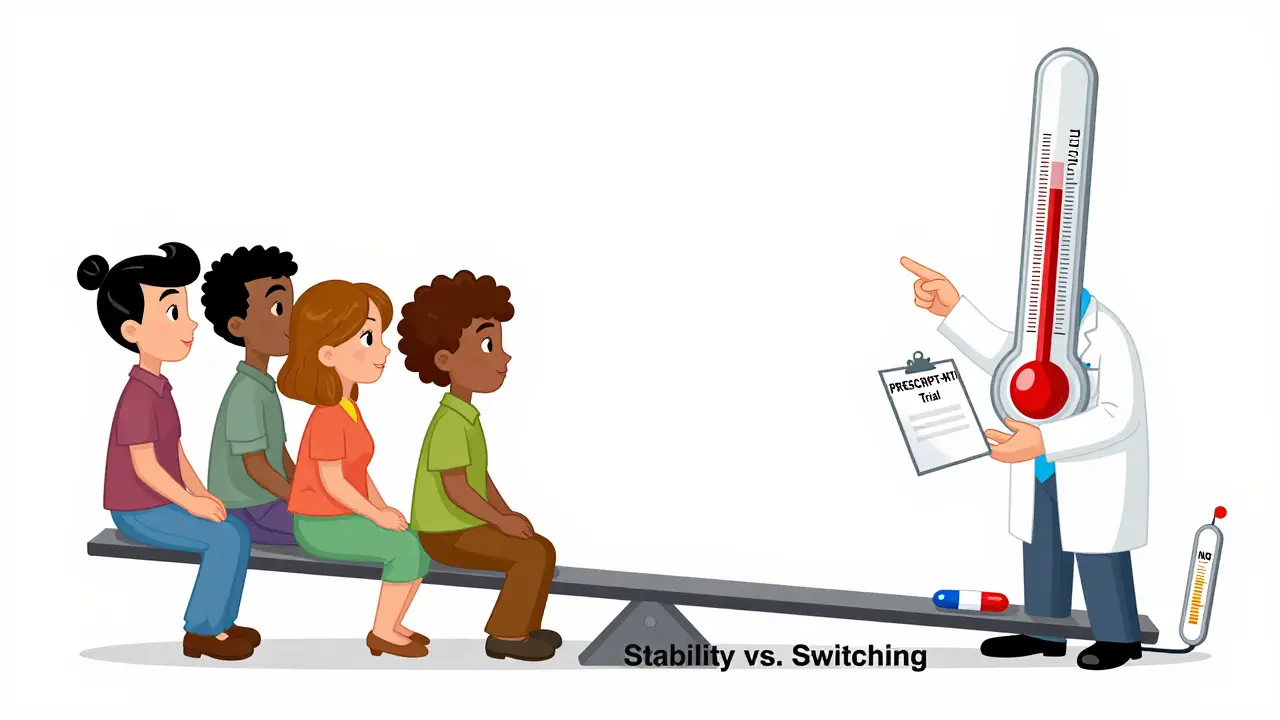
That’s why the FDA added 12 new drugs to its NTI list in March 2023-and removed three others. They’re not ignoring concerns. They’re adapting. But they’re also pushing for more real-world evidence. The PRESCRIPT-NTI trial, now enrolling 1,200 patients across 42 sites, is trying to answer the real question: Does switching NTI drugs actually hurt outcomes?
What’s the Future?
Generic use of NTI drugs is rising. It jumped from 62% in 2023 to an expected 78% by 2028. But growth isn’t automatic. It depends on trust. And trust comes from consistent results, clear communication, and prescriber involvement.
Some specialties are changing. The American Society of Clinical Oncology now supports generic substitution for oral cancer drugs-so long as therapeutic drug monitoring is in place. That’s a sign that with the right safeguards, substitution can be safe.
But for now, the safest path is simple: if a patient is stable on a drug-whether brand or generic-don’t switch. If you’re starting a new patient, consider the brand first. If substitution happens, notify the prescriber. And always, always monitor.
Are generic NTI drugs really as safe as brand-name ones?
The FDA says yes, based on post-market data showing 98% of generic NTI drugs perform within 3-4% of their brand-name equivalents. But real-world experience tells a more complex story. Small variations in absorption, patient metabolism, or drug formulation can lead to instability in sensitive populations-like transplant recipients or patients on warfarin. That’s why many prescribers still prefer to avoid switching unless absolutely necessary.
Why do some states restrict NTI drug substitution?
Twenty-eight U.S. states have laws limiting automatic substitution for NTI drugs because prescribers and pharmacists have seen cases where switching led to clinical instability. States with patient consent laws saw 23% fewer substitutions. These laws aren’t about blocking generics-they’re about ensuring that substitution only happens with awareness, monitoring, and communication.
What NTI drugs are most commonly involved in substitution issues?
The top five NTI drugs with the highest brand-name retention rates are tacrolimus (32%), warfarin (28%), levothyroxine (25%), phenytoin (21%), and lithium (19%). These are used in transplant, anticoagulation, thyroid, seizure, and psychiatric care-areas where small changes in blood levels can cause serious harm. Prescribers are most cautious with these.
Should pharmacists always notify prescribers before substituting an NTI drug?
Yes, and 78% of hospital pharmacists already do. The American Society of Health-System Pharmacists recommends prescriber notification as a best practice. Electronic alerts in electronic health records are the most efficient way to do this. It’s not about distrust-it’s about safety. A quick notification gives the doctor a chance to check lab values or adjust the plan before a problem arises.
Can NTI drug substitution lead to patient harm?
Yes, though it’s rare. Between 2015 and 2020, the Institute for Safe Medication Practices recorded 1,247 NTI-related errors, with 37% tied to substitution. Only 8% caused harm, but those 100 cases included hospitalizations, organ rejection, and seizures. For patients on critical drugs like lithium or phenytoin, even one avoidable error is too many.


Susheel Sharma
February 3, 2026 AT 18:08Let’s be real-NTI drugs aren’t just medications; they’re high-wire acts with no safety net. 🤯 One milligram off, and you’re in ICU territory. I’ve seen patients on tacrolimus after transplant go from stable to rejecting organs because a generic switch wasn’t flagged. Pharmacists aren’t villains, but systems that don’t scream ‘NTI!’ at them? That’s negligence wrapped in bureaucracy.
And don’t get me started on the FDA’s 98% claim. That’s lab data. Real people? They’re on six meds, sleep-deprived, eating curry one day and tofu the next. Bioequivalence doesn’t care about your chai or your kidney function. We need real-world tracking-not post-market PR.
States with consent laws? Genius. Not because generics are evil, but because uncertainty kills. I’d rather wait 48 hours for a call than bury someone because a pill looked different.
Also-why isn’t there a universal NTI icon on scripts? Like a skull-and-crossbones for meds that’ll murder you if you blink? We’ve got QR codes on soda cans. We can’t code ‘DANGER: DO NOT SWAP’?
And yes, I’m Indian. Yes, I’ve seen generic warfarin cause INR spikes in rural clinics. No, the patient didn’t get a follow-up. That’s not a system failure. That’s a crime.
Fix the tech. Not the policy. The tech is lazy. The people? They’re just trying not to die.
Katherine Urbahn
February 4, 2026 AT 10:04It is absolutely imperative, and I cannot stress this enough, that we recognize the profound clinical implications of substituting NTI drugs without explicit, documented, and verifiable prescriber authorization. The FDA’s data, while statistically compelling, is fundamentally flawed in its reliance on controlled, homogeneous populations-populations that do not, and never have, represented the heterogeneous, comorbid, polypharmacy-laden reality of clinical practice.
Moreover, the notion that ‘generic equals equivalent’ is a dangerous oversimplification that ignores pharmacokinetic variability, excipient interactions, and the fact that bioequivalence studies are conducted on healthy volunteers-individuals who do not have renal impairment, hepatic dysfunction, or fluctuating gastrointestinal motility-all of which are common in patients on NTI drugs.
Furthermore, the 37% of errors tied to substitution are not merely ‘incidents’-they are preventable tragedies. Each one represents a breakdown in communication, a failure in system design, and, frankly, a moral lapse in prioritizing cost over care.
And yet, we continue to allow pharmacists to make therapeutic decisions without oversight? This is not innovation. This is recklessness dressed up as efficiency.
States with consent laws are not ‘restrictive’-they are prudent. They are the only rational response to a system that has, for decades, treated human lives like variables in a spreadsheet.
Alex LaVey
February 5, 2026 AT 23:23I love how this post doesn’t just list facts-it tells a story. And honestly? That’s what makes it powerful. We’re not talking about pills. We’re talking about people trying to survive after transplants, after seizures, after strokes. And yeah, generics save money-but not if they cost someone their health.
I work in a clinic where we’ve got a 78-year-old on warfarin who’s been stable for 8 years. Her INR? Perfect. Then her pharmacy switched her to a generic without telling her or us. She ended up in the ER with a bleed. We fixed it. But she hasn’t trusted generics since.
It’s not about being anti-generic. It’s about being pro-stability. Pro-safety. Pro-human.
And the idea of electronic alerts? YES. Let’s make every pharmacy system flash a big red banner: ‘NTI DRUG. CALL DOCTOR.’ No jargon. No ambiguity. Just a simple, loud, clear signal.
We don’t need bans. We need better tools. And we need to listen to the folks who’ve seen the damage.
Jhoantan Moreira
February 6, 2026 AT 04:57Love this thread. 🙌 Seriously. I’m a pharmacist in Scotland, and we’ve got a similar debate here-though we don’t have state laws like the US. But we do have a culture of caution with NTI drugs.
Here’s the thing: I’ve substituted levothyroxine for years. And I’ve never had an issue. But I also never do it without checking the patient’s last TSH, talking to them, and documenting why I did it.
It’s not about the pill. It’s about the process.
Maybe the answer isn’t ‘ban substitution’-it’s ‘mandate conversation.’ A quick 30-second chat with the patient? A note in the EHR? A flag on the script? That’s all it takes.
And if we can do it for insulin? We can do it for tacrolimus.
Small steps. Big impact. 💙
Justin Fauth
February 7, 2026 AT 04:06Let me get this straight-we’re letting some guy at a pharmacy in Ohio swap out a life-saving drug because it’s 3 bucks cheaper? Are you F’ING kidding me? This isn’t ‘affordable care’-this is corporate greed with a white coat.
My cousin got a generic tacrolimus after his transplant. He got rejected. Twice. Now he’s on a waiting list for another one. And the pharmacy? They didn’t even tell his doctor.
Generic? Fine. But not without consent. Not without a damn alert. Not without a freaking warning label that says ‘DO NOT SWITCH’ in bold red.
This isn’t a debate. It’s a crime. And the FDA? They’re asleep at the wheel.
Meenal Khurana
February 7, 2026 AT 06:17Stable patients stay stable. Switching adds risk. Simple.
Joy Johnston
February 8, 2026 AT 20:11Thank you for this comprehensive and meticulously referenced analysis. I found the inclusion of the PRESCRIPT-NTI trial particularly compelling, as it represents a critical step toward evidence-based policy rather than anecdotal practice. The data on 23% fewer substitutions under affirmative consent laws is not merely statistically significant-it is clinically transformative.
Moreover, the emphasis on electronic notification systems as a non-intrusive yet highly effective intervention aligns with best practices in human factors engineering. I would further propose that standardized NTI flags be integrated into the National Drug Code (NDC) system, and that all pharmacy dispensing software be mandated to require a double-confirmation prompt when an NTI substitution is attempted.
Additionally, the 41% of patients who experienced confusion post-substitution underscores the urgent need for patient-facing educational materials, ideally co-developed with clinical pharmacists and patient advocacy groups.
While cost containment is a legitimate objective, it must never supersede patient safety. This is not a partisan issue. It is a medical imperative.
Shelby Price
February 9, 2026 AT 23:24So… if I’m on levothyroxine and my pharmacy switches me to a generic… do I just… feel different? Or is it just my anxiety? I’ve been paranoid for months now. My TSH is ‘fine’ but I’m exhausted. Am I crazy? Or is this a thing?
Also-why does no one ever tell you when they switch your meds? Like… a text? A call? A note? I just got a new bottle and thought ‘wait… this looks weird.’
Jesse Naidoo
February 11, 2026 AT 02:11Wait-so you’re telling me that a patient on lithium could go from stable to suicidal because some pharmacy decided to save $0.20 per pill? And you’re just sitting there like ‘well, the FDA says it’s fine’? That’s not science. That’s corporate negligence with a medical license.
My sister tried switching her generic phenytoin. She had a seizure in her kitchen. She’s on disability now. And the pharmacy? They said ‘we didn’t know it was NTI.’
Who taught them that? Who trained them? Who approved this system?
Someone needs to get fired. Someone needs to go to jail.
Zachary French
February 11, 2026 AT 14:13Okay, so let me get this straight-because some lab rat in a white coat says generics are ‘98% equivalent,’ we’re gonna gamble with people’s lives? 🤡
I’ve seen the reports. I’ve read the studies. I’ve talked to the nurses. And guess what? The patients who got switched? They’re the ones in the ER, crying, asking ‘why did you change my pill?’
And don’t even get me started on the ‘electronic alert’ nonsense. You think a pop-up in Epic is gonna save someone? Nah. It’s gonna get ignored. Like every other alert.
We need a LAW. Not a suggestion. Not a ‘best practice.’ A LAW. Like ‘NO NTI SUBSTITUTION WITHOUT WRITTEN CONSENT.’
And if you’re a pharmacist who swaps tacrolimus without telling the doc? You lose your license. PERIOD.
Enough. With. This. BS.
Daz Leonheart
February 13, 2026 AT 11:52Hey, I just wanted to say thank you for writing this. It’s not often you see a post that actually gets it. I’m a nurse in a transplant unit, and I see this every single day. We don’t fight generics-we fight surprise switches.
The fix? Simple. When a pharmacist swaps an NTI drug, the system should auto-email the prescriber AND the patient. No exceptions. No opt-outs.
And if the patient’s INR jumps? We call them. We don’t wait. We don’t hope. We act.
It’s not about money. It’s about trust. And we’ve got to earn it back, one careful step at a time.
Keep speaking up. We’re listening.