
PLLR Information Guide
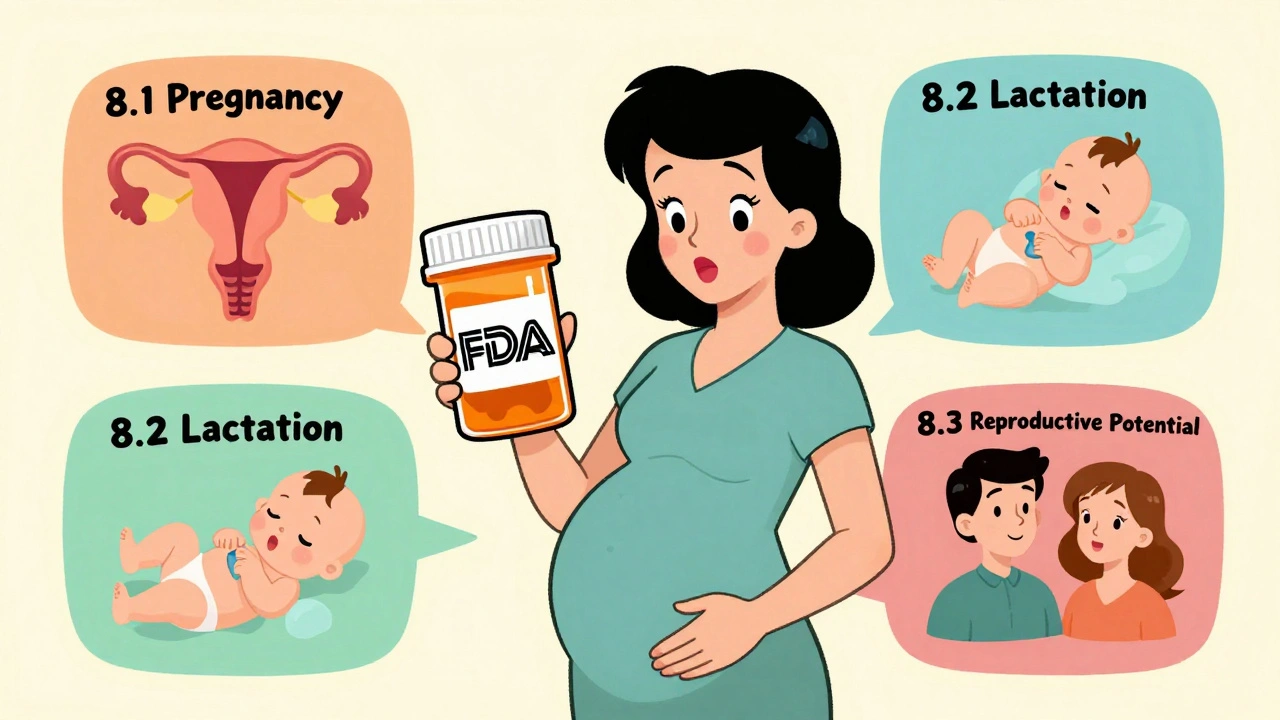
The Pregnancy and Lactation Labeling Rule (PLLR) replaced the old letter system with detailed narratives to help you understand medication safety during pregnancy and breastfeeding. This interactive guide breaks down the three key sections you need to know.
Click on each section below to learn what information to look for in FDA drug labels. Each section shows examples of how safety information is presented under the PLLR.
Remember: Always consult your healthcare provider before making decisions about medications during pregnancy or breastfeeding.
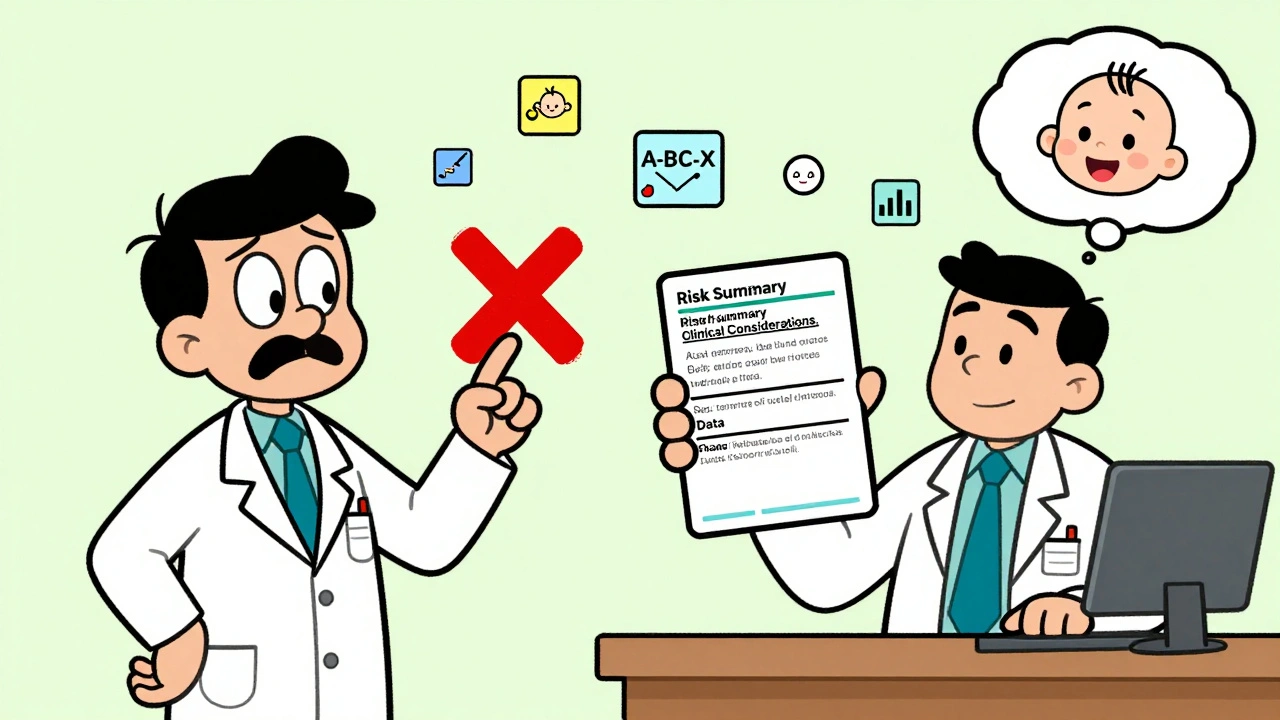
Risk Summary
Direct statement of pregnancy risks: "Use of this drug during pregnancy is associated with an increased risk of oligohydramnios." Or: "No increased risk of major birth defects was observed in over 1,500 exposed pregnancies."
Clinical Considerations
Contextual information: Does the drug cross the placenta? When is it safest to use? How does it affect amniotic fluid? What happens if you stop mid-pregnancy?
Data
Evidence details: "Among 217 pregnant women exposed to Drug X in the first trimester, 4 had neural tube defects (1.8%), compared to a background rate of 0.1% in the general population."
Example from a Drug Label
Risk Summary: "Use of Drug Y during pregnancy may be associated with an increased risk of premature delivery."
Clinical Considerations: "The drug crosses the placenta. Use should be avoided during the second and third trimesters due to increased risk of neonatal respiratory depression."
Data: "In a registry of 150 pregnancies, 12% of women who used Drug Y during the third trimester delivered prematurely compared to 6% in the general population."
Drug Transfer
How much drug gets into breast milk: "Maternal serum levels of Drug Z are 2.5 times higher than milk levels. Estimated infant dose is 0.3% of the maternal weight-adjusted dose."
Infant Effects
Possible effects on the infant: "No adverse effects reported in 35 breastfed infants."
Recommendations
Specific guidance: "Avoid breastfeeding for 4–6 hours after dosing to minimize infant exposure."
Example from a Drug Label
Drug Transfer: "Drug A is excreted into breast milk. The infant receives approximately 1.2% of the maternal dose."
Infant Effects: "No adverse effects reported in 52 breastfed infants through 6 months of age."
Recommendations: "Breastfeeding is compatible with this drug at recommended doses."
Contraception
"Pregnancy must be excluded before starting. Two forms of contraception required."
Male Effects
"Male partners should use condoms during treatment due to potential sperm effects."
Risks to Offspring
"This drug has been associated with birth defects when taken by males."
Example from a Drug Label
Contraception: "Women of childbearing potential must use two forms of contraception and have a negative pregnancy test before starting."
Male Effects: "Men should use condoms during treatment and for 3 months after stopping to prevent potential birth defects."
Risks to Offspring: "Exposure during conception or early pregnancy may increase the risk of fetal abnormalities."
- Read the full prescribing information - not just the patient leaflet
- Start with the Risk Summary - is the risk clearly stated?
- Check Clinical Considerations - does it mention timing, dose changes, or effects on labor?
- Look for the Data section - if it says "limited data," that's a red flag
- Ask about pregnancy registries - sign up if available
- Don't assume breastfeeding is unsafe - check the Lactation section
Remember: "No human data" doesn't mean "dangerous" - it means we don't know yet.
Before 2015, if you were pregnant and your doctor prescribed a medication, you might have seen a simple letter on the label: A, B, C, D, or X. That letter was supposed to tell you if it was safe. But it didn’t. Not really. It didn’t say how much risk, when it mattered, or what the real data showed. It just gave you a grade - and too often, that grade misled both patients and providers.
The FDA changed that. In December 2014, they rolled out the Pregnancy and Lactation Labeling Rule (PLLR), replacing the outdated letter system with clear, detailed narratives. This wasn’t just a tweak. It was a complete rewrite of how drug safety for pregnant and breastfeeding women is communicated. Today, every prescription drug label approved after June 30, 2001, follows this new format. And if you’re trying to understand whether a medication is safe during pregnancy or while breastfeeding, knowing how to read these sections can make all the difference.
What the PLLR Replaced - and Why It Wasn’t Enough
The old system - A, B, C, D, X - looked simple. But it was anything but helpful. Category A meant “safe in controlled studies.” Category X meant “dangerous.” But here’s the problem: most drugs didn’t have enough human data to even get a Category A. So they got stuck as Category C - “risk can’t be ruled out.” That didn’t mean the drug was risky. It just meant nobody had studied it well enough. And yet, many doctors avoided Category C drugs entirely, even when the benefits clearly outweighed the unknowns.
Take antidepressants. A woman with severe depression might be told to stop her medication because it’s Category C. But what if stopping it leads to a suicide attempt? The old system didn’t help weigh that trade-off. It didn’t mention that untreated illness carries its own risks. It didn’t explain how much of the drug passes into breast milk. It didn’t say whether the drug affects milk supply. And it didn’t tell you if there was a registry tracking outcomes in women who took it.
The PLLR fixed this by ditching the letters and forcing manufacturers to tell the full story - with data, context, and real-world evidence.
The Three Sections You Need to Know
Under the PLLR, all drug labels now have three new subsections under Section 8: 8.1 Pregnancy, 8.2 Lactation, and 8.3 Females and Males of Reproductive Potential. Each follows the same three-part structure: Risk Summary, Clinical Considerations, and Data. Let’s break them down.
8.1 Pregnancy: What You Need to Know
The Pregnancy section starts with the Risk Summary. This isn’t a vague warning. It’s a direct statement: “Use of this drug during pregnancy is associated with an increased risk of oligohydramnios.” Or: “No increased risk of major birth defects was observed in over 1,500 exposed pregnancies.”
Then comes the Clinical Considerations. This is where context kicks in. Does the drug cross the placenta? Does it affect amniotic fluid levels? Is there a safe window for use? What happens if you stop it mid-pregnancy? Are there dose adjustments needed in the third trimester? Does it affect labor or delivery? The label now answers these questions - not with guesses, but with what’s known from human studies, animal data, and pharmacological principles.
Finally, the Data section shows the evidence. It doesn’t just say “studies show.” It tells you how many women were studied, what outcomes were tracked, and whether the data came from registries, case reports, or controlled trials. For example: “Among 217 pregnant women exposed to Drug X in the first trimester, 4 had neural tube defects (1.8%), compared to a background rate of 0.1% in the general population.” That’s the kind of detail you need to make a decision.
8.2 Lactation: Breastfeeding and Medications
Many women are told to stop breastfeeding when they start a new medication. But that’s not always necessary - and the old system didn’t help them figure out why.
The Lactation section now tells you: How much of the drug gets into breast milk? Is it measurable? Is it absorbed by the baby’s gut? Is there any documented effect on the infant? Does the drug reduce milk supply?
For example, a label might say: “Maternal serum levels of Drug Y are 2.5 times higher than milk levels. Estimated infant dose is 0.3% of the maternal weight-adjusted dose. No adverse effects reported in 35 breastfed infants.” That’s actionable. You can use that to decide whether to breastfeed, pump and dump, or switch meds.
Some labels even include advice like: “Avoid breastfeeding for 4-6 hours after dosing to minimize infant exposure.” That’s not speculation. It’s based on pharmacokinetic studies.
8.3 Females and Males of Reproductive Potential
This section is often overlooked, but it’s critical. It tells you whether the drug requires pregnancy testing before starting, what kind of contraception is needed, and whether it causes infertility or birth defects in offspring if taken by men.
For drugs like isotretinoin (Accutane), it says: “Pregnancy must be excluded before starting. Two forms of contraception required. Monthly pregnancy tests.” For others, like certain antivirals, it might say: “Male partners should use condoms during treatment due to potential sperm effects.”
This section turns reproductive safety from a woman’s issue into a shared responsibility - and gives clear, enforceable guidance.
Why the PLLR Is Better - And How It’s Being Used
One of the biggest wins of the PLLR is that it forces manufacturers to include information about the risks of not treating the illness. A woman with epilepsy who stops her seizure medication because she’s pregnant might have a seizure that harms her baby. The PLLR now requires labels to say: “Untreated epilepsy increases the risk of fetal loss and congenital malformations.” That’s life-saving context.
Another improvement? Pregnancy exposure registries. Before the PLLR, these were optional. Now, if a drug has enough use in pregnancy to warrant tracking, the label must say: “A pregnancy exposure registry is available at [website].” These registries collect real-world data from thousands of women - data that helps future patients.
And the FDA doesn’t let labels sit outdated. If new safety data emerges - say, a study shows a drug causes heart defects in infants - the label must be updated within months. That’s a huge shift from the old system, where outdated warnings could stay on shelves for years.
What to Do When You’re Pregnant or Breastfeeding
Here’s how to use the PLLR sections in real life:
- Ask for the full prescribing information - not just the patient leaflet. The PLLR details are in the professional label, not the consumer summary.
- Start with the Risk Summary - is the risk clearly stated? Is it high, moderate, or low? Don’t skip this.
- Check the Clinical Considerations - does it say anything about timing? Dose changes? Effects on labor? These matter.
- Look for the Data section - if it says “limited data,” that’s not a green light. It’s a red flag to proceed with caution.
- Ask about the registry - if one exists, sign up. Your data helps others.
- Don’t assume breastfeeding is unsafe - check the Lactation section. Many drugs are compatible.
And remember: if a drug’s label says “no human data,” that doesn’t mean it’s dangerous. It just means we don’t know yet. That’s different from “known to cause harm.”
What’s Still Missing - And What’s Next
The PLLR isn’t perfect. Some labels still use vague language like “potential risk” without quantifying it. Others don’t clearly explain how animal data translates to humans. And while the FDA and EMA (Europe’s agency) both have similar goals, their wording often differs - leading to confusion for global patients and prescribers.
But progress is real. More labels now include specific outcomes: amniotic fluid levels, infant weight gain, developmental milestones. More include data from registries. More mention the risks of stopping treatment.
The future? Better harmonization with global regulators. More use of real-world data from electronic health records. And eventually, dynamic labeling that updates in real time as new evidence emerges.
For now, the PLLR is the best tool we have. It doesn’t give you a simple answer. But it gives you the information to find your own - with your doctor, your values, and your health in mind.
What does the PLLR stand for?
PLLR stands for Pregnancy and Lactation Labeling Rule. It’s a U.S. Food and Drug Administration (FDA) regulation that replaced the old pregnancy letter categories (A, B, C, D, X) with detailed, narrative sections on drug safety during pregnancy, breastfeeding, and reproductive potential.
When did the PLLR go into effect?
The PLLR was finalized in December 2014 and became effective for new drug approvals starting in 2015. Manufacturers of drugs approved after June 30, 2001, were required to update their labels by June 2018. Older drugs had to remove the old letter categories within three years of the rule’s effective date.
Does the PLLR apply to over-the-counter (OTC) drugs?
No. The PLLR only applies to prescription drugs and biological products regulated under the Physician Labeling Rule (PLR). OTC medications still use the older, less detailed labeling formats. Always check with your pharmacist or provider before using any OTC drug during pregnancy or breastfeeding.
How do I find the PLLR section on a drug label?
Look for Section 8: Use in Specific Populations. Within that section, you’ll find three subsections: 8.1 Pregnancy, 8.2 Lactation, and 8.3 Females and Males of Reproductive Potential. These are standardized across all FDA-approved prescription drugs and are found in the full prescribing information - not the patient package insert.
What if a drug label says ‘no data available’?
That means there’s no published human data on the drug’s effects during pregnancy or breastfeeding. It doesn’t mean the drug is dangerous - just that we don’t know yet. In these cases, decisions should be based on animal studies, pharmacological properties, and the risks of leaving the condition untreated. Talk to your provider about whether the benefit outweighs the unknown risk.
Are pregnancy registries mandatory?
Yes. Under the PLLR, if a drug is commonly used during pregnancy and there’s enough potential risk to warrant monitoring, the label must include information about a pregnancy exposure registry. These registries collect data on outcomes for women and their babies, helping build better safety evidence over time.
Can men’s use of medication affect pregnancy?
Yes. The PLLR’s Section 8.3 now requires labels to address male reproductive effects. Some medications can affect sperm quality, increase the risk of birth defects in offspring, or interact with contraception. If a drug has known or suspected effects on male fertility or fetal development, the label must say so - and recommend condom use if needed.


Shannara Jenkins
December 3, 2025 AT 02:12Finally, someone explained this in a way that actually helps. I was so confused by those old A-B-C-D-X labels - thought Category C meant ‘avoid at all costs.’ Turns out it just meant ‘we haven’t studied it enough.’ That’s a huge difference.
My OB-GYN didn’t even know about the PLLR until I brought it up. Now she sends me the full prescribing info for every med. Game changer.
Elizabeth Grace
December 3, 2025 AT 14:53I cried reading this. After my second miscarriage, I was told to stop my anxiety meds because they were ‘Category C.’ No one told me not taking them might’ve been worse. This rule should’ve been around five years ago.
Steve Enck
December 4, 2025 AT 09:17While the PLLR represents a methodological improvement in pharmacovigilance, it remains fundamentally constrained by the epistemological limitations of human clinical data in reproductive contexts. The reliance on observational registries and underpowered case studies introduces significant confounding bias, rendering even the most ‘detailed’ narratives statistically ambiguous. One must interrogate not merely the presence of data, but its inferential validity - which, in most cases, remains woefully inadequate.
मनोज कुमार
December 5, 2025 AT 09:50Joel Deang
December 6, 2025 AT 18:19OMG YES!! I just found out my prenatal vitamin has a pregnancy registry!! I signed up lol 🙌 I feel like a science hero now. Also, my doc didn't even know about section 8.3 until I showed him. He was like 'wait, men's meds matter too??' 😅
Roger Leiton
December 7, 2025 AT 09:29This is exactly what I needed. I’m 14 weeks and on a med that used to be ‘Category C’ - now I can see the actual numbers: 1200+ women, no increase in defects. That’s peace of mind.
Also, the lactation section said my antidepressant only passes at 0.2% to milk? I’m breastfeeding without guilt now. Thank you for making this so clear.
Laura Baur
December 7, 2025 AT 23:28Let’s be honest - the PLLR is just corporate PR dressed up as science. Manufacturers still bury the most concerning data in footnotes. The ‘Risk Summary’ often says ‘no increased risk’ while the ‘Data’ section reveals a 3.5x spike in preterm birth among women on the drug. And no one calls them out. We’re being sold a sanitized narrative under the guise of transparency. The FDA is too cozy with Big Pharma to truly protect vulnerable populations.
And don’t get me started on how they still let ‘potential risk’ slide as a clinical consideration. That’s not information - that’s evasion.
Jack Dao
December 8, 2025 AT 17:02Anyone who trusts a drug label without checking the registry or asking for the full prescribing info is playing Russian roulette with their baby’s health.
And if your doctor says ‘it’s just Category C, better safe than sorry’ - fire them. They’re operating in 2008.
dave nevogt
December 9, 2025 AT 11:06I’ve spent years as a nurse in maternal health, and I’ve seen too many women terrified by vague warnings or outright misinformation. The PLLR doesn’t solve everything - but it finally gives us something real to hold onto. It’s not perfect, but it’s honest in a way the old system never was.
What matters most isn’t the label itself, but whether we’re willing to sit with the uncertainty, to listen to the patient’s fears, and to weigh the risk of doing nothing against the risk of doing something. That’s the real work - and the PLLR just gives us the tools to do it better.
Arun kumar
December 10, 2025 AT 12:41Zed theMartian
December 11, 2025 AT 18:12Oh wow. The FDA actually did something useful? Who knew? Next they’ll tell us vaccines don’t cause autism and the moon landing wasn’t faked.
But seriously - this is the most honest thing the government has done since the 90s. I’m shocked. And slightly suspicious. What’s the catch?
Ella van Rij
December 12, 2025 AT 20:32Oh honey, you mean the FDA didn’t just make it easier to read labels? They made them… *useful*? 😱
Next they’ll be giving us free hugs and free Wi-Fi. I’m not sure I can handle this level of competence.
ATUL BHARDWAJ
December 13, 2025 AT 21:35Steve World Shopping
December 14, 2025 AT 18:08Let me cut through the noise: this is a compliance exercise masquerading as patient empowerment. The data is still cherry-picked, the registries underfunded, and the language still designed to absolve manufacturers, not inform mothers. The real issue? Pharma doesn’t want to fund large-scale reproductive studies - so they give us pretty narratives with incomplete data. We’re being managed, not protected.
Shannara Jenkins
December 16, 2025 AT 10:16@5429 - I’m so sorry you went through that. You’re not alone. I had the same experience - told to stop my meds, ended up in the ER with panic attacks. I wish I’d known about the PLLR back then.
But now I’m helping other moms find the labels. I even made a simple guide for my mom’s book club. Turns out, a lot of us were just scared and confused.