
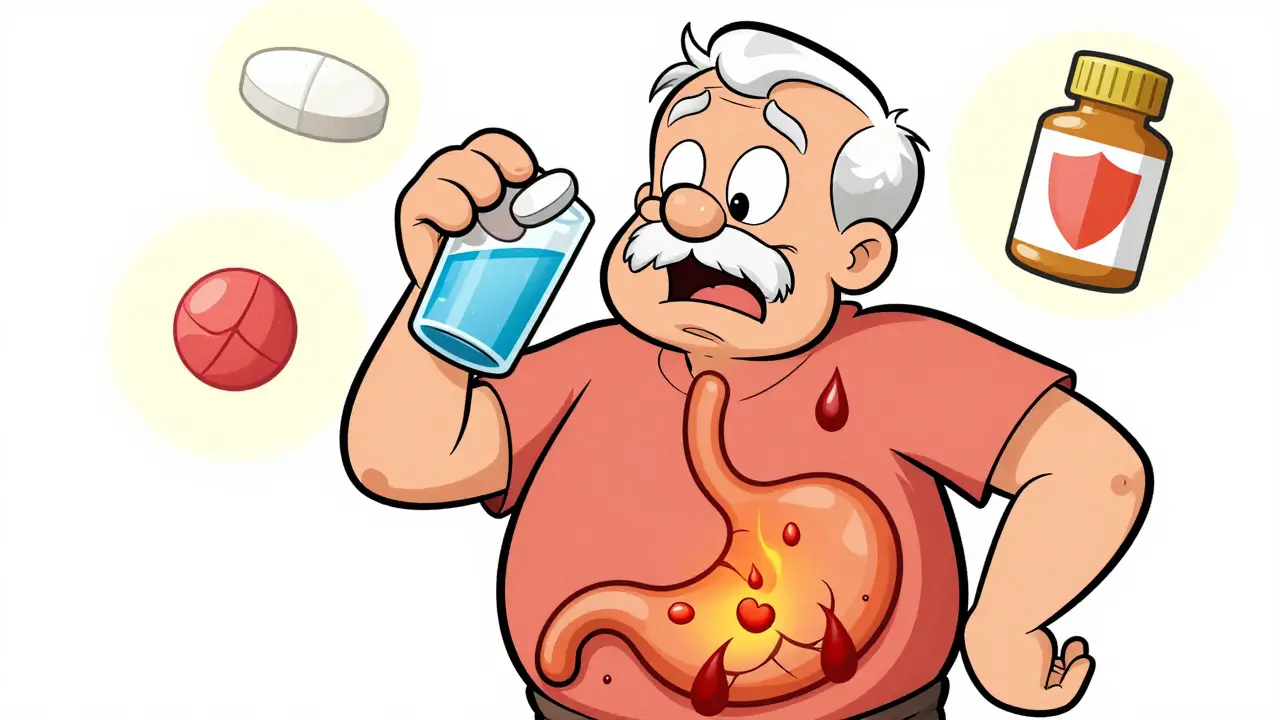
Every year, millions of people take antiplatelet medications to keep their hearts safe. These drugs stop blood clots from forming, which is crucial after a heart attack, stent placement, or stroke. But for every person who avoids a clot, another faces a dangerous side effect: gastrointestinal bleeding. It’s not rare. It’s not theoretical. It’s happening right now to people who thought they were doing everything right.
Aspirin, clopidogrel, prasugrel, ticagrelor - these aren’t just names on a prescription bottle. They’re powerful tools that change how your blood behaves. But they don’t care if your stomach is sensitive, if you’re over 65, or if you’ve had an ulcer before. They work the same way everywhere: by stopping platelets from sticking together. And that’s exactly what makes them dangerous in the gut.
How Antiplatelet Drugs Work - And Why They Hurt Your Stomach
There are two main types of antiplatelet drugs. Aspirin is the oldest. It blocks an enzyme called COX-1, which reduces a chemical called thromboxane A2. That chemical tells platelets to clump up. No thromboxane? No clots. Simple. But COX-1 also helps protect your stomach lining by producing mucus and maintaining blood flow. When aspirin shuts it down, your stomach gets vulnerable.
Then there are the P2Y12 inhibitors: clopidogrel, prasugrel, ticagrelor. These block a different signal - adenosine diphosphate (ADP) - that activates platelets. They’re stronger than aspirin. And they’re more likely to cause bleeding. Why? Because they don’t just stop clots. They also slow down healing. Platelets don’t just form clots. They also release growth factors that repair damaged tissue. When you block them, even small ulcers can’t heal.
Here’s the kicker: enteric-coated aspirin doesn’t fix this. It only delays release until the pill leaves the stomach. The antiplatelet effect still hits your bloodstream. Your gut still gets exposed. Studies show it doesn’t lower bleeding risk. It just gives people false confidence.
The Real Numbers Behind the Risk
Let’s talk numbers. Not vague ones. Real data from real studies.
- 1% of patients on antiplatelet therapy have a major GI bleed within the first 30 days after a heart procedure.
- 40% of people taking aspirin long-term develop visible stomach damage within 6-12 months.
- For those on dual therapy (aspirin + clopidogrel), that number jumps to 50%.
- Clopidogrel has an 80% higher risk of causing serious GI injury compared to aspirin alone.
- Ticagrelor increases bleeding risk by 30% compared to clopidogrel.
And it’s not just about the first month. Most bleeds happen after months - even years - of use. People think, “I’ve been on this for two years, I’m fine.” But the damage builds quietly. A tiny ulcer. A slow leak. Then, one day, you’re vomiting blood or passing black stools.
Who’s at Highest Risk?
Not everyone has the same risk. Some people are walking time bombs. Here’s who needs extra attention:
- Age 65 or older
- History of peptic ulcer or GI bleed
- Taking NSAIDs like ibuprofen or naproxen
- Infected with H. pylori (a common stomach bacteria)
- On blood thinners like warfarin or apixaban
- High-dose or long-term steroid use
One study found that patients with just two of these risk factors had a 3x higher chance of bleeding than those with none. If you have three or more? Your risk doubles again. And yet, many doctors still don’t screen for this.
Proton Pump Inhibitors (PPIs): The Go-To Shield
If you’re on antiplatelet therapy and you have any risk factor, you need a PPI. Not “maybe.” Not “if you feel bad.” Every time.
PPIs like esomeprazole, omeprazole, or pantoprazole reduce stomach acid. Less acid = less irritation = better healing. Simple. But here’s what most people don’t know:
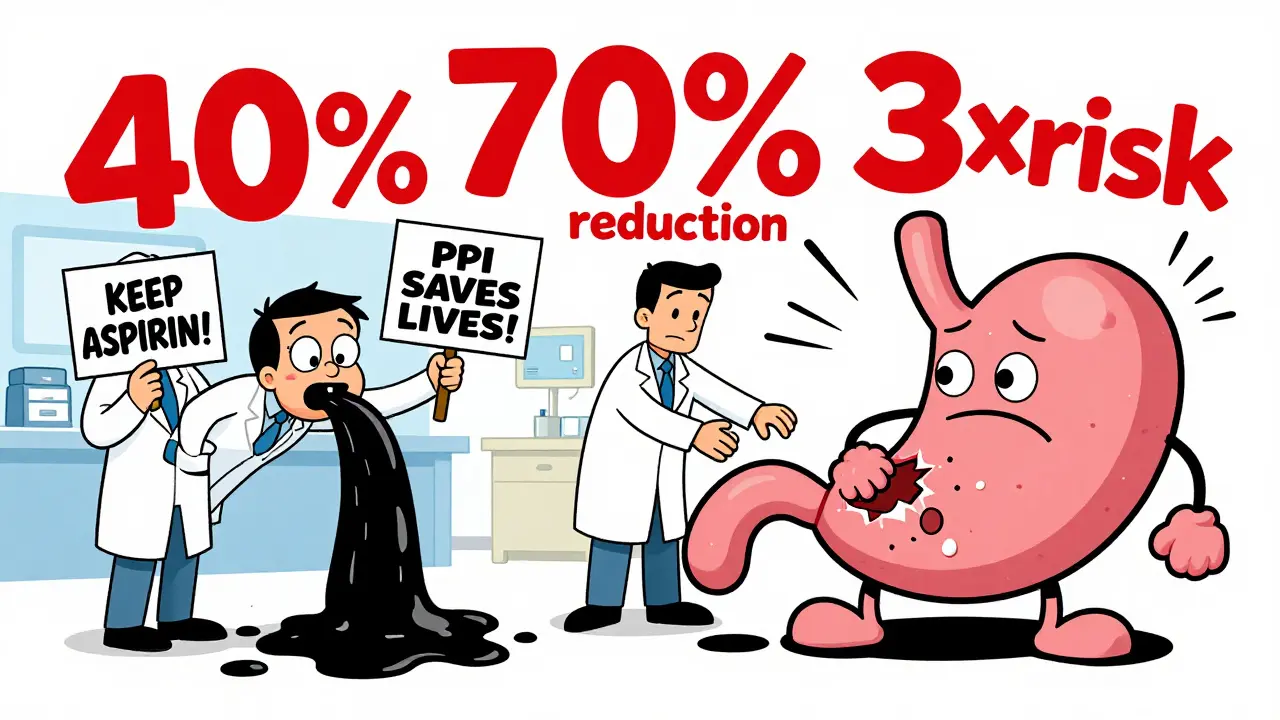
- They reduce the risk of GI bleeding by up to 70% in high-risk patients.
- For patients with prior ulcers, PPIs help 92% of ulcers heal within 8 weeks.
- Guidelines say to use high-dose PPIs (esomeprazole 40mg daily) for at least 8 weeks after a bleed.
- For those with recurrent ulcers, indefinite PPI use is recommended.
But there’s a catch. Some doctors worry about clopidogrel and PPIs. Back in 2009, the FDA flagged a possible interaction. The theory? PPIs might block the enzyme (CYP2C19) that turns clopidogrel into its active form. That could make clopidogrel less effective.
Here’s the truth: the evidence is mixed. Some observational studies say yes, you get more heart attacks. Others say no. The biggest randomized trials found no real difference in heart events. The American College of Gastroenterology says: if you need a PPI for GI protection, take it. Don’t skip it because of fear.
And if you’re worried? Take your PPI at night and your clopidogrel in the morning. That 12-hour gap may help. It’s not proven, but it’s low-risk and easy to try.
What About Stopping the Medication?
Here’s one of the most dangerous myths: “If I’m bleeding, I should stop my antiplatelet drug.”
Don’t. Not without a doctor.
Stopping aspirin during a GI bleed doesn’t stop the bleeding. It doesn’t help. In fact, it increases your risk of dying by 25%. Why? Because your heart is still at risk. A clot can form faster than your stomach can heal.
Guidelines are clear: keep aspirin going. Even if you’re vomiting blood. Even if you’re in the ER. Aspirin stays.
For P2Y12 inhibitors like clopidogrel or ticagrelor, hold them for 5-7 days during active bleeding. But restart as soon as the bleeding is controlled. Delaying longer than a week increases your risk of stent clotting - and that’s often fatal.
One study tracked 147 patients who quit their antiplatelet meds because of stomach pain. Three of them had heart attacks or stent clots within 30 days. One died.
What If You Can’t Tolerate PPIs?
Some people can’t take PPIs. They get diarrhea. Headaches. Or worse - long-term use can lead to low magnesium, bone fractures, or kidney issues. About 15-20% of long-term users report side effects.
Options:
- Switch to H2 blockers like famotidine - less effective than PPIs, but better than nothing.
- Use sucralfate - a coating agent that protects ulcers. It’s not as strong, but it’s safe.
- Try switching antiplatelet drugs. Aspirin alone has lower GI risk than clopidogrel. Ticagrelor? Higher risk. If you’re on clopidogrel and can’t take PPIs, ask your doctor about switching to aspirin - if your heart condition allows it.
There’s no perfect solution. But there’s a safer path.
The Future: Better Drugs, Better Protection
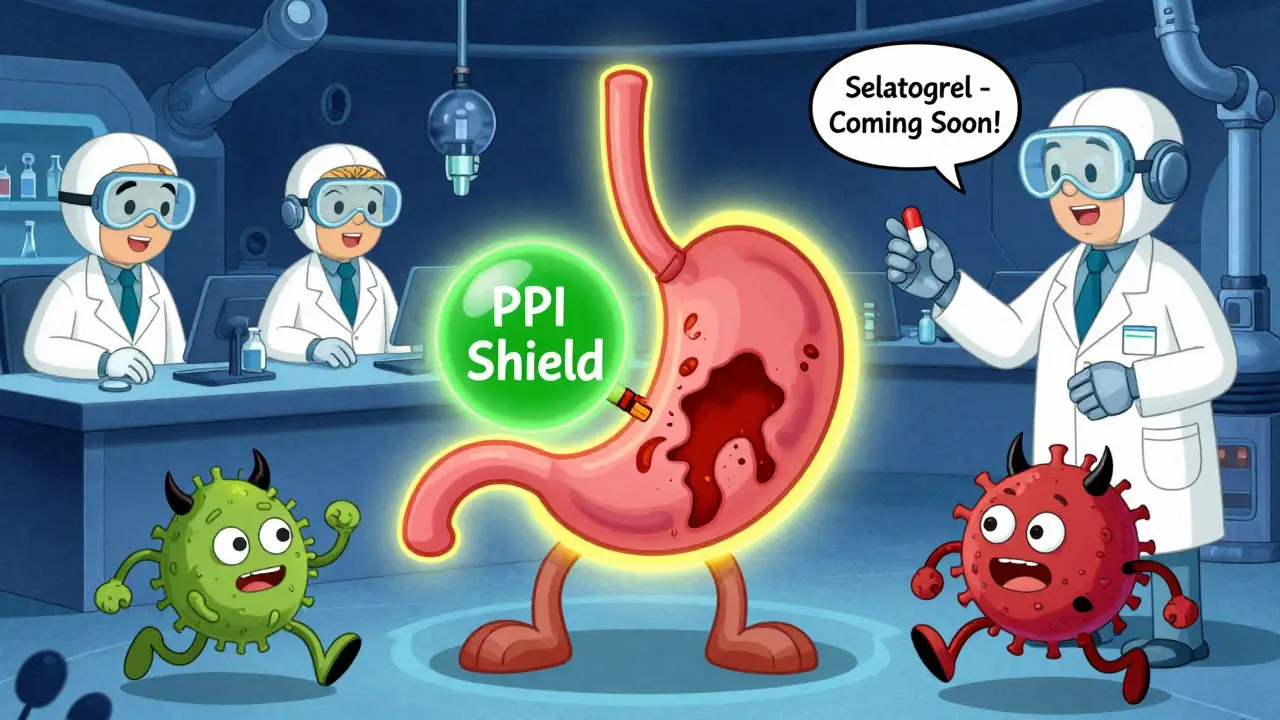
Researchers are working on antiplatelet drugs that don’t hurt the gut. One new drug, selatogrel, is in late-stage trials. In animal studies, it reduced GI injury by 35% compared to ticagrelor. It’s not available yet - but it’s coming.
Another path? Personalized medicine. Right now, some people don’t respond to clopidogrel because of their genes. A simple blood test can check for CYP2C19 mutations. If you’re a poor metabolizer, clopidogrel won’t work well - and you’re stuck with higher bleeding risk. Switching to ticagrelor or prasugrel might be better for you. But that test isn’t routine. It should be.
Future guidelines will likely include biomarkers - like pepsinogen or gastrin-17 - to predict who’s at highest risk for GI damage. That means you won’t have to guess. You’ll know.
What You Should Do Right Now
If you’re on an antiplatelet drug:
- Ask if you’re on the lowest effective dose. More isn’t always better.
- Check if you have any GI risk factors. Age? Ulcer history? NSAID use? H. pylori?
- If yes to any - confirm you’re on a PPI. If not, ask why.
- Never stop your antiplatelet drug without talking to your cardiologist and gastroenterologist together.
- If you notice black stools, vomiting blood, or sudden fatigue - get help immediately.
This isn’t about fear. It’s about awareness. Antiplatelet drugs save lives. But they can also take them - if you don’t protect your gut.
Do all antiplatelet drugs cause stomach bleeding?
Not all equally. Aspirin has the lowest GI bleeding risk among common antiplatelet drugs. Clopidogrel carries a higher risk, and newer agents like prasugrel and ticagrelor carry even higher risks. But all of them interfere with platelet function, which is essential for healing stomach lining. So even aspirin can cause damage over time, especially in high-risk patients.
Can I take ibuprofen with aspirin or clopidogrel?
Avoid it. NSAIDs like ibuprofen, naproxen, or diclofenac double your risk of GI bleeding when combined with antiplatelet drugs. They damage the stomach lining directly and block protective prostaglandins. If you need pain relief, use acetaminophen (Tylenol) instead. It doesn’t affect platelets or the stomach lining.
Is it safe to take a PPI long-term?
For patients with a history of GI bleeding or multiple risk factors, yes. The benefits of preventing life-threatening bleeding far outweigh the risks of long-term PPI use. That said, some people develop side effects like low magnesium, bone fractures, or kidney issues. If you’re on a PPI for more than a year, ask your doctor about periodic monitoring. Never stop abruptly - taper under medical supervision.
Should I get tested for H. pylori if I’m on antiplatelet therapy?
Yes - especially if you’ve had a GI bleed, an ulcer, or are over 65. H. pylori infection is a major cause of ulcers and increases bleeding risk by 3-5 times. Testing is simple (breath, stool, or blood test). If positive, treatment with antibiotics and a PPI can eliminate the infection and cut your bleeding risk dramatically.
What should I do if I have a GI bleed while on antiplatelet meds?
Don’t stop your aspirin. Call emergency services immediately. Aspirin should continue unless bleeding is life-threatening and uncontrolled. P2Y12 inhibitors like clopidogrel or ticagrelor should be held for 5-7 days, then restarted as soon as the bleeding is controlled. Endoscopic treatment is the standard for stopping active bleeding. Platelet transfusions are not recommended - they increase death risk.



Josiah Demara
February 16, 2026 AT 06:46Let’s cut through the corporate bullshit. Aspirin isn’t ‘safer’-it’s just the oldest drug they can still patent. The real problem? Doctors don’t give a shit about GI bleeds until you’re in the ER vomiting blood. PPIs? Sure, they help-but they’re not magic. Long-term use kills your microbiome, messes with magnesium, and turns your bones into chalk. And no one talks about how H. pylori screening is basically a joke in primary care. You need a GI bleed first? Then you get tested. By then, it’s too late. This isn’t medicine. It’s damage control with a side of placebo.
Kaye Alcaraz
February 16, 2026 AT 11:00Thank you for sharing this critical information. It is vital that we prioritize patient safety through proactive measures. PPIs are not optional for high-risk individuals-they are essential. If you are on antiplatelet therapy and have not been evaluated for GI risk factors, please speak with your care team. Prevention saves lives.
Charlotte Dacre
February 18, 2026 AT 09:55So let me get this straight-you’re telling me we’ve been giving people drugs that turn their stomachs into Swiss cheese… and the ‘solution’ is to give them more drugs to cover up the holes? Brilliant. Pure genius. Next up: giving people aspirin and then a prescription for duct tape.
Esha Pathak
February 19, 2026 AT 06:48It’s funny how we treat the body like a machine-fix one part, break another. Antiplatelets? They’re like a fire extinguisher in a house on fire. You stop the flames… but you drown the whole damn place. Maybe we need to stop asking how to protect the stomach… and start asking why we’re burning it in the first place. The real cure? Less aggression. More listening. More harmony with the body’s own wisdom. 🌿
Sarah Barrett
February 19, 2026 AT 08:33The data here is compelling. I’ve reviewed multiple studies on PPI use in dual antiplatelet therapy, and the consensus remains: benefit outweighs risk in high-risk populations. The 2009 clopidogrel interaction concern was overblown. RCTs like COGENT and others show no significant increase in cardiovascular events with concurrent PPI use. This isn’t anecdotal-it’s evidence-based.
Mike Hammer
February 21, 2026 AT 02:54man i’ve been on clopidogrel for 3 years and never thought about my stomach once. just assumed the doc had it covered. turns out i’m one of those 40% with visible damage. got an endoscopy last month-yep, ulcer. no symptoms. no warning. just… there. ppi’s are a must. why didn’t anyone tell me this before?
Daniel Dover
February 22, 2026 AT 21:39PPIs reduce bleeding risk by 70%. That’s not a suggestion. It’s standard care.
Joe Grushkin
February 23, 2026 AT 15:23You call this medicine? This is pharmaceutical theater. You’re telling people to take a drug that damages their gut… then give them another drug to fix the damage… then tell them to take it forever? Welcome to the American healthcare loop. The real solution? Stop overprescribing. Stop pretending pills are prevention. This isn’t science. It’s a business model.
Virginia Kimball
February 24, 2026 AT 05:34So many of us live in fear of heart attacks and never think about our guts. But your stomach doesn’t scream until it’s too late. Please-don’t wait for black stools to ask questions. Talk to your doctor. Get screened. Take the PPI. Your future self will thank you. You’ve got this 💪
Kapil Verma
February 24, 2026 AT 09:09India has been doing this right for decades. We don’t need fancy Western drugs to tell us what’s dangerous. Our grandmothers knew: turmeric, ginger, neem-natural healing. But now everyone chases pills and profits. Aspirin? It’s a colonial relic. PPIs? Corporate poison. You think your gut is safe? Look at the real data: Indian populations on traditional diets have 80% lower GI bleeding rates. We don’t need more drugs. We need to go back.
Michael Page
February 25, 2026 AT 14:14I wonder if the real issue isn’t the drugs-but the assumption that the body can be reduced to a single pathway. Platelets aren’t just clotters. They’re repairers. Immune modulators. Signaling hubs. By blocking them, we’re not just preventing clots-we’re disrupting an entire ecosystem. Maybe the answer isn’t more drugs… but a deeper understanding of physiology. We’ve been treating symptoms for a century. It’s time to ask why the system broke.
Mandeep Singh
February 26, 2026 AT 13:46Let me break this down for you slow folks who think aspirin is ‘safe.’ You’re on clopidogrel? You’re already in the top 10% of bleeding risk. You think enteric coating helps? That’s marketing, not medicine. The FDA doesn’t regulate your stomach. Your doctor didn’t warn you because they’re paid per script, not per outcome. You’re not ‘fine’ because you haven’t bled yet. You’re just one coffee, one ibuprofen, one birthday party away from a transfusion. And if you’re over 65? You’re basically a walking GI bleed waiting to happen. Stop pretending you’re invincible. Get the PPI. Now. Before your next poop looks like tar.
Betty Kirby
February 27, 2026 AT 07:28Aspirin is not ‘low risk.’ It’s the most common cause of GI bleeds in the elderly. And yet, every damn cardiology guideline still pushes it first. Why? Because it’s cheap. Because Big Pharma doesn’t make money off it. They make money off the PPIs you need to survive the aspirin. This isn’t healthcare. It’s a pyramid scheme with a stethoscope.