
What Is Hypertensive Retinopathy?
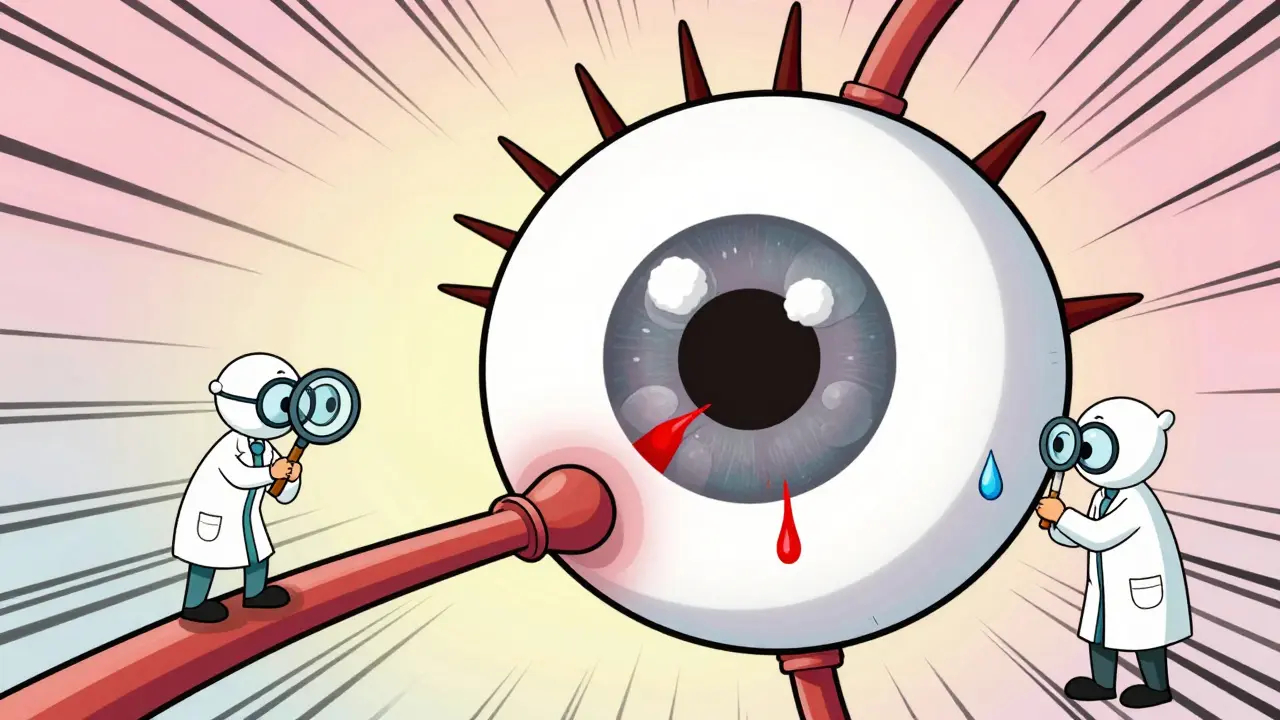
Hypertensive retinopathy is a condition where long-term high blood pressure damages the tiny blood vessels in the retina, the light-sensitive layer at the back of your eye. It doesn’t happen overnight. It builds up silently over years, often without symptoms, until vision starts to blur or dark spots appear. This isn’t just an eye problem-it’s a warning sign that your entire vascular system is under stress.
Think of your retina like a camera sensor. The blood vessels feeding it are as delicate as film. When blood pressure stays too high, those vessels thicken, narrow, and sometimes leak. Over time, this cuts off oxygen, floods the retina with fluid and fat, and can even cause bleeding. The damage is often irreversible.
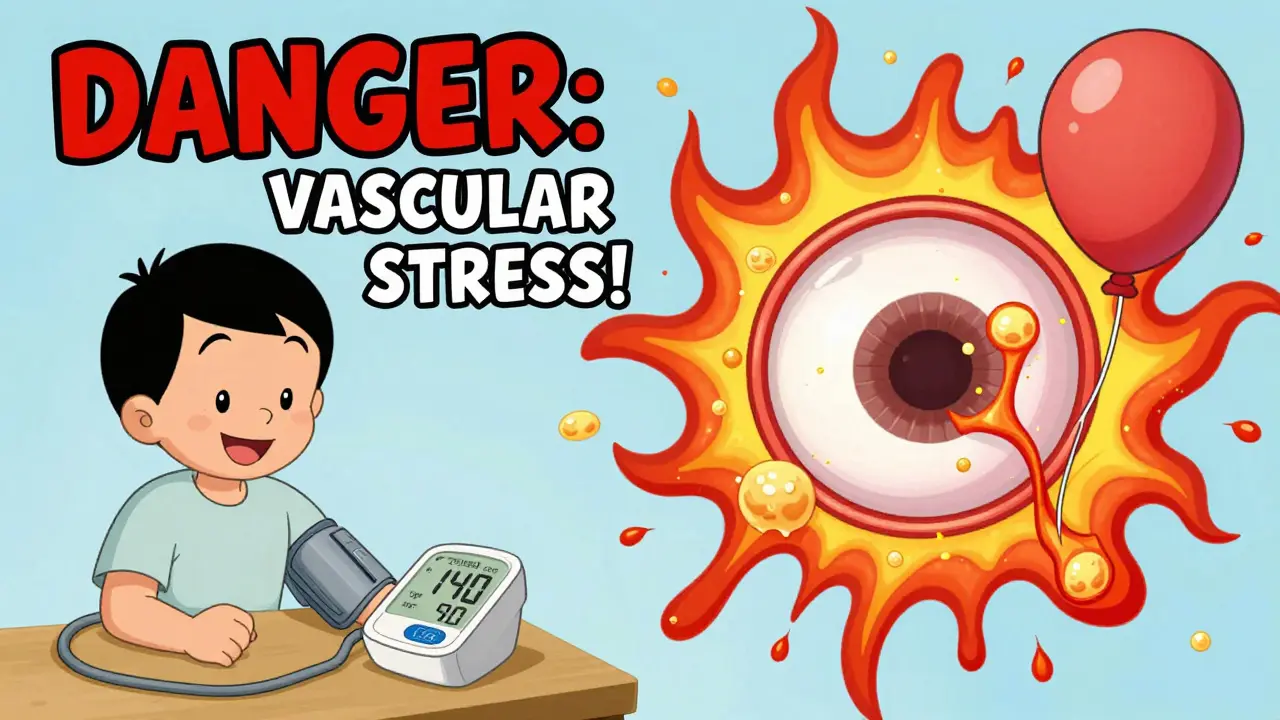
According to the CDC, nearly 1 in 7 U.S. adults has stage 2 hypertension-blood pressure at or above 140/90 mmHg. That’s about 19.2 million people at risk for this exact kind of eye damage. And many won’t know it until their vision changes.
How High Blood Pressure Harms the Retina
Your retina depends on a steady, controlled flow of blood. When your systolic pressure climbs above 160 mmHg or your diastolic hits 100+ mmHg, the force starts to break down the walls of the smallest vessels. This isn’t just about pressure-it’s about time. Studies show that after 3 to 5 years of uncontrolled hypertension, visible damage begins to show up in the retina.
The damage follows a pattern:
- First, arteries narrow-sometimes by 15% to 25%-as their walls thicken to resist pressure.
- Then, you get arteriovenous nicking, where an artery presses down on a vein, pinching it like a kinked hose.
- As pressure climbs further, vessels leak. Blood escapes, forming flame-shaped hemorrhages. Fat and proteins leak out too, creating hard, waxy exudates.
- Finally, the retina swells. Tiny patches of nerve tissue die off, appearing as cotton wool spots-white, fluffy patches on the retina.
At its worst, the optic nerve itself swells (papilledema). That’s a sign of malignant hypertension-blood pressure above 180/120 mmHg-and it can cause sudden, severe vision loss. About 40% of people with malignant hypertension develop this within 48 to 72 hours of a spike.
The Four Stages of Retinal Damage
Doctors use the Keith-Wagener-Barker (KWB) system to grade the severity. It’s not just a label-it tells you how much damage is done and how urgent treatment needs to be.
- Grade 1: Mild narrowing of arteries. No bleeding or swelling. You might have had high blood pressure for 3+ years. Most people feel nothing.
- Grade 2: More narrowing, plus arteriovenous nicking. Blood flow is clearly restricted. About 22% of people with uncontrolled hypertension show this after 3 years.
- Grade 3: Hemorrhages, cotton wool spots, and hard exudates appear. Vision may start to blur. This stage means the blood-retinal barrier is breaking down.
- Grade 4: All of the above, plus optic disc swelling. This is a medical emergency. It signals damage to the brain and kidneys too. Patients with Grade 4 have a 78% higher risk of stroke.
Optical coherence tomography (OCT) scans can measure retinal thickness. In exudative stages, thickness increases by 10% to 15%. That’s not a small change-it’s structural damage.
Why You Might Not Notice Symptoms Until It’s Too Late
Here’s the scary part: 68% of people with early-stage hypertensive retinopathy have no symptoms at all. You could be walking around with leaking vessels in your eyes and not know it.
By the time symptoms show up, the damage is often advanced:
- Blurred vision (reported by 85% of Grade 3-4 patients)
- Sudden dark spots or floaters
- “Curtain-like” vision loss-like a shade pulling across your field of view
- Double vision with severe headaches (common during hypertensive crises)
One Reddit user, u/RetinaWarrior, described waking up with central vision blocked by dark spots after their blood pressure hit 210/110. Another reported double vision and a pounding headache-symptoms they ignored for weeks before seeking help.
Most patients wait 18 to 24 months before connecting their vision problems to high blood pressure. Only 15% make that link on their own. That delay is dangerous.
How Doctors Detect It
A simple eye exam can spot this long before you feel anything. Ophthalmologists use a fundoscope to look directly at the retina. That’s how they see narrowing, bleeding, and exudates.
Today, many clinics use AI-assisted imaging tools like IDx-DR. These systems analyze retinal photos and flag signs of damage with 92% accuracy-up from 75% with human eyes alone. In May 2022, the FDA cleared the first AI system specifically designed to grade hypertensive retinopathy: RetinaCheck AI.
It’s not just for specialists anymore. More primary care offices are starting to use portable retinal cameras. If your blood pressure is consistently above 140/90, your doctor should be checking your eyes-even if you feel fine.
Can Vision Be Restored?
Yes-but only if you act fast.
Lowering your systolic blood pressure by 25 mmHg within 48 hours can reverse acute retinal changes in 65% of cases. That means reducing a pressure of 180/110 down to 155/90 quickly can stop the bleeding and reduce swelling.
But recovery isn’t instant. Vision improvement usually starts in 7 to 10 days. Full recovery can take 3 to 6 months. If the macula-the center of your vision-is damaged, you may never get 100% back. About 22% of patients have permanent vision loss despite treatment.
That’s why early detection matters so much. If you’re in Grade 1 or 2, controlling your blood pressure can stop progression entirely. Studies show 85% of early cases stabilize with proper management.
What You Can Do
There’s no magic pill for hypertensive retinopathy. The only proven treatment is controlling your blood pressure-and doing it consistently.
- Take your meds as prescribed. Adherence jumps to 70% when patients combine medication with regular eye checkups.
- Check your blood pressure at home. Use a validated device. Track readings daily for 2 to 3 weeks. That’s the best way to know if your treatment is working.
- Get an annual eye exam if you have hypertension. If your BP is resistant (still high after 3 meds), get checked every 6 months.
- Watch your salt, lose weight if needed, move daily, and limit alcohol. These aren’t just general tips-they directly lower pressure and reduce retinal strain.
Some medications work better than others for eye protection. The European Society of Cardiology found ACE inhibitors reduce retinal damage progression by 32% compared to calcium channel blockers. If you’re on blood pressure meds and your vision is worsening, ask your doctor if switching could help.
Why This Matters Beyond Your Eyes
Hypertensive retinopathy isn’t just an eye disease. It’s a mirror of your overall vascular health.
Retinal changes predict heart attacks, strokes, and kidney failure. Patients with arteriovenous nicking or optic disc swelling have a 3.2x higher risk of stroke. Those with Grade 3 or 4 retinopathy are 2.5x more likely to have a cardiovascular event.
That’s why doctors call it a “window to systemic vascular health.” What you see in the eye is happening in the brain, the heart, and the kidneys. Treating retinopathy isn’t about saving vision-it’s about saving your life.
And the stakes are rising. The diagnostic market for this condition is projected to hit $1.8 billion by 2027. New tools like the RetiFlow system-non-invasive devices that measure retinal blood flow with 94% accuracy-are coming fast. Soon, we might detect damage before it even becomes visible.
Final Reality Check
If you have high blood pressure, you are not safe just because you feel fine. Your eyes are telling you something your body isn’t.
Don’t wait for blurred vision. Don’t wait for dark spots. Don’t wait for a headache.
Get your blood pressure checked. Get your eyes checked. Take your meds. Make lifestyle changes. And don’t let silence fool you-this condition doesn’t shout. It whispers. And if you don’t listen, it’s already too late.


kabir das
January 29, 2026 AT 11:45Jasneet Minhas
January 30, 2026 AT 03:16Eli In
January 31, 2026 AT 20:50Megan Brooks
February 1, 2026 AT 18:40Ryan Pagan
February 2, 2026 AT 06:17Paul Adler
February 3, 2026 AT 05:11Robin Keith
February 3, 2026 AT 20:40Sheryl Dhlamini
February 4, 2026 AT 04:41