Imagine a world where a simple pharmacy error could be stopped before it even reaches the patient. It sounds like a dream, but that's exactly what the latest wave of global health updates is trying to achieve. We've seen a massive shift in 2025 and early 2026, with the world's biggest health authorities rewriting the playbook on how drugs are handled, prescribed, and monitored. Whether you're a patient, a caregiver, or a healthcare professional, these changes are designed to stop the "preventable" harms that still happen far too often.
The core problem is that medicine evolves faster than the rules we use to manage it. When new high-potency drugs hit the market, our old safety protocols can't always keep up. That's why the drug safety monitoring landscape has shifted toward a more proactive, data-driven approach. From the World Health Organization's global push to cut serious medication harm by 50% to the very specific lists of hazardous drugs updated by NIOSH, the goal is clear: fewer mistakes and safer outcomes.
Pharmacy Workflow: The New ISMP Standards
If you've visited a community pharmacy recently, you might notice things feeling a bit more rigorous. That's likely due to the Institute for Safe Medication Practices is an organization that provides evidence-based best practices to prevent medication errors in healthcare settings. Also known as ISMP, they released their 2025-2026 Targeted Medication Safety Best Practices in March 2025.
The ISMP isn't just giving vague advice; they've identified six critical areas where errors frequently happen and are demanding a change in how pharmacies operate. For instance, they are now pushing for the strict use of patient weight to verify doses for weight-based medications-a move that has already helped some pharmacies cut pediatric dosing errors by 63%. They're also stressing the need for independent double-checks on "high-alert" medications, which are drugs that carry a higher risk of causing significant harm if used incorrectly.
They've also tackled the digital side of things. Since we rely so much on screens, the ISMP's August 2025 guidelines for electronic communication focus on how drug names are displayed and ensuring that dose, route, and frequency are standardized across electronic health records. It's about removing the "guessing game" for the pharmacist and the nurse.
Handling Danger: The Updated NIOSH Hazardous Drugs List
Not all medications are safe for the people preparing them. This is where the National Institute for Occupational Safety and Health is a U.S. federal agency responsible for ensuring safe and healthful working conditions by making recommendations for disease and injury prevention. Commonly referred to as NIOSH, they keep a critical list of hazardous drugs in healthcare settings.
In December 2024 and again in July 2025, NIOSH updated its list to include new antineoplastic agents. These are drugs used to treat cancer, such as datopotamab deruxtecan, treosulfan, and telisotuzumab vedotin. Because these drugs can be toxic to the staff handling them, the updates require pharmacies to use Containment Primary Engineering Controls (C-PECs). This isn't a cheap upgrade-costs can range from $15,000 to $50,000 per pharmacy-but it's the only way to prevent occupational exposure for oncology staff.
| Organization | Primary Focus | Key Target/Metric | Implementation Speed |
|---|---|---|---|
| ISMP | Pharmacy Operations | Reduction in dispensing errors | Immediate to Medium-term |
| WHO | National Policy | 50% reduction in global preventable harm | Long-term (Systemic) |
| NIOSH | Worker Safety | Prevention of hazardous drug exposure | Immediate (for new drug additions) |
| CMS | Accountability/Quality | Star Ratings & Adherence Rates | Continuous/Annual |
Global Policy and the WHO's Big Move
While ISMP looks at the pharmacy counter, the World Health Organization is a specialized agency of the United Nations responsible for international public health. Known as WHO, they released a groundbreaking guideline on balanced national controlled medicines policies in September 2025.
The WHO is trying to solve a difficult paradox: how do we make sure patients can get the controlled medications they need (like strong painkillers for terminal illness) without making those drugs so available that misuse and addiction skyrocket? Their new framework moves away from the old 2011 guidance and pushes for digital tracking tools in the supply chain and legal reforms that protect a patient's right to possess a prescribed controlled medicine.
Their "Medication Without Harm" campaign is the umbrella for this effort. The goal is an ambitious 50% reduction in serious medication harm globally. While some experts, like Dr. Lucian Leape, argue that the plan lacks specific pathways for poor, low-resource settings, the baseline data is finally being collected in 47 countries, allowing us to see where the gaps really are.
The Financial Stakes: CMS and Star Ratings
In the U.S., safety isn't just about health-it's about money. The Centers for Medicare & Medicaid Services is the federal agency that administers the Medicare and Medicaid programs. Often called CMS, they use Patient Safety measures to hold insurance plans accountable.
CMS has implemented 16 specific Patient Safety measures for 2025. If a Medicare Part D plan fails to keep patients on their cholesterol meds (like statins) or allows too many people without cancer to use high-dose opioids, their "Star Rating" drops. This isn't just a badge of honor; it affects enrollment and funding. To fix this, pharmacies are adopting automated refill reminders and "medication synchronization" programs to ensure patients never miss a dose.
The Future: AI and the End of Human Error
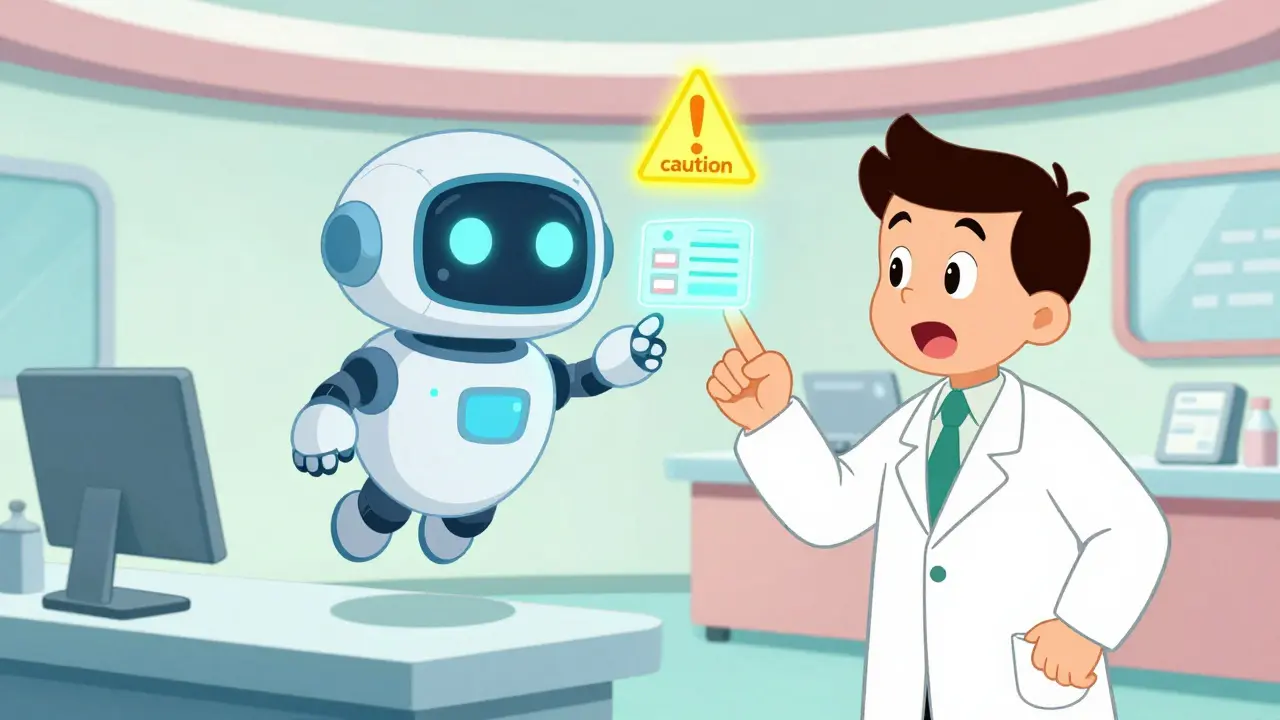
Where do we go from here? The next big leap is Artificial Intelligence. We're moving toward a world where AI doesn't just flag a mistake after it happens but predicts the error before it's made. Analysts predict that by 2027, 65% of safety interventions will use AI for error prediction. Some studies already show a 41% reduction in serious errors when AI-driven clinical decision support is used.
However, we have a human problem: workforce shortages. It's hard to implement a 12-hour training protocol for new safety standards when there's a 14.7% vacancy rate for hospital pharmacists. The technology is ready, but the people are stretched thin. The challenge for 2026 will be integrating these safety layers without burning out the very people tasked with keeping us safe.
What are "high-alert" medications in the ISMP guidelines?
High-alert medications are drugs that bear a heightened risk of causing significant patient harm when used in error. While they are not necessarily more "dangerous" than other drugs in terms of toxicity, the consequences of a mistake (like a dosing error) are much more severe. The ISMP recommends independent double-checks for these specific medications to ensure accuracy.
How does the NIOSH hazardous drugs list affect my local pharmacy?
If your pharmacy handles oncology (cancer) drugs, the NIOSH list dictates how they must store and compound those medications. This includes using specialized ventilation and containment systems (C-PECs) to protect pharmacists and technicians from absorbing toxic chemicals through their skin or by breathing them in.
What is the "Medication Without Harm" campaign?
Launched by the WHO, this is a global initiative aimed at reducing preventable medication-related harm by 50% within five years. It focuses on improving national policies, training healthcare workers, and implementing digital tracking for controlled substances to balance access with safety.
Why are CMS Star Ratings important for medication safety?
CMS uses these ratings to measure the quality of Medicare Part D plans. By tying financial incentives and enrollment to safety measures-such as statin adherence and opioid monitoring-CMS forces insurance plans and pharmacies to implement better patient engagement and monitoring systems.
Will AI actually replace the pharmacist's role in safety?
Not replace, but augment. AI is being used for "predictive prevention," flagging potential drug-drug interactions or dosing errors based on a patient's specific history before the pharmacist even reviews the order. This allows the human pharmacist to focus on complex clinical decisions rather than manual data checking.
Next Steps for Patients and Providers
If you're a patient, the best way to benefit from these new guidelines is to be an active part of your care. Ask your pharmacist: "Do you use a double-check system for high-alert meds?" or "Can we synchronize my refills to make sure I don't miss a dose?"
For healthcare providers, the path forward is phased. Start with "immediate wins" like establishing better patient engagement protocols and updating your high-alert lists. From there, look into the ISMP Implementation Toolkit to transition into medium-term tech upgrades like barcode scanning. The goal isn't to do everything overnight, but to build a system where the human error is caught by a safety net long before it reaches the patient.
![Buy Generic Claritin (Loratadine) Online Cheap: Safe Canadian Deals, Prices & Alternatives [2025]](/uploads/2025/08/thumbnail-buy-generic-claritin-loratadine-online-cheap-safe-canadian-deals-prices-alternatives.webp)