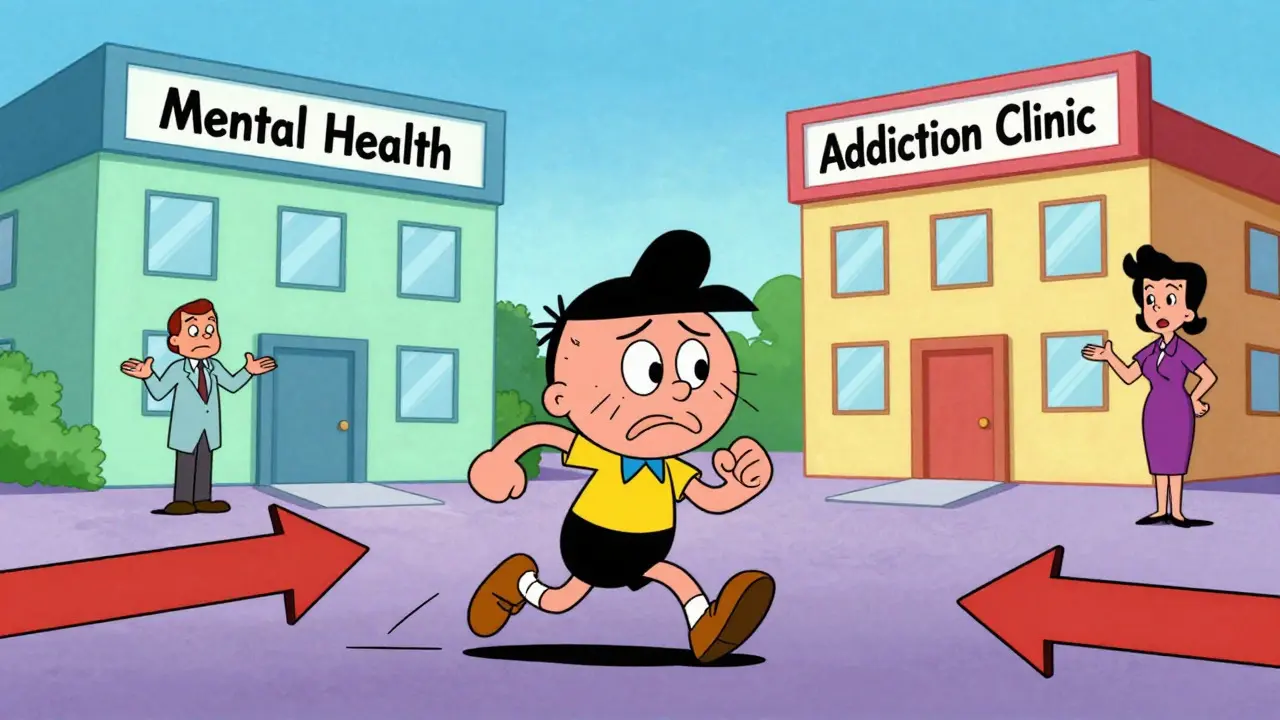
Imagine trying to put out a fire while someone keeps pouring gasoline on it. That is exactly what happens when you treat mental illness and addiction separately. For decades, the healthcare system kept these two conditions in different rooms-literally. You might see a psychiatrist for depression and a counselor for alcohol use, but they rarely talked to each other. The result? Patients bounced between clinics, confused by conflicting advice, often getting worse instead of better.
This fragmented approach is changing. Today, experts agree that Integrated Dual Diagnosis Care is a treatment model where mental health and substance use disorders are treated simultaneously by the same team of providers within a single organization. Also known as Integrated Dual Disorder Treatment (IDDT), this method is now considered the gold standard for people facing both challenges. It stops the cycle of relapse caused by untreated trauma or anxiety and addresses the root causes of addiction alongside the symptoms.
The Reality of Co-Occurring Disorders
You are not alone if you struggle with both a mental health condition and a substance use issue. In fact, it is incredibly common. About half of all people who experience a substance use disorder will also have a mental health disorder at some point in their lives. The reverse is true as well. According to recent data from the Cleveland Clinic, approximately 20.4 million U.S. adults had a dual diagnosis in 2023. That is a massive number of individuals navigating a complex web of symptoms that feed into each other.
Why does this happen? Often, people use drugs or alcohol to self-medicate. If you have severe anxiety, a drink might calm your nerves temporarily. If you are depressed, stimulants might give you a brief lift. But over time, the substance use worsens the mental health condition, creating a vicious loop. Untreated schizophrenia can lead to heavy drug use, and heavy drug use can trigger psychotic episodes. They are intertwined, so treating them in isolation simply doesn't work.
| Feature | Traditional Parallel Treatment | Integrated Dual Diagnosis Care (IDDT) |
|---|---|---|
| Treatment Structure | Separate clinics for mental health and addiction | Single setting, one unified care team |
| Assessment | Screened separately, often missing co-occurring issues | Comprehensive screening for both conditions simultaneously |
| Goal Setting | Often demands immediate abstinence before addressing mental health | Harm reduction focus; accepts gradual progress |
| Patient Experience | Confusing, conflicting messages, high dropout rates | Consistent message, reduced stigma, higher engagement |
| Effectiveness | Clinically proven inefficient and costly | Evidence-based reduction in substance use days |
How Integrated Dual Disorder Treatment (IDDT) Works
The IDDT model was developed in the 1990s by researchers including Dr. Robert Drake at Dartmouth. It was designed specifically to address the failures of parallel treatment. Instead of forcing patients to choose which problem to fix first, IDDT tackles both at once. This isn't just about convenience; it's about biology and psychology. When you stabilize one condition, you create space to heal the other.
The model relies on nine specific evidence-based components. These aren't vague suggestions; they are structured interventions that clinicians are trained to deliver. Here is what that looks like in practice:
- Motivational Interviewing: Rather than lecturing patients, therapists help them find their own reasons for change. This builds internal motivation rather than relying on external pressure.
- Substance Abuse Counseling: Practical strategies to manage cravings, identify triggers, and handle cues that lead to relapse.
- Group Treatment: Peer support groups that address both mental health and addiction issues together, reducing feelings of isolation.
- Family Psychoeducation: Teaching families how to support their loved ones without enabling harmful behaviors.
- Pharmacological Treatment: Using medications carefully to treat mental illness while considering interactions with substances.
- Health Interventions: Addressing physical health needs, which are often neglected in traditional mental health settings.
- Relapse Prevention: Creating concrete plans for what to do when things get tough.
A key feature of IDDT is its harm reduction philosophy. Many traditional programs demand total abstinence on day one. If a patient slips up, they are kicked out. IDDT recognizes that abstinence may not be immediately realistic for everyone. The goal is to reduce harm and improve quality of life, even if some substance use continues initially. This pragmatic approach keeps people engaged in treatment longer, which ultimately leads to better outcomes.

Why Parallel Treatment Fails
To understand why integrated care is necessary, you have to look at why the old way failed. The Substance Abuse and Mental Health Services Administration (SAMHSA) has stated clearly that parallel treatment is "costly, inefficient, and ineffective." Think about the logistics. A patient might need to go to one clinic on Monday for therapy and another on Wednesday for addiction counseling. If those clinics don't communicate, the therapist might encourage coping mechanisms that contradict the addiction counselor's advice.
There is also the issue of gatekeeping. Many mental health clinics would refuse to treat someone who was actively using drugs, telling them to get sober first. Meanwhile, many addiction programs refused to treat people with severe mental illnesses like bipolar disorder or schizophrenia, saying they were too unstable. Patients fell through the cracks, bouncing from door to door until they gave up. SAMHSA reports that despite 6.6% of U.S. adults having co-occurring disorders, only about 6% receive treatment for both. That is a staggering gap.
Sequential treatment-treating one disorder before the other-also falls short. If you treat depression first, the patient might still use alcohol to cope, undermining the medication. If you treat addiction first, the underlying anxiety or trauma remains, leading to rapid relapse. Integrated care eliminates this guesswork by addressing the whole person.
Real-World Effectiveness and Challenges
Does IDDT actually work? The research says yes, but with caveats. A randomized controlled trial published in PubMed involving 154 patients found that after implementing IDDT, there was a statistically significant reduction in the number of days patients used alcohol or drugs. The Washington State Institute for Public Policy reported similar findings, noting reductions in standardized symptoms for both alcohol and illicit drug use disorders.
However, it is not a magic bullet. The same studies noted that improvements in secondary outcomes like overall functioning or therapeutic alliance were less clear. Implementation is hard. Training clinicians to be effective in both mental health and addiction counseling requires significant resources. One study found that a three-day training session did not significantly improve clinicians' skills in motivational interviewing, highlighting the complexity of disseminating this model effectively.
There are also economic challenges. The benefit-cost ratios for IDDT hover around 0.5, meaning the costs of implementation currently exceed the measured financial benefits in some analyses. This makes widespread adoption difficult without government support or insurance reforms. Yet, when you consider the cost of emergency room visits, hospitalizations, and lost productivity associated with untreated dual diagnoses, the long-term value becomes clearer.

What This Means for Patients and Families
If you or a loved one is struggling with both mental illness and addiction, looking for an integrated program should be your top priority. Ask potential providers direct questions: "Do you treat both conditions in the same setting?" "Is the same team handling my care?" "Do you use a harm reduction approach?"
Patient feedback suggests that the biggest benefit of integrated care is simplicity. Consumers report feeling less confused and more supported because they receive one consistent message. They don't have to explain their history twice. They don't feel judged for using substances while seeking mental health help. This reduces the stigma that often drives people away from treatment.
Families also benefit. Family psychoeducation helps relatives understand that addiction is not a moral failing and mental illness is not a character flaw. It equips them with tools to support recovery without burning out. Group treatments provide a community of peers who truly understand the unique struggle of living with dual diagnoses.
The Future of Integrated Care
The trajectory is moving toward integration. Healthcare systems are shifting to value-based payment models that reward keeping patients healthy rather than just treating acute crises. This aligns perfectly with the goals of IDDT. Organizations like SAMHSA continue to push for broader adoption through grants and technical assistance. The Co-Occurring Center of Excellence provides resources to states trying to build infrastructure for integrated services.
Despite progress, barriers remain. Workforce development is critical. We need more clinicians trained in both fields. Financial support for providers must increase to cover the initial costs of reorganizing services. Until then, the gap between those who need care and those who receive it will persist. But for those who find an integrated program, the difference can be life-changing. It offers a path out of the chaos and toward stability, dignity, and recovery.
What is the difference between dual diagnosis and co-occurring disorders?
These terms are often used interchangeably. Both refer to having a mental health condition and a substance use disorder at the same time. "Dual diagnosis" is the older clinical term, while "co-occurring disorders" is preferred today because it emphasizes that the conditions exist together rather than one causing the other exclusively.
Is IDDT covered by insurance?
Coverage varies by provider and plan. Because IDDT is recognized as an evidence-based practice by SAMHSA, many Medicaid and Medicare plans cover integrated services. However, private insurance coverage depends on whether the specific clinic is in-network and if they bill for integrated care codes. Always check with your insurer before starting treatment.
How long does integrated dual diagnosis treatment take?
There is no fixed timeline. Recovery is a long-term process. Some patients see significant improvement in substance use within months, while others require years of ongoing support. IDDT focuses on continuous care rather than short-term fixes, adjusting the intensity of services as the patient's needs change.
Can I get integrated care in outpatient settings?
Yes. While IDDT originated in assertive community treatment teams, the principles apply to outpatient clinics, intensive outpatient programs (IOP), and residential facilities. Look for clinics that explicitly state they offer "integrated" or "dual diagnosis" services rather than separate tracks for mental health and addiction.
What if I am not ready to stop using substances completely?
IDDT is ideal for this situation. Unlike traditional rehab centers that may kick you out for any slip-up, IDDT uses a harm reduction approach. The goal is to reduce negative consequences and improve your overall health, even if you are still using. As your stability improves, you may naturally move toward reduced use or abstinence.