
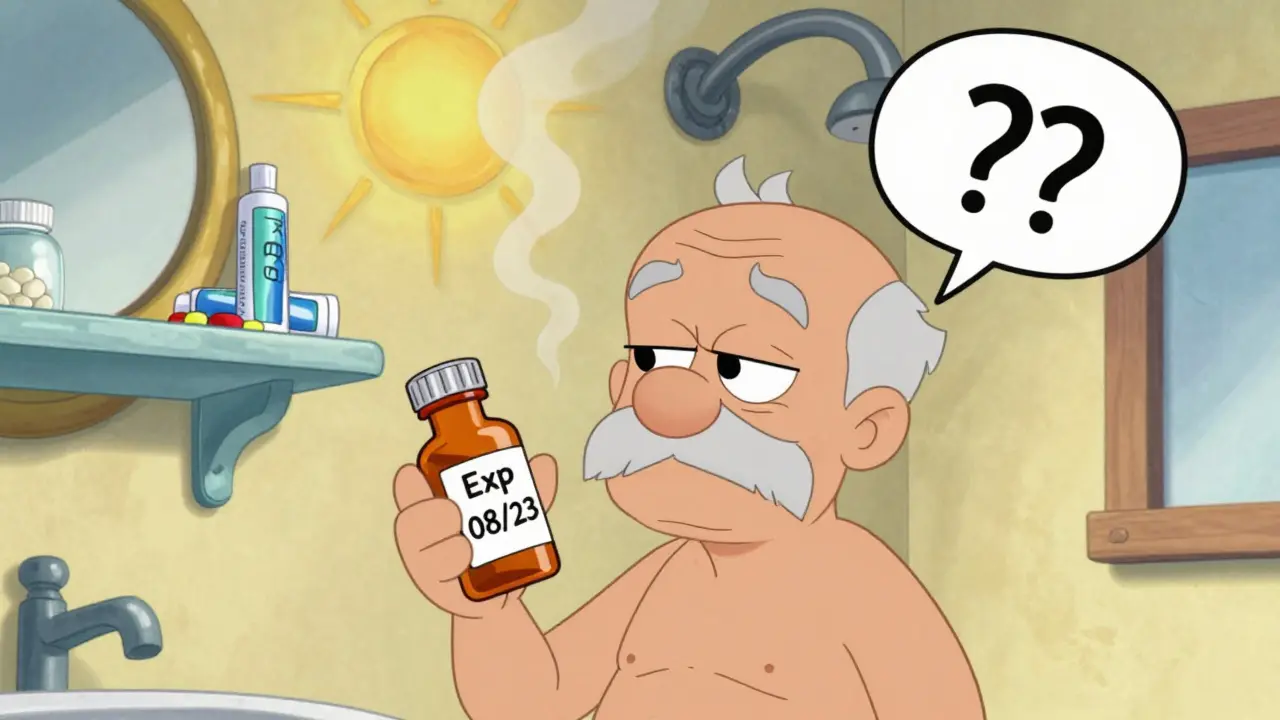
Most people don’t think twice about taking an old pill-until it doesn’t work, or worse, makes them sick. Expiration dates on medication packaging aren’t just bureaucratic footnotes. They’re science-backed deadlines that tell you when a drug is guaranteed to be safe and effective. But if you’ve ever stared at a bottle wondering whether that faint "Exp 08/23" means August 8 or August 31, you’re not alone. Confusion over expiration labels is common, and the stakes are higher than you might think.
What an Expiration Date Actually Means
An expiration date isn’t a "use-by" warning like milk. It’s the last day the manufacturer guarantees the medicine will work as intended and remain safe to use, assuming it’s been stored properly. This isn’t guesswork. Drugmakers run stability tests for months or years under different temperatures, humidity levels, and light conditions. They track how the active ingredients break down over time. The date you see is based on real data-not a random number.
The U.S. Food and Drug Administration (FDA) has required expiration dates on all prescription and over-the-counter drugs since 1979. In Canada, Health Canada enforces similar standards. Most medications are labeled with expiration dates between 1 and 5 years after manufacture. Injections often last 2-5 years. Topical creams and patches? Usually 1-3 years. Eye drops? Shorter-often 6 months to 2 years-because they’re more prone to contamination once opened.
How Expiration Dates Are Shown on Packaging
Look closely. You’ll see different labels depending on the manufacturer and region:
- "Exp" or "Expiration" followed by a date (e.g., Exp 08/23)
- "Use by" or "Use before" (e.g., Use by 12/2025)
- "Expiry Date" with a slash, hyphen, or dot (e.g., 23-08-2025 or 2025.08.23)
If the date only shows a month and year-like "08/23"-it means the drug expires on the last day of that month. So "08/23" expires on August 31, 2023. This rule applies in the U.S., Canada, and most of Europe.
In the European Union, you’ll typically see day/month/year (e.g., 31/08/2023). In China, it’s year/month/day (e.g., 2023/08/31). If you’re unsure, check the format on the original box or bottle. The manufacturer’s label is the most reliable source.
Pharmacy Labels vs. Manufacturer Expiration Dates
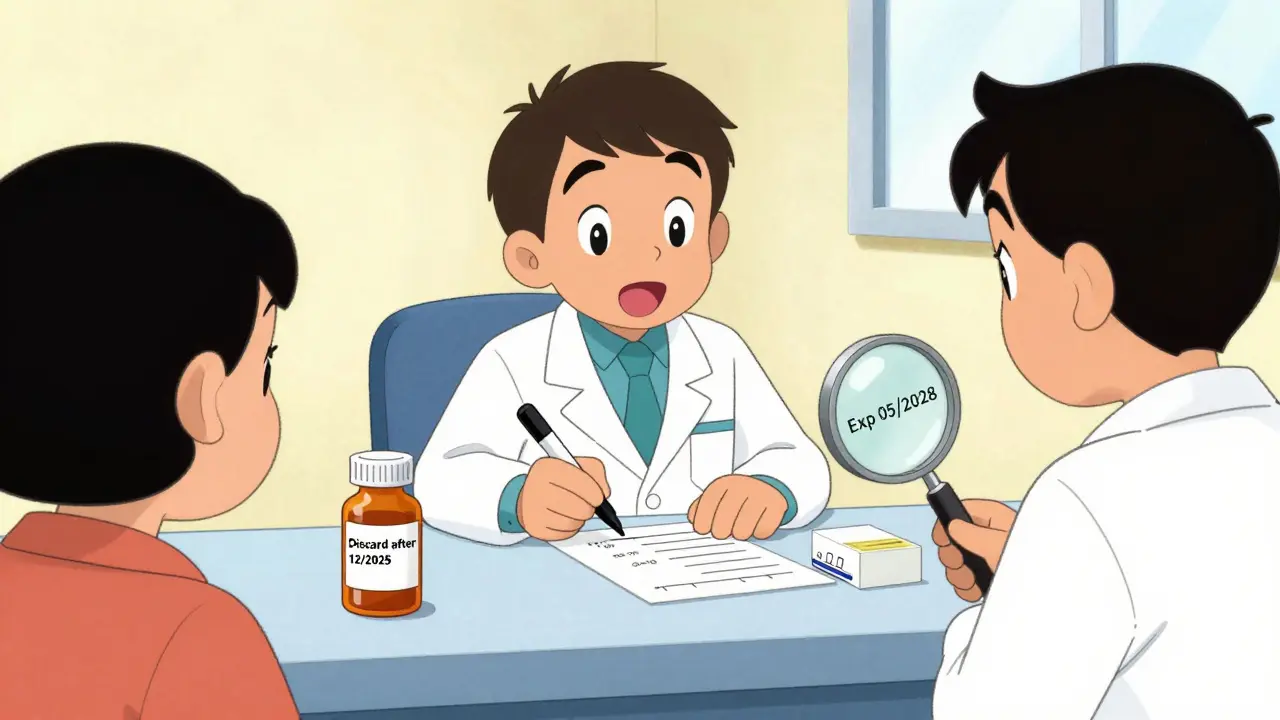
Here’s where things get tricky. When you pick up a prescription, the pharmacy puts its own label on the bottle. That label might say "Discard after 12/2025" or "Do not use after 1 year." That’s not the manufacturer’s expiration date-it’s a beyond-use date.
Why does this exist? Because once a medication leaves the sealed factory package and gets repackaged into a pill bottle, it’s exposed to air, moisture, and handling. Pharmacists set these shorter dates based on safety guidelines. For example:
- Antibiotic suspensions (liquid antibiotics) often have a beyond-use date of just 14 days after mixing.
- Insulin pens may be labeled for 28 days after first use.
- Most other pills? Usually 1 year from dispensing.
But here’s the catch: the original manufacturer’s expiration date might still be years away. If your prescription bottle says "discard after 12/2025" but the box says "Exp 05/2028," which one do you follow? The pharmacy’s label. Always. The pharmacy’s date is the one that matters for your specific bottle.
That’s why it’s smart to ask your pharmacist to write the manufacturer’s expiration date on the bottle too. That way, you know if your pharmacy’s date is shorter than the drug’s true shelf life.
Which Medications Are Dangerous After Expiration?
Most expired pills won’t kill you. But some can. The FDA and Health Canada warn against using certain drugs past their expiration date because of serious risks:
- Insulin: Loses potency quickly. Taking ineffective insulin can lead to dangerously high blood sugar.
- Birth control pills: Reduced hormone levels can cause unintended pregnancy.
- Thyroid medications: Even small drops in potency can throw off your metabolism.
- Anti-platelet drugs like aspirin or clopidogrel: If they don’t work, you’re at higher risk of heart attack or stroke.
- EpiPens: Epinephrine degrades over time. An expired EpiPen might not save your life during anaphylaxis.
There’s one infamous case: tetracycline. Older versions of this antibiotic could break down into toxic compounds. But modern tetracycline doesn’t have this issue. Still, if you find an old bottle from the 1980s? Don’t take it.
For everything else-ibuprofen, antihistamines, acetaminophen-most studies show they remain safe for months or even years past expiration. But they may not work as well. That’s risky too. If an antibiotic doesn’t fully kill an infection, it can lead to drug-resistant bacteria.
How Storage Affects Expiration
Expiration dates assume ideal storage. That means:
- Room temperature (68-77°F or 20-25°C)
- Low humidity
- Out of direct sunlight
- Not in the bathroom or car
But most people store meds in humid bathrooms or hot cars. That speeds up degradation. Heat, moisture, and light break down chemicals faster than time alone. A bottle of pills left in a sunlit medicine cabinet might lose potency in 6 months-even if the expiration date is 3 years away.
Some drugs, like insulin or certain antibiotics, require refrigeration. If you forget to refrigerate them, their shelf life drops dramatically. Always read the storage instructions on the label.
What to Do If You Find an Expired Medicine
Don’t just toss it in the trash. Don’t flush it down the toilet. Here’s what to do:
- Check the date on both the pharmacy label and original packaging.
- If it’s expired, don’t use it-especially if it’s one of the high-risk drugs listed above.
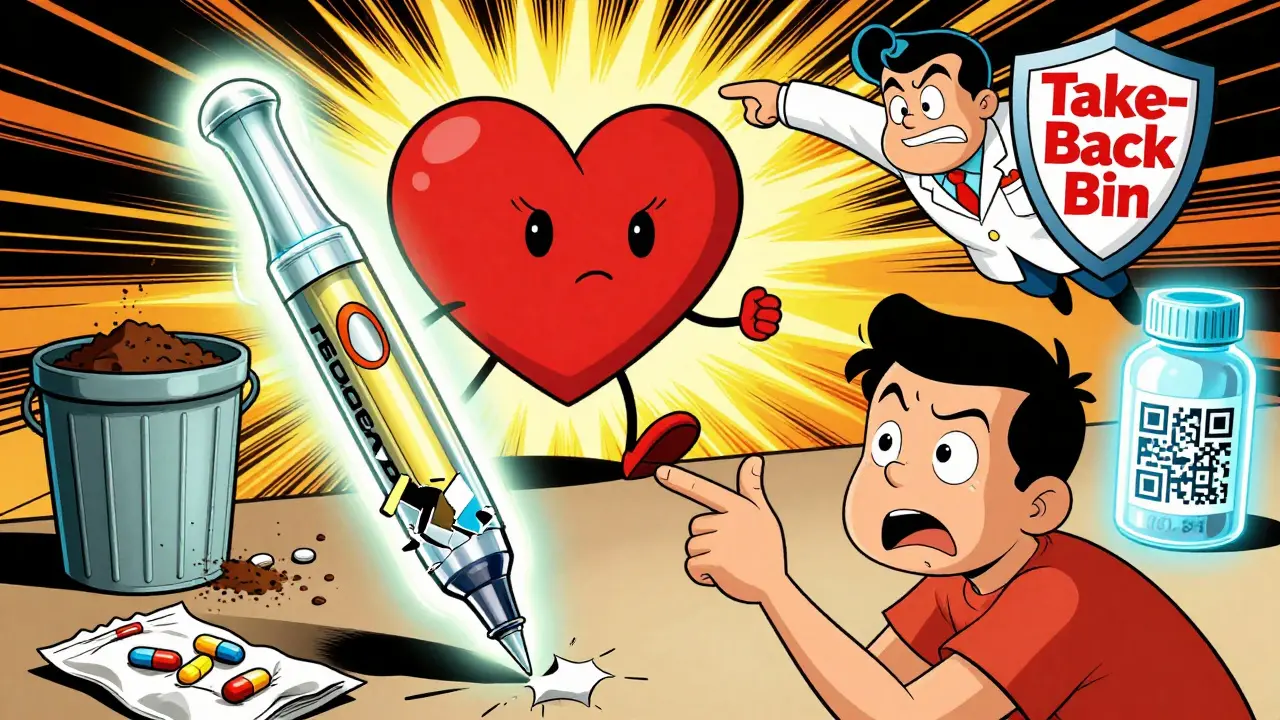
- Look for a drug take-back program. Many pharmacies, hospitals, or police stations offer free disposal bins.
- If no take-back is available, mix pills with coffee grounds or cat litter, seal them in a bag, and throw them in the trash. This keeps kids and pets from finding them.
Keep original packaging if possible. It has the lot number and manufacturer info, which matters if there’s a recall.
How to Avoid Confusion in the Future
Here are simple habits to keep your meds safe:
- Write the expiration date on the bottle with a permanent marker if it’s not clear.
- Use apps like MedSafe or MyTherapy to set reminders for when your meds expire.
- When refilling prescriptions, ask your pharmacist: "Is this the manufacturer’s date, or your beyond-use date?"
- Don’t stockpile old meds. Buy only what you need. Medications expire. You don’t need a 3-year supply of allergy pills.
- Check your medicine cabinet twice a year. Spring and fall are good times to clean it out.
One study found that 68% of elderly patients thought expired meds were immediately dangerous. They’re not. But they’re not reliable either. The goal isn’t fear-it’s awareness.
What’s Changing in the Future
Technology is helping. Some new packaging includes QR codes that link to real-time expiration info. Others use thermochromic ink that changes color if the medicine got too hot. Merck started using smart labels on insulin in late 2022.
The World Health Organization now recommends a global standard: YYYY-MM-DD format. That means no more "08/23" confusion. Everyone will see 2023-08-31. It’s coming-but slowly.
For now, the best defense is simple: know your labels, store your meds right, and when in doubt, ask your pharmacist. They’ve seen it all.
Do all medications expire exactly on the date listed?
No. The expiration date is the last day the manufacturer guarantees full potency and safety under proper storage. Many medications remain stable for months or even years beyond that date, especially if kept cool and dry. But you can’t count on it. The date is a safety line, not a magic cutoff.
Can I still use expired pain relievers like ibuprofen or acetaminophen?
In most cases, yes-if they’ve been stored properly and are only a few months past the date. Studies show these drugs degrade slowly. But if the pills are discolored, crumbly, or smell odd, don’t take them. And never use expired pain meds for serious conditions like heart pain or severe injury. Better safe than sorry.
Why do pharmacies put shorter expiration dates on prescription bottles?
Pharmacies repackage medications from factory containers into smaller bottles. Once opened, exposure to air, light, and moisture can reduce potency faster. The pharmacy’s date is based on safety guidelines for these repackaged forms-not the original sealed product. It’s a conservative estimate to protect you.
Is it dangerous to take expired antibiotics?
Yes. Expired antibiotics may not kill all the bacteria, which can lead to stronger, drug-resistant infections. Even if the pill looks fine, it might be 30% less effective. Never take expired antibiotics for a new infection. Always get a fresh prescription.
What should I do if I accidentally take an expired medication?
If it’s a common pain reliever and you’re healthy, you’re likely fine. Watch for side effects like nausea or dizziness. If it’s insulin, epinephrine, thyroid medicine, or antibiotics, contact your doctor or pharmacist immediately. They’ll advise whether you need to take action. Don’t panic, but don’t ignore it.
Natasha Bhala
February 8, 2026 AT 08:29Ashley Hutchins
February 10, 2026 AT 02:23Jesse Lord
February 11, 2026 AT 00:54AMIT JINDAL
February 12, 2026 AT 11:16Catherine Wybourne
February 13, 2026 AT 15:57Mary Carroll Allen
February 14, 2026 AT 02:25Paula Sa
February 15, 2026 AT 05:16Lakisha Sarbah
February 15, 2026 AT 21:41Marcus Jackson
February 16, 2026 AT 14:03Gouris Patnaik
February 17, 2026 AT 12:21Niel Amstrong Stein
February 18, 2026 AT 11:42Ariel Edmisten
February 18, 2026 AT 16:35