
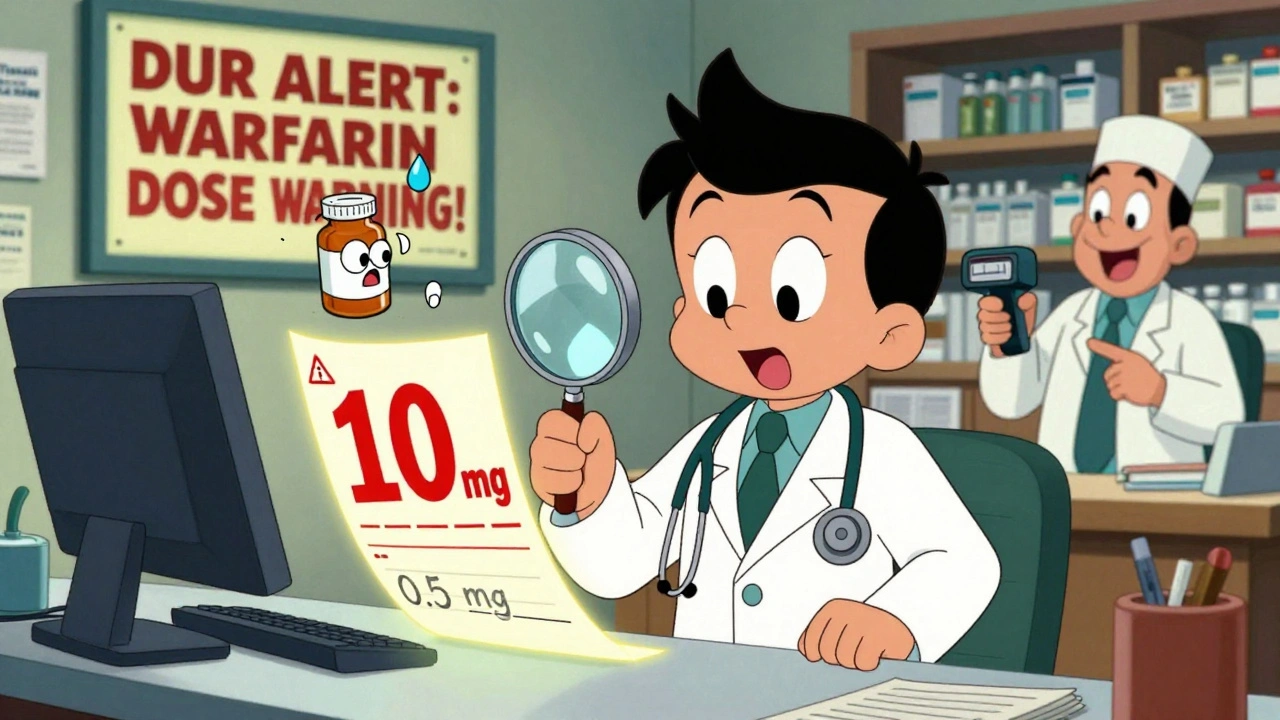
Every year, over 1.5 million people in the U.S. are harmed by medication errors. Many of these mistakes never reach patients-not because the system is perfect, but because pharmacists are standing between the prescription and the patient, catching errors that others miss.
The Final Check Before the Patient Gets the Medicine
Pharmacists aren’t just the people who hand out pills. They’re the last trained professional to review a prescription before it leaves the pharmacy. That means they see things others don’t: a dose that’s ten times too high, a drug that clashes with another the patient is already taking, or a label that doesn’t match the prescription. A 2023 study found that pharmacists prevent about 215,000 medication errors each year in the U.S. alone. That’s not luck. It’s a system built on training, technology, and vigilance.How Pharmacists Catch Errors
Pharmacists use a mix of tools and habits to catch mistakes:- Electronic drug utilization reviews (DUR): These automated systems scan prescriptions for dangerous interactions, allergies, or incorrect dosages. They flag about 85-90% of potential issues-but they’re not perfect. That’s where the pharmacist comes in.
- Double-check systems: In hospitals and many community pharmacies, high-risk medications like insulin, blood thinners, or opioids go through two independent checks. One by a technician, one by the pharmacist. This cuts dispensing errors by 42%.
- Medication reconciliation: When a patient moves from hospital to home, or from one provider to another, their medication list often gets messed up. Pharmacists compare what the patient should be taking with what they are taking, catching an average of 2.3 errors per patient during transitions.
- Barcode scanning: Before handing over a bottle, pharmacists scan both the medication and the patient’s wristband (in hospitals) or ID (in pharmacies). This reduces wrong-patient and wrong-drug errors by 51%.
Technology Helps, But People Still Matter
Computer systems have cut down on handwriting errors and dosage miscalculations. Electronic prescribing has reduced those errors by 95%. But technology alone doesn’t fix everything. A 2021 analysis showed that while computerized order systems catch 17-25% of errors, adding a pharmacist review pushes that number to 45-65%. Why? Because algorithms can’t understand context. They don’t know if a patient is frail, pregnant, or has kidney disease. A pharmacist does. For example, a system might flag a drug interaction between two medications-but if one of them is a low-dose aspirin for heart protection, the pharmacist knows the benefit outweighs the risk. That’s clinical judgment. No algorithm can replace it.Where Errors Come From
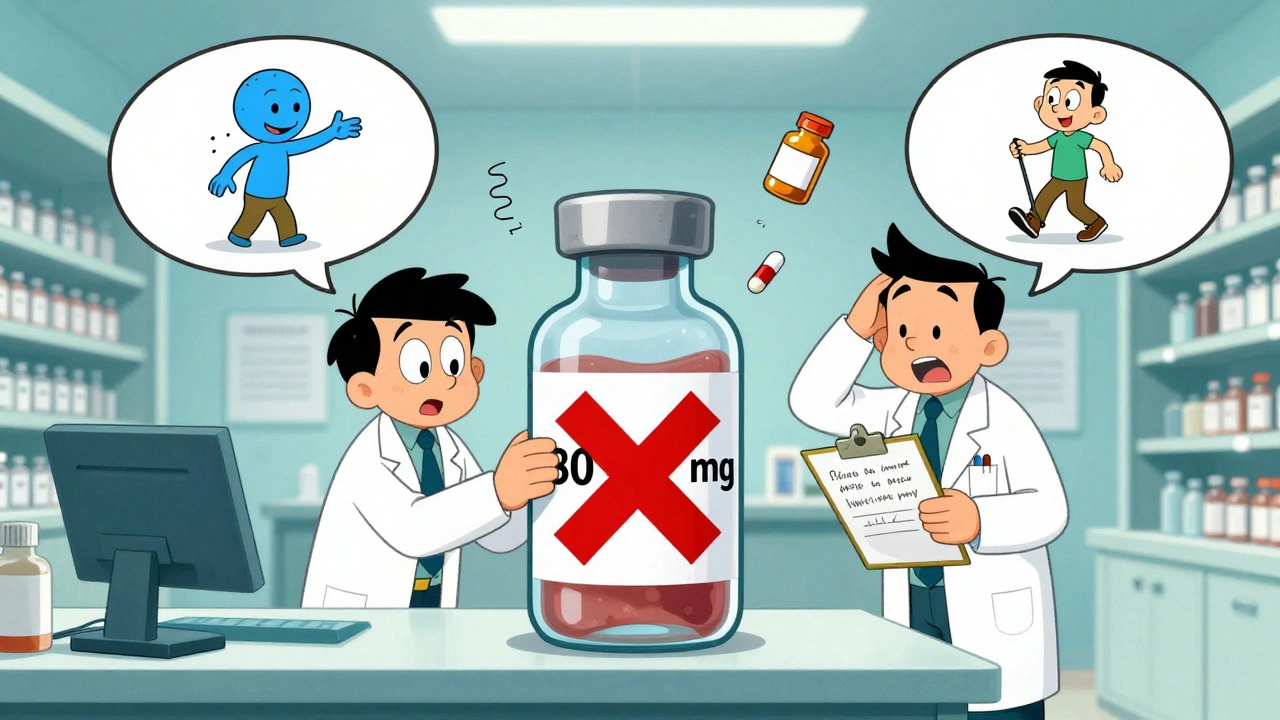
Most people think errors come from pharmacists. But studies show the opposite. In a 2021 study of 861 patients in Tehran, physicians made 49.1% of the errors, nurses made 48.2%, and patients themselves made just 2.7%. That means most mistakes happen long before the prescription reaches the pharmacy. Common errors pharmacists catch:- Wrong dose (e.g., 10 mg instead of 1 mg)
- Wrong drug (e.g., metformin instead of metoprolol-sound-alike names)
- Drug allergies the prescriber missed
- Drug interactions (e.g., mixing blood thinners with NSAIDs)
- Expired or incorrect formulations (e.g., extended-release pills dispensed as immediate-release)
Real Stories, Real Saves
One patient left a review on Yelp in June 2023 describing how their pharmacist caught a 10-fold overdose on warfarin. The prescription read “5 mg,” but the prescriber had meant “0.5 mg.” That mistake would have caused life-threatening bleeding within days. The pharmacist noticed the discrepancy because the patient’s INR levels were stable on a lower dose. She called the doctor, confirmed the error, and saved the patient’s life. On Reddit, a pharmacy technician shared that they catch 3-4 potentially serious errors per week before they even reach the pharmacist. One week, they spotted a prescription for “Lisinopril 80 mg”-a dose that’s rarely used and not FDA-approved for most patients. The technician flagged it, the pharmacist confirmed it was wrong, and the prescriber admitted they’d typed it by accident.The Hidden Costs of Errors-and How Pharmacists Save Money
Medication errors don’t just hurt patients. They cost the system billions. Each prevented error saves an estimated $13,847 in healthcare costs, according to the American Journal of Health-System Pharmacy. That adds up to $2.7 billion saved annually in the U.S. because pharmacists are doing their job. In hospitals, pharmacist-led interventions reduce readmissions by 20% and shorten hospital stays. In community pharmacies, they prevent emergency room visits from adverse drug reactions. These aren’t abstract numbers-they’re real dollars saved, lives improved, and families spared from trauma.Where the System Falls Short
Pharmacists aren’t superheroes. They’re overworked. In community pharmacies, some pharmacists handle 200-300 prescriptions a day. That’s one every 2-3 minutes. When you’re rushing, even the best-trained person can miss something. A 2022 study found that pharmacists override nearly half of all drug interaction alerts because they’re too noisy. If the system flags every minor interaction, you start ignoring them. That’s called alert fatigue. Newer systems are fixing this by using tiered alerts: high-risk interactions (like warfarin and antibiotics) get loud, urgent flags. Low-risk ones fade into the background. This cuts override rates from 49% to 28%. Another problem? Documentation. Hospitals have good systems for logging errors. Independent pharmacies? Not so much. Only 2.8 out of 5 on a reporting scale, according to Pharmacy Times. That means many errors go unreported-and unlearned from.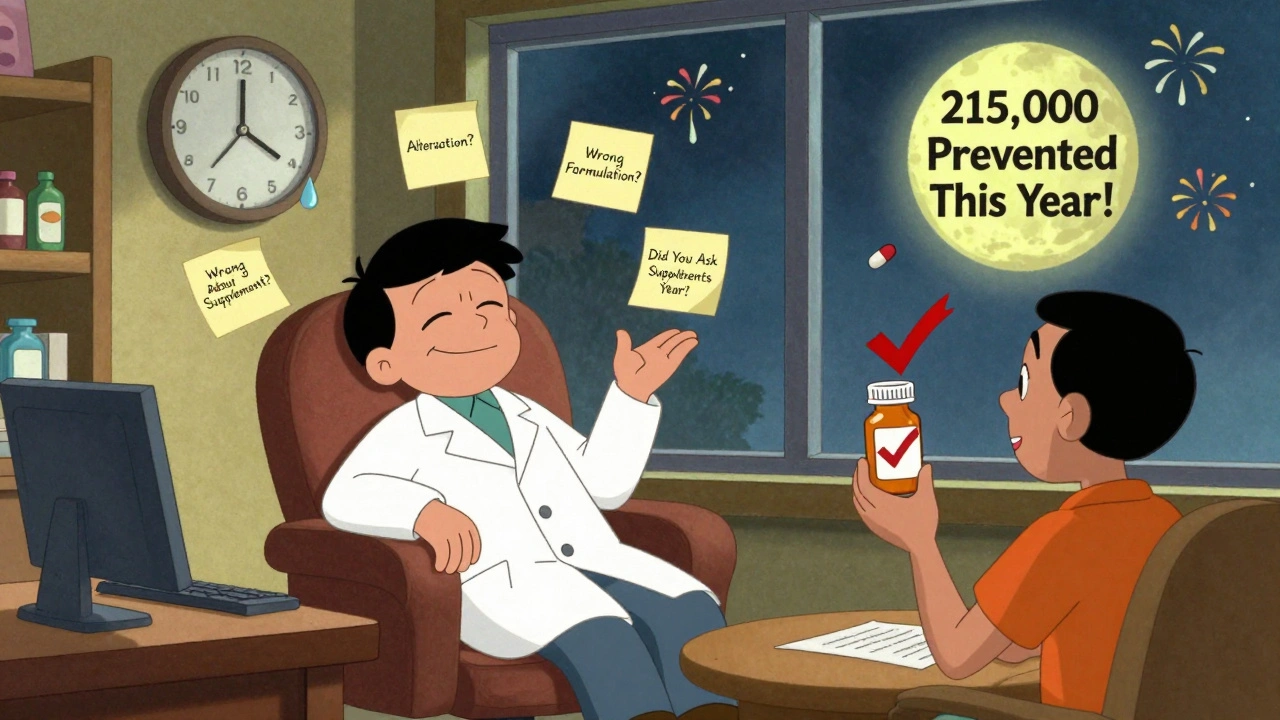
What Makes a Great Medication Safety Pharmacist
It’s not just about knowing drugs. It’s about:- Attention to detail: Spotting a decimal point out of place.
- Therapeutic knowledge: Knowing when a dose is too high, even if it’s technically within the range.
- Communication: Calling a doctor to clarify a prescription isn’t a failure-it’s part of the job.
- Time: The ASHP recommends 15-20 minutes per complex regimen review. Few pharmacies give that time.
The Future: More Responsibility, Better Tools
Pharmacists are no longer just dispensers. They’re becoming active members of care teams. By 2023, 68% of U.S. hospitals had pharmacists leading medication safety committees. Twenty-seven states now let pharmacists adjust medications under collaborative agreements-without needing a doctor’s signature every time. New AI tools are helping. One NIH-backed system uses artificial intelligence to flag the highest-risk prescriptions, reducing the pharmacist’s workload by 35% while keeping error detection at 98% accuracy. Analysts predict a 22% increase in dedicated medication safety pharmacist roles by 2026. But there’s a catch: the U.S. is projected to face a shortage of 15,000 pharmacists by 2025. Without more staff, even the best systems won’t be enough.What Patients Can Do
You don’t have to rely only on the pharmacist. You can help:- Keep a current list of all your medications-including supplements and over-the-counter drugs-and bring it to every appointment.
- Ask: “Is this the right dose? Is this safe with my other meds?”
- Check the label when you pick up your prescription. Does it match what your doctor told you?
- If something seems off, speak up. Pharmacists want you to.
Why This Matters
Medication errors are preventable. But they won’t disappear unless we recognize pharmacists for what they are: essential safety engineers in healthcare. They don’t just count pills. They interpret science, protect lives, and save money. And when they’re supported-with time, tools, and staffing-they prevent far more than they miss. The next time you get a prescription filled, remember: someone with years of training just stopped a mistake that could have hurt you. That’s not routine. That’s lifesaving work.How often do pharmacists catch medication errors?
Pharmacists prevent an estimated 215,000 medication errors each year in the U.S. Studies show they intercept about 1 in 4 potentially harmful errors that would otherwise reach patients. In hospitals, they catch an average of 2.3 medication discrepancies per patient during transitions like hospital discharge.
What types of errors do pharmacists catch?
Pharmacists catch wrong doses, incorrect drugs (especially sound-alike names like metformin and metoprolol), drug allergies missed by prescribers, dangerous interactions (like blood thinners with NSAIDs), expired medications, and wrong formulations (e.g., extended-release instead of immediate-release). They also spot errors from transcription, handwriting, or electronic system glitches.
Can technology replace pharmacists in catching errors?
No. While electronic systems reduce errors by 17-25%, adding pharmacist review increases detection to 45-65%. Algorithms can’t assess individual patient needs-like kidney function, pregnancy, or frailty. Only a trained pharmacist can weigh risks and benefits in context.
Do pharmacy technicians help prevent errors?
Yes. Pharmacy technicians act as the first line of defense. In double-check systems, they catch 78% of dispensing errors before the pharmacist reviews them. They verify National Drug Codes, check for confusing labels, and flag illegible handwriting-freeing pharmacists to focus on complex clinical decisions.
Why do some errors still get through?
Workflow pressure is the biggest factor. Pharmacists in community pharmacies may process 200-300 prescriptions a day, leaving little time for deep review. Alert fatigue from too many system warnings also causes pharmacists to overlook real risks. Staffing shortages and poor documentation systems further increase the chance of missed errors.

aditya dixit
December 5, 2025 AT 10:32It's fascinating how pharmacists operate as the silent guardians of the healthcare system. They don't get applause, but they're the ones catching the 10-fold overdose before it kills someone. I think we've normalized their presence so much that we forget they're the final firewall between a typo and a tragedy.
It’s not just about accuracy-it’s about context. An algorithm sees two drugs and flags interaction. A pharmacist sees a 78-year-old with kidney disease and knows the interaction is irrelevant because the patient hasn’t taken one of those drugs in years. That’s wisdom, not just training.
And yet, we treat them like glorified cashiers. 300 scripts a day? No human brain should be expected to maintain that level of vigilance under that pressure. It’s not sustainable. It’s not ethical. It’s just capitalism masquerading as healthcare.
I’ve seen pharmacists cry in the back room because they missed something. Not because they were careless-but because the system forced them to move too fast. We need to fund them like the clinical professionals they are, not like warehouse stock clerks.
When we finally give them the time, the staffing, and the respect, we’ll see a drop in ER visits, hospital readmissions, and preventable deaths. But we won’t do it until someone we love gets hurt. And that’s the real tragedy.
Lynette Myles
December 5, 2025 AT 20:27Pharmacists don’t catch errors-they’re paid to look busy while Big Pharma pushes dangerous drugs through.
Jimmy Jude
December 6, 2025 AT 04:22Let’s be real-this whole ‘pharmacist as hero’ narrative is just corporate PR. You think they’re saving lives? Nah. They’re just the last cog in a machine designed to profit off your suffering.
Remember when CVS started charging $15 for a flu shot? That’s not healthcare-that’s a subscription to anxiety. And now they want you to believe they’re saints because they caught a wrong dose once? Please.
Meanwhile, the same people who ‘prevent’ errors are the ones who hand out 90-day supplies of opioids to people who clearly shouldn’t have them. Double standards? More like double fraud.
Don’t glorify the system. Burn it down and start over. We don’t need more pharmacists-we need less pharmaceuticals.
Chris Brown
December 7, 2025 AT 21:18While it is commendable that pharmacists serve as a final check in the medication dispensing process, one must not overlook the structural deficiencies inherent in the current healthcare paradigm. The reliance upon individual human vigilance, rather than systemic redesign, is an epistemological failure.
The assertion that pharmacists prevent 215,000 errors annually is statistically misleading unless one accounts for the volume of prescriptions processed. A 0.01% error rate may appear impressive, but when scaled to 4 billion annual prescriptions, it becomes an indictment of the entire chain.
Furthermore, the notion that pharmacists are ‘essential safety engineers’ conflates remediation with prevention. True safety engineering eliminates risk at the source-not compensates for it at the endpoint.
Until prescriber accountability is enforced with the same rigor as dispensary protocols, we are merely rearranging deck chairs on the Titanic.
Carole Nkosi
December 8, 2025 AT 17:36You people are delusional if you think pharmacists are heroes. They’re just middlemen in a death machine. Every pill they hand out is a step toward dependency. Every ‘error’ they catch? That’s just the system’s way of keeping you alive long enough to keep buying more drugs.
Look at the stats-2.7 billion saved? That’s not saving lives, that’s saving Big Pharma’s bottom line. They don’t want you healthy-they want you medicated. Forever.
And don’t get me started on ‘medication reconciliation.’ That’s just a fancy term for ‘we’re too lazy to keep your records straight, so now we make the pharmacist fix our mess.’
Wake up. The system is rigged. And pharmacists? They’re just the smiling faces on the conveyor belt.
Mellissa Landrum
December 9, 2025 AT 05:09pharmacists my ass. they just scan barcodes and say 'you're good' while the real errors happen in the docs office. i got my kid's amoxicillin dose wrong once and the pharmacist didn't even blink. they're just there to make money. #pharmacistsofinstagram
Mark Curry
December 11, 2025 AT 02:52Yeah, I’ve seen my pharmacist catch stuff before. Once I picked up my blood pressure med and the label said 20mg, but my doctor wrote 10. She called him right away.
It’s nice when people care. But they’re stretched so thin. I feel bad for them.
Maybe we should just give them more time. And pay them more. They’re doing the work no one else wants to do.
:)
Manish Shankar
December 12, 2025 AT 00:20It is with profound respect that I acknowledge the indispensable role of pharmacists in safeguarding public health. Their meticulous attention to detail, coupled with extensive clinical knowledge, constitutes a critical bulwark against medical negligence.
However, it is imperative that institutional frameworks evolve to alleviate the unsustainable workload imposed upon them. The current paradigm, wherein one professional is expected to process upwards of three hundred prescriptions daily, is not only inefficient but ethically indefensible.
It is my fervent hope that policy-makers will recognize pharmacists not as dispensers of commodities, but as integral members of the therapeutic team-entitled to adequate resources, time, and professional autonomy.
May their diligence be honored not merely in anecdote, but in systemic reform.
luke newton
December 12, 2025 AT 18:05So now we’re turning pharmacists into saints because they do their job? What about the doctors who write illegible scripts? Or the EHR systems that auto-fill the wrong drug? Or the insurance companies that force generic substitutions without checking interactions?
You’re blaming the pharmacist for fixing the mess everyone else made. That’s not heroism-that’s damage control.
And don’t get me started on how they’re forced to override 50% of alerts just to get through the day. That’s not vigilance-that’s burnout with a white coat.
Stop romanticizing broken systems. Fix the源头. Don’t make the pharmacist the scapegoat for your laziness.
an mo
December 12, 2025 AT 18:09Let’s deconstruct the metrics. The 215,000 prevented errors figure is derived from extrapolated intercept rates across a fragmented, under-resourced network of community and hospital pharmacies. It’s a projection, not a census.
Furthermore, the 45-65% detection rate with pharmacist involvement is confounded by selection bias-pharmacists are more likely to review high-risk scripts, which skews the success rate upward.
And while the $13,847 per error saved is cited, it excludes downstream litigation, long-term disability, and caregiver burden-costs rarely captured in pharmacoeconomic models.
The real issue? The system is designed to externalize risk onto frontline clinicians. The algorithm flags. The technician verifies. The pharmacist absorbs the cognitive load. The patient pays. The corporation profits.
This isn’t safety. It’s triage under capitalism.