

When a generic drug hits the market, it doesn’t mean the work is done. In fact, the real challenge often begins after approval. Generic manufacturers can’t just keep making the drug the same way forever. If they change how it’s made-whether it’s the equipment, the factory, the process, or even the raw materials-they have to prove to the FDA that the drug is still safe, effective, and identical to the brand-name version. This isn’t paperwork for paperwork’s sake. It’s a legal and scientific requirement. And if you get it wrong, the drug gets pulled from shelves, patients lose access, and the company loses millions.
Why Does the FDA Care About Manufacturing Changes?
The FDA doesn’t approve a generic drug because it’s cheap. They approve it because it’s the same as the brand-name drug in every way that matters: active ingredient, strength, dosage form, route of administration, and, most importantly, how the body absorbs it. That’s called bioequivalence. But here’s the catch: two versions of the same drug can look identical on paper but behave differently in the body if the manufacturing process changes.
For example, if a tablet is pressed harder or at a different temperature, the way it dissolves in your stomach can change. That affects how fast the medicine enters your bloodstream. A 10% difference in absorption might be harmless for an allergy pill-but it could be dangerous for a blood thinner or an epilepsy medication. That’s why the FDA treats manufacturing changes like a switch. Flip it, and you have to prove nothing changed in the outcome.
What Kind of Changes Trigger Re-Evaluation?
Not every tweak needs FDA approval. But some do-and they fall into three clear buckets:
- Prior Approval Supplements (PAS): These are the big ones. You can’t make the change until the FDA says yes. This includes switching to a new factory, changing the synthetic route of the active ingredient, or scaling up production by more than 50%. If you’re moving from batch manufacturing to continuous manufacturing (a newer, faster method), that’s a PAS.
- Changes Being Effected (CBE): You can make these changes right away-but you still have to tell the FDA within 30 days. This applies to minor adjustments like swapping out a supplier for a similar excipient (inactive ingredient) or updating a test method with better equipment.
- Annual Reports (AR): These are the smallest changes. You log them in your yearly report. Think: updating a label, changing the packaging material, or minor adjustments to cleaning procedures.
According to FDA data from 2018 to 2022, manufacturing process changes made up nearly 16% of all post-approval submissions-and over half of those were classified as PAS. That’s not small. A single PAS can take 10 to 14 months to get approved. And if the FDA asks for more data? That clock resets.
What Makes a Change a PAS?
Here’s what typically forces a PAS submission:
- Changing the drug substance manufacturer or synthesis route
- Moving production to a new facility (even if it’s the same company)
- Increasing batch size by more than 50%
- Switching from one type of tablet press to another that changes compression force or speed
- Adding a new impurity control or changing specification limits for impurities
- Modifying the drug product formulation (e.g., changing a binder or coating)
For complex drugs-like peptides, injectables, or inhalers-the rules are even stricter. The FDA requires that any new impurity in a peptide drug must be under 0.5% and must be shown to have no effect on safety. That’s not guesswork. It requires detailed analytical studies, stability data over 6-12 months, and sometimes even new bioequivalence trials.
One company in 2022 tried to scale up a solid oral tablet from 5 million to 7 million units per batch. They thought it was just a bigger machine. The FDA required 6 months of stability data, full process validation, and 12 pre-submission meetings. Approval took 14 months.
Why Do Some Changes Take So Long?
It’s not just bureaucracy. It’s science.
For every PAS, the FDA expects:
- Comparative analytical data showing pre- and post-change products are identical
- Stability studies proving the drug won’t degrade faster or slower
- Process validation records showing the new method is consistent and controlled
- Facility inspection readiness (the FDA can show up anytime)
- Proof the change doesn’t affect bioequivalence
And here’s the kicker: 68.4% of PAS submissions in 2023 received at least one complete response letter-meaning the FDA asked for more data. The most common reasons? Analytical method changes (28.7%), facility transfers (24.5%), and formulation tweaks (19.3%).
Small manufacturers get hit hardest. Companies with fewer than five generic products report review times 43% longer than big players. Why? They lack the in-house regulatory teams, the history with the FDA, and the resources to pre-emptively answer questions before submission.
How Can Manufacturers Avoid Long Delays?
The smartest companies don’t wait for a change to happen. They plan for it during initial development.
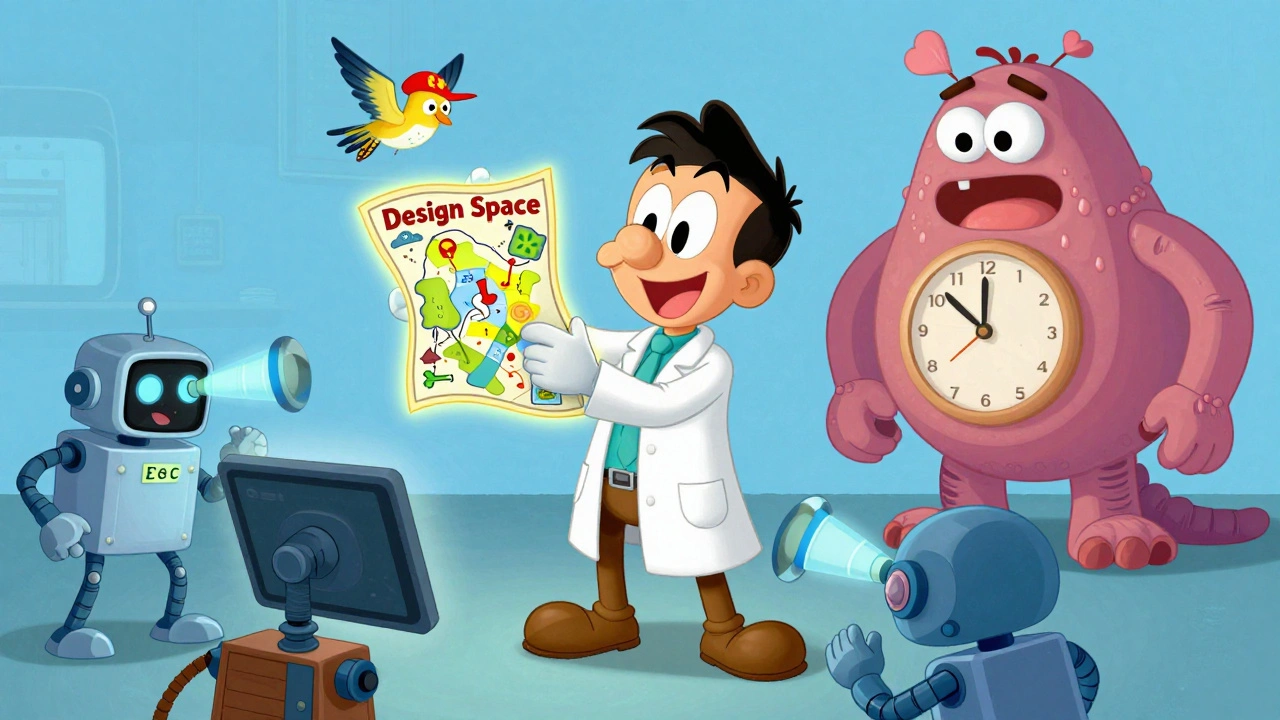
Quality by Design (QbD) isn’t just a buzzword. It’s a strategy. If you map out how every variable-temperature, pressure, mixing time-affects the final product during development, you build a “design space.” That means future changes within that space don’t require a PAS. You’ve already proven the drug works under those conditions.
Companies using Process Analytical Technology (PAT)-real-time sensors that monitor production-reported 32.6% fewer PAS submissions over five years. Why? They catch problems before they happen. One plant in New Jersey uses infrared sensors to track tablet hardness during production. If a batch drifts, the system adjusts automatically. No recall. No PAS.
Pre-submission meetings with the FDA also help. The agency recommends 3-5 of these for complex changes. It’s not a formality. It’s a chance to get feedback before spending $200,000 on studies that might be rejected.

The Cost of Change
A single PAS submission can cost $287,500 on average. That’s not the FDA fee-it’s the cost of studies, validation, staffing, and delays. For a low-margin generic drug selling for pennies per pill, that’s a hard sell to shareholders.
That’s why many companies avoid improvements altogether. One quality manager on Reddit described a tablet press upgrade that took 18 months to approve-even though the final product met all specs. The company decided not to upgrade again.
But the tide is turning. In September 2023, the FDA launched the ANDA Prioritization Pilot Program. If you make your drug in the U.S., use U.S.-sourced active ingredients, and do bioequivalence testing here, your review can be cut from 30 months to as little as 8 months. The goal? Incentivize $4.2 billion in U.S. manufacturing investment by 2027.
Companies like Teva have already seen results. Their continuous manufacturing line for amlodipine got approved in 8 months-half the usual time-thanks to early FDA collaboration and complete data packages.
What’s Coming Next?
The FDA is working on new guidance for complex generics, expected in 2025. It could reduce PAS requirements for minor changes by up to 35%. There’s also the PreCheck program, which fast-tracks facility inspections. Instead of waiting 18 months for a facility transfer, companies might get approval in 9 months.
And GDUFA IV-the next round of user fee negotiations-could bring standardized rules across FDA review divisions. Right now, one division might call a change a CBE, while another says it’s a PAS. That inconsistency is a nightmare for manufacturers.
Long-term, McKinsey projects that by 2030, companies using advanced manufacturing could save $8.7 billion annually in lost revenue from delays. The message is clear: invest in better processes now, or pay more later.
Bottom Line
Manufacturing changes aren’t optional in the generic drug world. They’re inevitable. But they don’t have to be a nightmare. The key is understanding the rules before you change anything. Know your change type. Document everything. Talk to the FDA early. Build quality into the process from day one.
Because when a patient takes a generic pill, they shouldn’t have to wonder if the company changed how it was made. They should trust it’s the same-every time. And that trust? It’s built in the lab, not the courtroom.
What triggers a Prior Approval Supplement (PAS) for a generic drug?
A PAS is triggered by changes that could affect the drug’s safety, effectiveness, or quality. This includes switching manufacturing facilities, changing the synthesis route of the active ingredient, scaling up production by more than 50%, modifying the drug formulation, or introducing new impurity controls. Any change that falls outside the FDA’s predefined "design space" requires a PAS and FDA approval before implementation.
Can a generic drug manufacturer change its supplier without FDA approval?
It depends. If the new supplier provides the same active ingredient or excipient with identical specifications and quality attributes, it may qualify as a Changes Being Effected (CBE-30) submission-you can make the change and notify the FDA within 30 days. But if the new material has different properties (e.g., particle size, moisture content, purity), it likely requires a Prior Approval Supplement (PAS). Always conduct comparative testing first.
How long does FDA approval take for a manufacturing change?
Review times vary by change type. A Prior Approval Supplement (PAS) typically takes 10-14 months. CBE-30 changes require 30 days’ notice after implementation, and CBE-0 changes can be made immediately with annual reporting. Under the FDA’s new Prioritization Pilot Program, qualifying U.S.-manufactured generics can be approved in as little as 8 months.
Why do some generic drug manufacturers avoid making manufacturing improvements?
The cost and time involved are major barriers. A single PAS can cost over $287,500 and take over a year to approve. For low-margin generics, the financial return on process improvements often doesn’t justify the regulatory burden. Many companies choose to stick with older, proven methods-even if they’re less efficient-to avoid delays and uncertainty.
Does the FDA inspect facilities before approving a manufacturing change?
Yes, especially for PAS submissions involving new facilities or major process changes. The FDA can and does conduct pre-approval inspections. In fact, 41.7% of manufacturers report unexpected inspections as a major challenge. Being inspection-ready-meaning your documentation, training records, and equipment logs are complete-is critical to avoiding delays.
What is Quality by Design (QbD) and how does it help with manufacturing changes?
Quality by Design (QbD) is a systematic approach to development that identifies how process variables affect product quality. By mapping out a "design space" during initial ANDA development, manufacturers can make future changes within that space without needing a PAS. For example, if you prove a tablet’s dissolution rate stays consistent between 40-60 psi compression pressure, you can adjust the press within that range without FDA re-approval.
Are there any FDA programs to speed up approval for manufacturing changes?
Yes. The ANDA Prioritization Pilot Program (launched September 2023) accelerates review for generics made entirely in the U.S. with U.S.-sourced active ingredients. The PreCheck program (announced February 2024) offers a two-phase facility inspection process that can cut approval time for facility transfers from 18 months to 9 months. Both are designed to reduce supply chain risks and encourage domestic manufacturing.
Manufacturing changes aren’t the enemy of generic drugs-they’re the engine of improvement. But only if you know how to navigate the system.


David Palmer
December 10, 2025 AT 19:17Michaux Hyatt
December 11, 2025 AT 21:30Aileen Ferris
December 13, 2025 AT 10:30Regan Mears
December 15, 2025 AT 03:08Ben Greening
December 16, 2025 AT 08:31Neelam Kumari
December 17, 2025 AT 02:46Queenie Chan
December 17, 2025 AT 18:36Stephanie Maillet
December 19, 2025 AT 01:12Doris Lee
December 19, 2025 AT 14:14Nikki Smellie
December 21, 2025 AT 10:26Michelle Edwards
December 23, 2025 AT 05:36Sarah Clifford
December 25, 2025 AT 04:13