
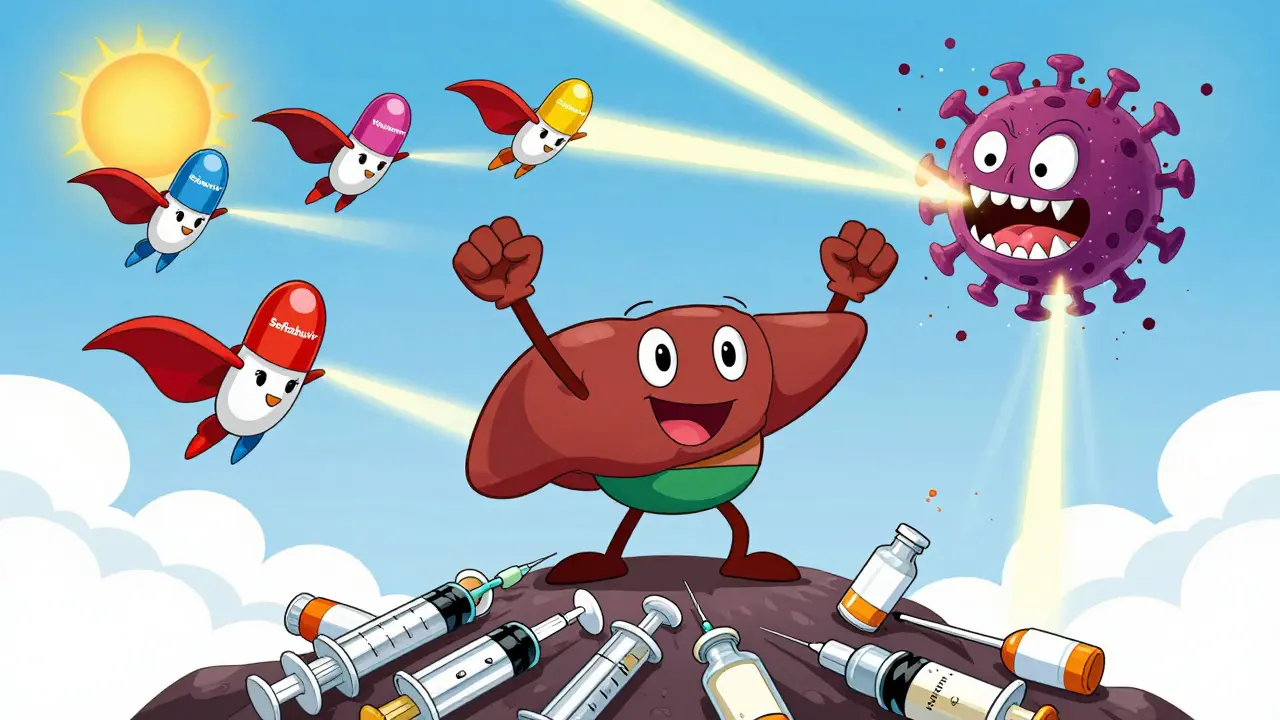
For decades, chronic hepatitis C was a silent, slow-moving threat. Many people carried the virus for years without symptoms, only to wake up one day with cirrhosis, liver cancer, or the need for a transplant. The old treatments? Brutal. Injections of interferon, weeks of nausea, crushing fatigue, depression, and still no guarantee you’d be cured. But that’s not the story anymore.
Today, hepatitis C is curable - and it’s simpler than ever
Since 2014, direct-acting antivirals (DAAs) have completely changed the game. These are oral pills, taken once a day, for just 8 to 12 weeks. No shots. No hospital visits. No debilitating side effects. More than 95% of people who finish the course are cured. That’s not a hopeful statistic - it’s the standard. The hepatitis C cure is now a reality for nearly everyone who gets treated.
These pills don’t just suppress the virus. They wipe it out. Completely. Once the virus is gone, your liver stops getting damaged. The inflammation fades. Scar tissue can actually begin to reverse. Studies show that within five years of being cured, 70% of patients see measurable improvement in liver stiffness and fibrosis. For many, it’s like hitting a reset button on their liver health.
How do these antivirals actually work?
Hepatitis C is a virus that hijacks liver cells to make copies of itself. DAAs block specific parts of that process. Think of it like cutting three different wires in a bomb - each drug targets a different step.
- NS5B polymerase inhibitors (like sofosbuvir) stop the virus from copying its RNA.
- NS5A inhibitors (like velpatasvir, pibrentasvir) prevent the virus from assembling new particles.
- NS3/4A protease inhibitors (like glecaprevir) block the virus from cutting its proteins into usable pieces.
Modern treatments combine two or three of these drugs into one pill. That’s why regimens like Epclusa (sofosbuvir/velpatasvir) and Mavyret (glecaprevir/pibrentasvir) work against all six major strains of hepatitis C - no need to test your genotype anymore. The WHO and CDC now recommend these as first-line options for nearly every patient, including children as young as three.
Your liver doesn’t just survive - it heals
One of the most powerful outcomes of curing hepatitis C isn’t just the absence of the virus. It’s what happens to your liver afterward.
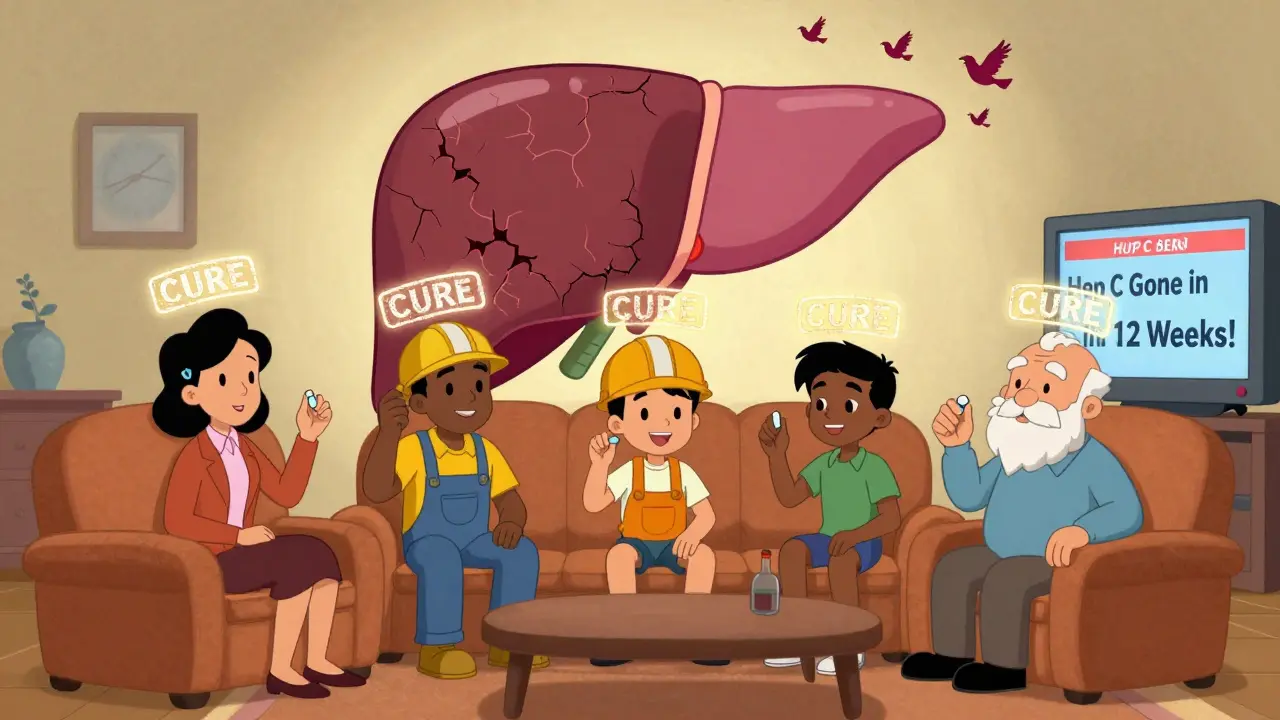
Before DAAs, once cirrhosis set in, the damage was considered permanent. Now, we know that’s not true. After successful treatment, liver fibrosis stops progressing in 95% of cases. In 70% of patients, the liver’s scar tissue begins to break down and remodel itself. That’s not theory - it’s seen in liver scans and biopsies across multiple studies from Mayo Clinic, CDC, and clinical trials worldwide.
For people who already had advanced scarring, the risk of liver failure drops by 75%. The chance of developing liver cancer falls by 70%. Even those who’ve had a liver transplant can now be cured with DAAs - and their survival rates after transplant have jumped from 25% with old treatments to 94% today.
One man in Vancouver, cured in 2021, told his doctor: "I finally feel like I can plan for the future. I’m dating again. I want to adopt. I didn’t think I’d ever get to that point." That’s not just physical healing. It’s emotional and social restoration.
What about side effects? Are these pills safe?
Compared to interferon? They’re like a vacation. Most people feel fine. The most common side effects? Mild fatigue or a headache - and even those fade after the first week for most.
Over 90% of patients report no significant disruption to their daily life. No one needs to quit work. No one needs to cancel plans. No one needs to stay in bed for weeks. A 2023 Gilead survey of 5,000 treated patients showed 97% would recommend the treatment to a friend.
The only real risk? Drug interactions. If you’re taking other medications - especially for epilepsy, HIV, or heart conditions - your doctor will check for conflicts. About 15% of patients need a small adjustment to their other meds, but this is easy to manage with a quick review. No one should skip treatment because they’re on other pills. There’s almost always a safe combination.
Cost used to be a barrier. Now, it’s much more manageable
When sofosbuvir first launched in 2013, a 12-week course cost $94,500. That price tag made headlines - and made treatment impossible for most.
Today, prices have dropped sharply. In the U.S., a full course now averages around $74,700, but that’s not what most people pay. Insurance covers the vast majority. Manufacturer assistance programs help uninsured patients - 70% of those without coverage get the meds for free or at deep discounts.
In low-income countries, generic versions cost as little as $50 per course. Over 10 million people worldwide have been cured since 2013, thanks to these efforts. The global treatment market is shrinking - not because the drugs don’t work, but because fewer people need them. That’s the goal.
Why aren’t more people cured yet?
The problem isn’t the medicine. It’s access.
Only about 20% of people infected with hepatitis C globally even know they have it. Many don’t get tested because they feel fine. Others can’t find a clinic. Others face stigma - especially people who inject drugs, migrants, or those without stable housing.
In the U.S., treatment rates vary wildly. The Veterans Health Administration has cured 95% of diagnosed patients. Community clinics? Only 65%. The gap isn’t about drugs. It’s about screening, outreach, and removing barriers.
Reinfection is another issue. Among people who still inject drugs, 5-10% get hepatitis C again after being cured. That’s why harm reduction programs - clean needles, education, counseling - are just as important as pills.
What if the first treatment doesn’t work?
It’s rare - less than 5% of patients fail a first DAA course. But when it happens, there are options. Vosevi (sofosbuvir/velpatasvir/voxilaprevir) is designed specifically for those who’ve already tried one or more DAAs. It’s not the first choice, but it’s highly effective as a second-line treatment.
Doctors now have clear, step-by-step retreatment guidelines. No one is out of options. The real challenge is identifying who needs retreatment early - and making sure they get it.
Where do you start if you think you might have hepatitis C?
Step one: Get tested. A simple blood test - called an HCV RNA test - can tell you if the virus is active in your body. No fasting. No needles. Just a finger prick or a regular blood draw.
Step two: Talk to your doctor. Primary care providers can now manage 85% of cases without needing a liver specialist. You don’t need to be referred. You don’t need to wait months.
Step three: Start treatment. If you test positive, your doctor will pick a DAA regimen based on your health history. You’ll get a prescription. You’ll take it daily. You’ll be monitored with a simple blood test after 12 weeks. If the virus is gone - you’re cured.
There’s no waiting. No "let’s see how it goes." If you have chronic hepatitis C, and you’re eligible, you should start treatment now. The sooner you do, the more your liver can heal.
What’s next for hepatitis C?
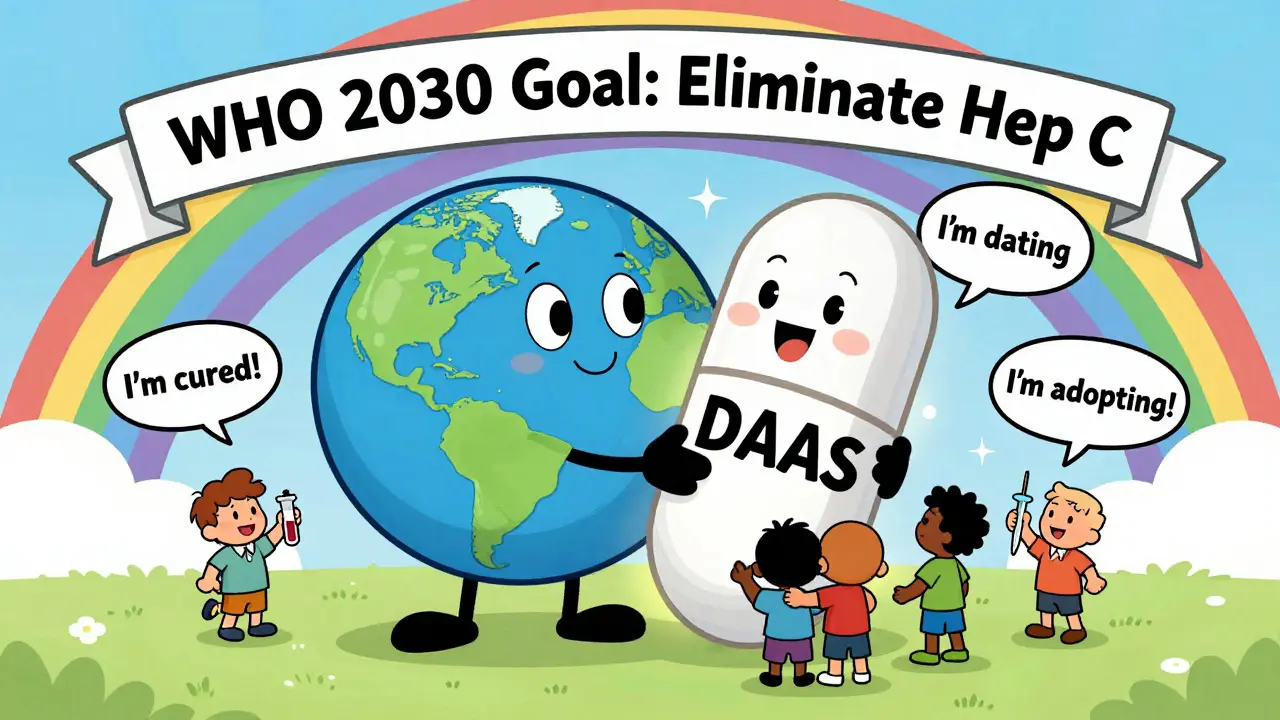
The World Health Organization wants to eliminate hepatitis C as a public health threat by 2030. That means reducing new cases by 90% and cutting deaths by 65%.
We have the tools. We have the cures. What’s missing is the will - to test everyone at risk, to treat everyone who needs it, and to remove the stigma that keeps people silent.
The next decade won’t be about inventing better pills. It’ll be about reaching the people who still don’t know they’re infected. It’ll be about making sure no one gets left behind because of cost, location, or shame.
Chronic hepatitis C is no longer a life sentence. It’s a treatable condition. And for those who’ve been cured, it’s often the beginning of a new chapter - one where the liver heals, the fear fades, and the future feels possible again.
Can hepatitis C come back after being cured?
Once you achieve a sustained virologic response (SVR) - meaning the virus is undetectable 12 weeks after finishing treatment - you’re considered cured. The virus doesn’t hide in your body. However, you can be reinfected if you’re exposed again, especially if you continue injecting drugs or have unprotected sex with someone who has hepatitis C. Being cured doesn’t give you immunity. Regular testing is still important if you’re at ongoing risk.
Do I need to avoid alcohol after being cured?
Yes. Even after curing hepatitis C, your liver may still have some scarring. Alcohol adds stress to the liver and can slow healing or worsen remaining damage. Experts recommend avoiding alcohol completely, especially in the first few years after treatment. For those with advanced fibrosis or cirrhosis, any alcohol use increases the risk of liver cancer.
Can I get hepatitis C again after being cured?
Yes. Being cured doesn’t protect you from future infections. Hepatitis C doesn’t create lasting antibodies like some other viruses. If you’re exposed again - through sharing needles, unsterile tattoos, or other blood contact - you can become infected again. That’s why harm reduction and safe practices remain critical, even after cure.
Are DAAs safe for people with kidney disease?
Yes. Several DAA regimens, including Mavyret and Epclusa, are safe for people with advanced kidney disease, including those on dialysis. In fact, hepatitis C is especially dangerous for people with kidney problems because it speeds up liver damage and increases transplant complications. Treating the virus improves survival and transplant outcomes. Always tell your doctor about your kidney function - they’ll choose the right regimen.
How long does it take to feel better after starting treatment?
Many people feel better within the first two weeks. Fatigue, brain fog, and joint pain - common symptoms of chronic hepatitis C - often improve quickly after starting DAAs. But the real benefit comes later. The liver begins healing after the virus is cleared, and that process takes months. Don’t expect overnight changes. But if you’re feeling worse after starting, talk to your doctor - it’s not typical.
Is hepatitis C treatment covered by insurance?
In most cases, yes. Private insurance, Medicare, and Medicaid in the U.S. cover DAA treatment for chronic hepatitis C. Some insurers used to require proof of advanced liver damage before approving treatment - but that’s mostly changed. Now, most require only a positive HCV RNA test. If you’re denied, appeal. Manufacturer patient assistance programs also cover 70% of uninsured patients.
Can children be treated for hepatitis C?
Yes. Since 2022, the WHO and FDA have approved DAA treatments for children as young as three years old. Pediatric formulations are available in liquid or chewable forms. Early treatment prevents long-term liver damage and gives kids a full, healthy future. If your child has hepatitis C, ask your pediatrician about testing and treatment options.
What happens if I miss a dose of my antiviral?
If you miss one dose, take it as soon as you remember - as long as it’s within 12 hours of your usual time. If it’s been longer, skip the missed dose and take your next one at the regular time. Don’t double up. Missing one or two doses rarely causes treatment failure, but consistent daily dosing gives you the best chance for cure. Set phone reminders or use a pill organizer if you’re worried about forgetting.

![Buy Generic Claritin (Loratadine) Online Cheap: Safe Canadian Deals, Prices & Alternatives [2025]](/uploads/2025/08/thumbnail-buy-generic-claritin-loratadine-online-cheap-safe-canadian-deals-prices-alternatives.webp)
Edith Brederode
January 21, 2026 AT 05:43Just finished my 12-week course last month and I can’t believe how different I feel. No more brain fog, I’m sleeping through the night, and I actually have energy to go for walks. 🌞 This isn’t just medicine-it’s a second chance. Thank you for writing this.
Art Gar
January 21, 2026 AT 18:14While the statistics are impressive, one must consider the broader context of pharmaceutical monopolies and the ethical implications of pricing structures that once rendered this cure inaccessible to millions. The narrative of 'miracle drugs' often obscures systemic failures in healthcare equity.
Renee Stringer
January 22, 2026 AT 02:06I’m glad people are getting cured, but why are we celebrating pills when we still don’t test high-risk populations systematically? This isn’t progress-it’s selective compassion.
Crystal August
January 23, 2026 AT 08:01Wow. Just… wow. I read this whole thing and cried. My brother got cured last year and he’s been a different person. I’m so tired of people thinking this is just some 'drug addict disease.' It’s a virus. Anyone can get it. And now it’s curable. That’s huge.
Shane McGriff
January 24, 2026 AT 03:54Let’s be real-this is one of the biggest medical victories of the 21st century. We’ve gone from a death sentence to a 12-week pill regimen with 95% success. And yet, people still don’t get tested. Why? Fear. Stigma. Ignorance. We need public campaigns, not just pamphlets. We need doctors to offer tests proactively, not wait for patients to ask. This isn’t just about liver health-it’s about dignity.
And yes, alcohol still matters. I know someone who got cured but kept drinking. Two years later, they needed a transplant. The virus was gone, but the damage wasn’t. Don’t celebrate the cure and ignore the healing.
Also, if you’re on other meds? Talk to your pharmacist. I missed that step. Took me three weeks to fix a dangerous interaction. Don’t be like me.
Jacob Cathro
January 25, 2026 AT 05:20sofusbuvir? velatapsvir? lol who even made these names up? also why is everyone acting like this is new? i had this in 2016 and it cost me $30k out of pocket. the 'cure' is just a rebrand of the same old pharma scam. they just lowered the price from $90k to $75k. still a ripoff. also, who says you're really cured? maybe it's just hiding. i think they're lying.
kumar kc
January 25, 2026 AT 11:06Good news. But testing still not available in rural India. Many die silently.
Thomas Varner
January 25, 2026 AT 12:17Okay, but… what about the people who got cured but still have cirrhosis? Like, yes, the virus is gone-but the liver doesn’t magically become perfect. And what if you’re 65 and you’ve had it for 30 years? Is 'healing' even possible? I’m not saying it’s not amazing-I’m just saying… don’t oversell it.
Manoj Kumar Billigunta
January 25, 2026 AT 23:10I work with people who use drugs. Many of them don’t trust doctors. But when I told them, 'You can take a pill for 3 months and never worry about this again,' they listened. We’ve had 14 people cured in our clinic this year. No injections. No shame. Just pills. It’s changed everything.
And yes, they still need clean needles. And counseling. And food. But now, they have hope. That’s worth more than any drug.
Andy Thompson
January 27, 2026 AT 13:59Who paid for this article? Big Pharma is pushing this to make us think we’re safe. But they’re still selling vaccines and insulin at 10x the cost. This is a distraction. They don’t want you healthy-they want you dependent. And what about the 5% who don’t respond? Are they just discarded? I don’t trust this.
sagar sanadi
January 28, 2026 AT 03:29so they cured hepatitis c… but you can still get it again? so what’s the point? just don’t do drugs and you won’t get it. problem solved. why are we spending billions on pills for people who won’t change their behavior?
pragya mishra
January 30, 2026 AT 01:04I’m a nurse. I’ve seen people die from this. I’ve seen families lose parents because they didn’t get tested. This isn’t just a medical topic-it’s a moral one. If you’re reading this and you’ve never been tested? Do it. Today. No excuses. Your liver doesn’t care about your pride.
clifford hoang
January 30, 2026 AT 22:14Think about this: if a virus can be erased with pills… what else are they hiding? What if cancer, diabetes, even aging… are all just suppressed by corporate-controlled 'treatments'? DAAs work because they were designed to work. But who controls the data? Who owns the patents? Who decides who gets cured? This isn’t science-it’s a controlled narrative. The liver heals? Maybe. But the system? Still broken. 🤔🩸