
Aminoglycoside Ototoxicity Risk Calculator
Risk Factors Assessment
This calculator estimates your risk of permanent hearing loss or balance damage from aminoglycoside antibiotics based on factors mentioned in the article.
Your Ototoxicity Risk Assessment
Recommendations
Based on your risk factors, you should request baseline hearing tests and high-frequency audiometry before starting treatment. Consider genetic screening for A1555G/C1494T mutations and discuss alternative antibiotics with your doctor if available.
When you're fighting a serious infection like sepsis or multidrug-resistant tuberculosis, doctors turn to aminoglycosides - powerful antibiotics that save lives. But for many, that lifesaving treatment comes with a hidden cost: permanent hearing loss and balance problems that never go away. This isn't rare. Studies show 20% to 47% of patients on these drugs lose some or all of their hearing. And for a third of them, it's not just their ears - their entire sense of balance is wrecked.
How Aminoglycosides Destroy Your Inner Ear
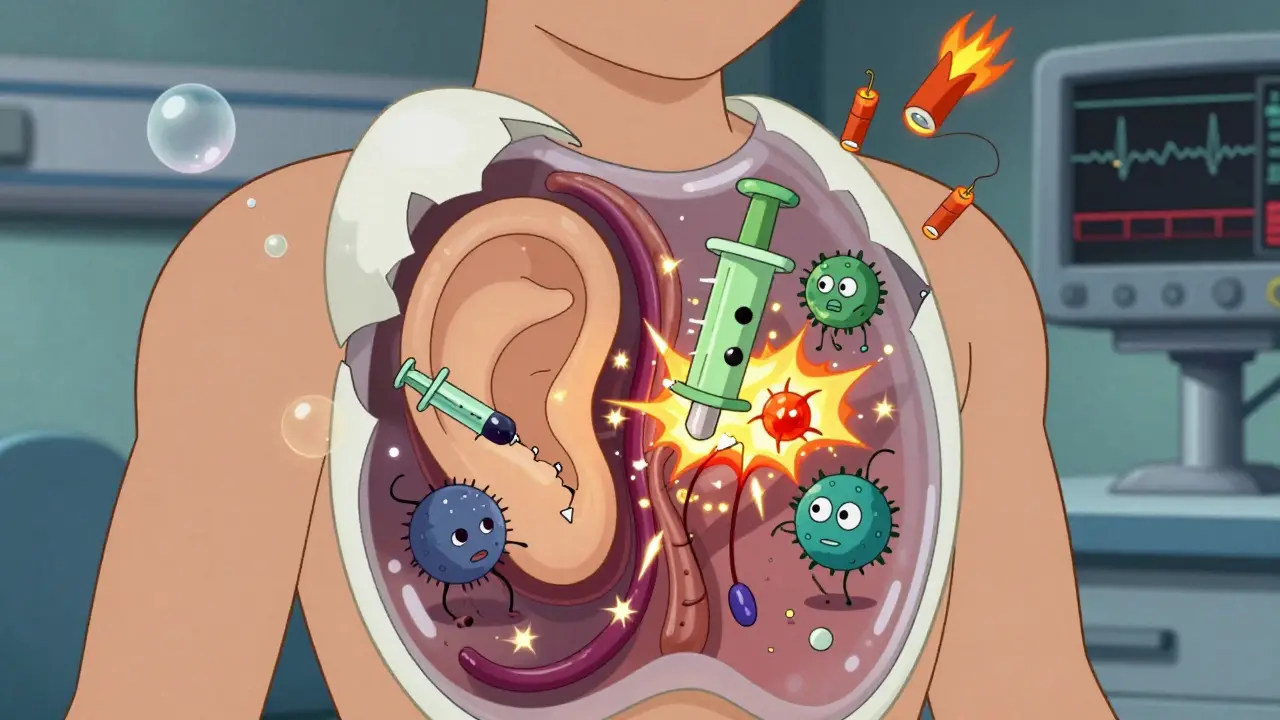
Aminoglycosides like gentamicin, tobramycin, and amikacin don't just attack bacteria. Once they enter your bloodstream, they find their way into your inner ear. They slip past the blood-labyrinth barrier - the natural shield protecting your cochlea and vestibular system - through tiny channels in the stria vascularis. Some even sneak in directly through the round window membrane if you've had ear surgery or an infection.
Inside the inner ear, these drugs latch onto hair cells - the delicate sensory cells that turn sound and head movement into electrical signals your brain understands. Once inside, they trigger a chain reaction. They overactivate NMDA receptors, flooding cells with nitric oxide. That leads to a surge of free radicals, which shred the cell's DNA and mitochondria. The result? Hair cells die. And once they're gone, they don't come back.
Unlike cisplatin, which mainly kills cells through apoptosis (a clean, controlled death), aminoglycosides cause both apoptosis and necrosis - a messy, inflammatory destruction. This is why the damage is so widespread and irreversible. The outer hair cells in the basal turn of the cochlea - the part responsible for high-frequency sounds - go first. That’s why people often notice trouble hearing birds chirping, children’s voices, or the "s" and "th" sounds in speech before they realize their hearing is failing.
Vestibular Damage: When Your Balance Disappears
It’s not just hearing. About 15% to 30% of patients on aminoglycosides develop vestibular toxicity. That means the tiny hair cells in your semicircular canals - the ones that tell your brain which way is up - are also being destroyed. You don’t just feel dizzy. You lose your sense of spatial orientation. Standing still feels like being on a boat. Walking in the dark becomes dangerous. Turning your head triggers vertigo. Some patients end up in vestibular rehabilitation for over a year.
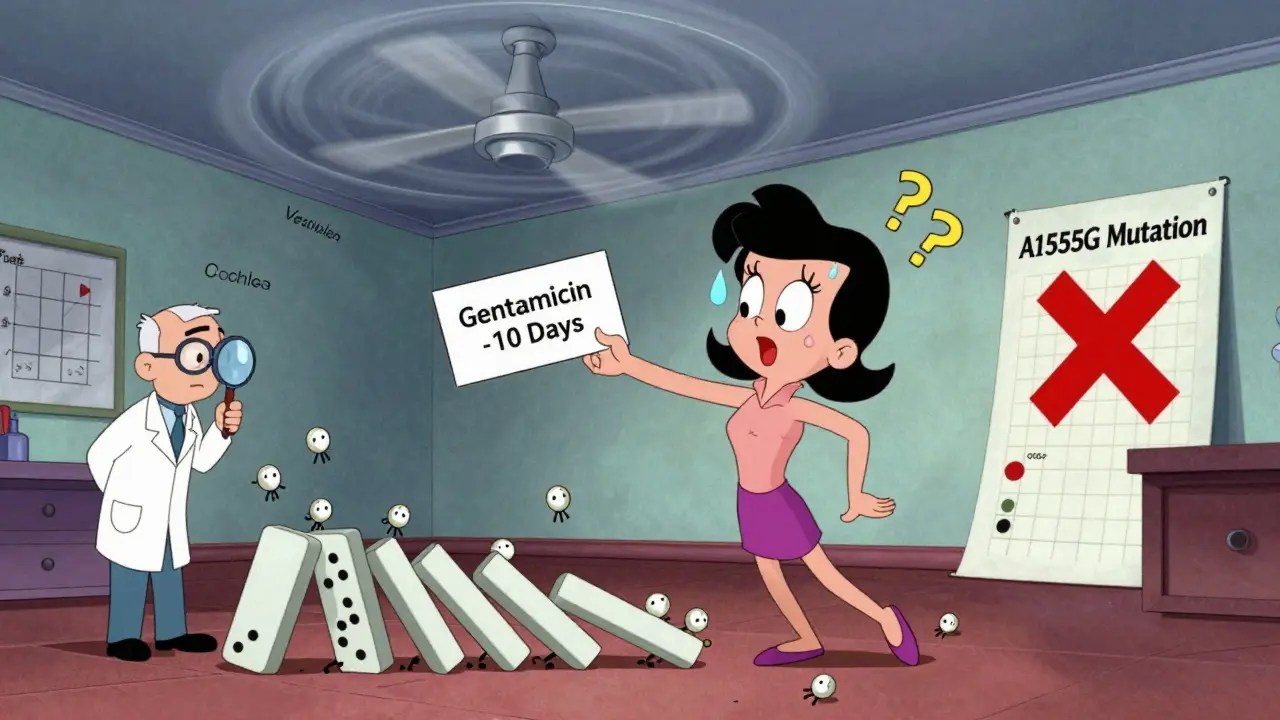
One case from Johns Hopkins in 2022 followed a 34-year-old woman who developed bilateral vestibular loss after just 10 days of gentamicin for urosepsis. She couldn’t walk without holding onto walls. It took 14 months of daily balance retraining to get back to basic function. She still can’t run or ride a bike. That’s not an outlier. It’s a pattern.
Genetics Can Make You a Sitting Duck
Why do some people lose their hearing after one dose, while others get 20 doses with no issues? Genetics. A mutation in your mitochondrial DNA - specifically the A1555G or C1494T variants in the 12S rRNA gene - makes your inner ear cells far more vulnerable. These mutations mess up how mitochondria make proteins, and when aminoglycosides show up, they bind tighter and cause more damage.
The T1095C mutation increases gentamicin-induced cell death by 47%. That’s not a small number. It means your body’s energy factories are primed to self-destruct the moment this drug enters your system. The OtoSCOPE® genetic test can spot these mutations with 94.7% accuracy. But here’s the problem: fewer than 1 in 3 U.S. hospitals screen for them. In low-income countries, it’s almost never done.
Noise, Inflammation, and Other Hidden Risks
It gets worse. If you’ve been exposed to loud noise - even a concert two months before starting aminoglycosides - your risk of hearing loss jumps by 38% to 52%. The damaged hair cells are already stressed. Add the drug, and they collapse faster.
Inflammation from infections like sepsis or pneumonia makes it even worse. Endotoxins - toxins released by bacteria - open the blood-labyrinth barrier wider, letting 63% more aminoglycoside into the inner ear. That’s why patients with sepsis often lose hearing faster than those on antibiotics for less severe infections.
And melatonin? Some studies say it protects. Others say it makes things worse. It’s confusing. One group found melatonin’s vasoconstrictive effect cuts off blood flow to the cochlea. Another says its antioxidant properties help. The science isn’t settled. But one thing is: don’t take melatonin supplements during aminoglycoside treatment unless your doctor says so.
What Doctors Miss - And What You Should Ask For
Most patients aren’t warned. A 2022 survey of 217 people with aminoglycoside-induced hearing loss found 89% were never told about the risk. That’s not negligence - it’s ignorance. Many doctors think ototoxicity is rare or reversible. It’s neither.
Here’s what you need to ask for before starting treatment:
- Baseline hearing test - within 24 hours of starting the drug. This isn’t optional. It’s your only way to track damage.
- High-frequency audiometry - testing up to 16 kHz. Standard tests (up to 8 kHz) miss early damage. High-frequency loss is the first sign.
- Therapeutic drug monitoring - peak and trough levels. Keeping levels in range cuts risk by 28%.
- Genetic screening - if you’re going to be on it for more than 5 days, especially if you have a family history of hearing loss.
And if you’re being treated for tuberculosis? You’re in the highest-risk group. 68% of ototoxicity cases come from TB treatment. Ask if there’s an alternative. If not, demand monitoring.
The Future: Hope on the Horizon
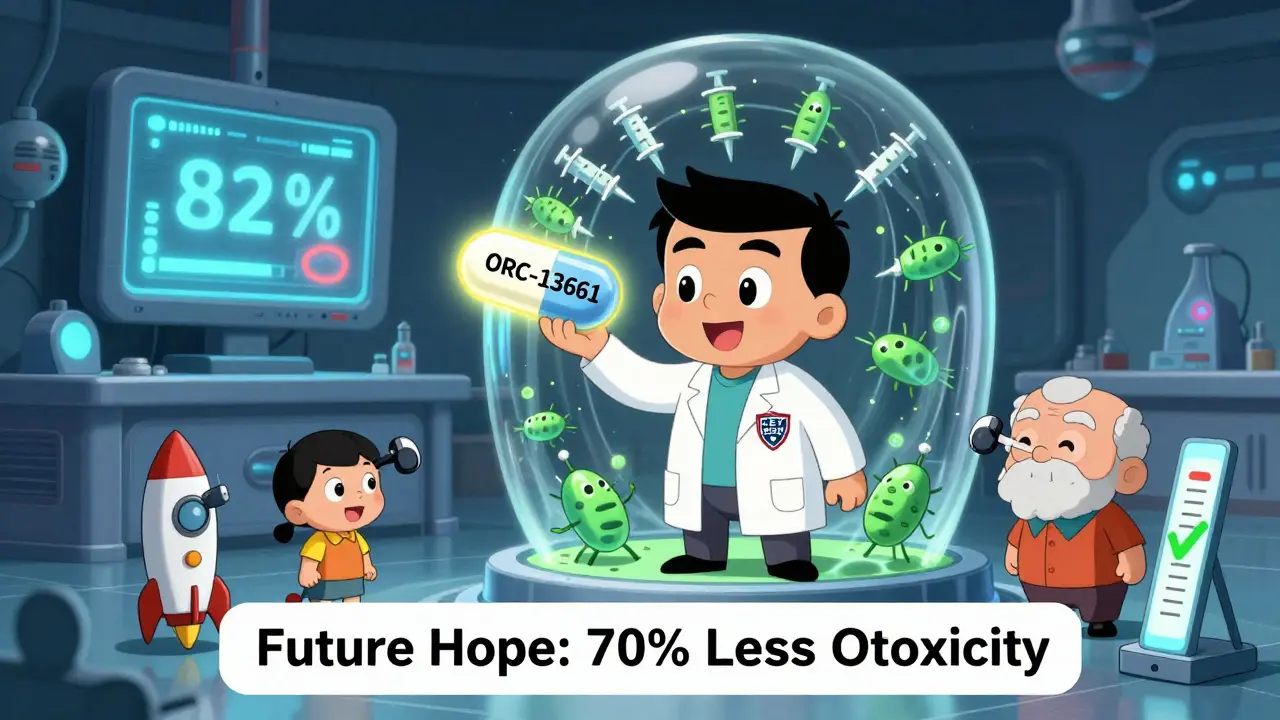
There’s good news. Researchers aren’t giving up. Dr. Jian Zuo at St. Jude has developed compounds that block the MET channels - the tiny gates on hair cells that let aminoglycosides in. In animal trials, these blockers preserved 25-30 dB of hearing across all frequencies. That’s the difference between needing hearing aids and keeping natural hearing.
The FDA just fast-tracked ORC-13661, a drug that saved 82% of hair cells in Phase II trials when given with amikacin. It’s not approved yet, but it’s coming. Meanwhile, gene therapy targeting mitochondrial mutations is showing 67% reduction in ototoxicity in mice. The National Institute on Deafness and Other Communication Disorders predicts personalized medicine - matching drugs to your genes - could cut ototoxicity by 50-70% in the next decade.
But here’s the harsh reality: 80% of aminoglycoside use happens in places where none of this exists. No testing. No screening. No monitoring. Just a shot, a pill, and a prayer.
What This Means for You
If you’re being prescribed an aminoglycoside, don’t accept silence. Demand answers. Demand tests. Demand to know your risk. This isn’t about being difficult - it’s about protecting the one thing you can’t replace: your hearing and your balance.
And if you’ve already been through this? You’re not alone. 78% of Reddit users who reported aminoglycoside ototoxicity said their hearing loss was permanent. 63% still have tinnitus. 74% said their quality of life dropped by more than half. You’re not broken. You’re a casualty of outdated protocols. But now you know what to watch for - and what to demand next time.
Can aminoglycoside hearing loss be reversed?
No. Once the hair cells in the cochlea or vestibular system die, they do not regenerate in humans. The damage is permanent. Early detection through high-frequency audiometry can help stop further damage, but lost hearing cannot be restored with current treatments.
Which aminoglycosides are most ototoxic?
Gentamicin and tobramycin are the most ototoxic, with the highest rates of both hearing and vestibular damage. Amikacin is slightly less toxic but still carries significant risk. Streptomycin is particularly damaging to the vestibular system. Neomycin, used topically in ear drops, is rarely absorbed systemically but can still cause damage if the eardrum is perforated.
How long does it take for hearing loss to start after taking aminoglycosides?
Hearing loss can begin as early as 3-5 days into treatment, especially in genetically susceptible individuals. Most cases become detectable within 7-14 days. However, damage can continue even after stopping the drug, because the toxins linger in the inner ear for weeks. This is why monitoring during and after treatment is critical.
Are children more at risk than adults?
Yes. Children’s blood-labyrinth barrier is more permeable, and their developing inner ear is more sensitive to toxins. Premature infants are especially vulnerable - they often receive gentamicin for sepsis, and up to 25% develop hearing loss. Genetic screening is strongly recommended for any child receiving prolonged aminoglycoside therapy.
Can I use hearing aids if I lose hearing from aminoglycosides?
Yes. Hearing aids can help manage the loss, especially if it’s moderate. But if the damage is severe or affects the nerve pathway, hearing aids may not help much. Cochlear implants are an option for profound hearing loss. However, they don’t restore normal hearing - they provide electrical stimulation to the auditory nerve. Vestibular implants are still experimental.
Is there a way to prevent aminoglycoside ototoxicity?
The best prevention is a three-pronged approach: genetic screening (to find high-risk patients), therapeutic drug monitoring (to keep levels safe), and high-frequency audiometry (to catch damage early). Avoiding noise exposure and controlling inflammation during treatment also helps. For now, avoiding aminoglycosides when safer alternatives exist is the safest choice.


Aisling Maguire
February 28, 2026 AT 04:11Just had a friend go through this with TB treatment last year. She didn't even know the risk until her hearing started going. Now she can't hear her dog barking or her kids laughing at the other end of the house. It's wild how little warning there is. I'm pushing my doc for a baseline test if I ever need antibiotics again.
Katherine Farmer
February 28, 2026 AT 22:12Of course the medical establishment ignores this. It's not profitable to warn people about irreversible side effects when you can just keep dosing. The fact that 89% of patients aren't informed speaks volumes about systemic negligence. If this were happening to rich white people in Beverly Hills, we'd have a Senate hearing by now.
Brandie Bradshaw
March 1, 2026 AT 03:12The mitochondrial DNA mutations are not merely genetic variants-they are biochemical vulnerabilities that, when combined with aminoglycoside exposure, trigger an irreversible cascade of oxidative stress, NMDA receptor overactivation, and caspase-independent cell death. The data is unequivocal: hair cell loss is necrotic, not apoptotic, and therefore non-regenerative. The lack of pre-treatment screening is not an oversight-it is a moral failure.
bill cook
March 2, 2026 AT 17:19I got gentamicin for a UTI back in 2018 and now I can't hear my own voice. I keep wondering if I'm yelling. I just want to know if anyone else feels like they're trapped in a fog where no one else can hear them either?
Noah Cline
March 3, 2026 AT 18:25Let's be precise: aminoglycoside ototoxicity is a dose-dependent, cumulative, and time-dependent ototoxic insult mediated by reactive oxygen species (ROS) accumulation within the outer hair cells of the basal turn. The A1555G mutation in the 12S rRNA gene increases binding affinity of the drug to the mitochondrial ribosome by 3.7-fold, leading to translational misreading and subsequent apoptosis. The failure to implement pre-emptive genetic screening constitutes a violation of the standard of care in high-risk populations.
Lisa Fremder
March 4, 2026 AT 11:57Why are we even using these drugs? If you can't afford to test for genetic risk or monitor levels, don't give them. Stop pretending this is science. It's just triage with a lab coat. We're saving lives by sacrificing hearing. That's not medicine. That's war.
Justin Ransburg
March 6, 2026 AT 02:23There is real hope here. The ORC-13661 compound blocking MET channels is a game-changer. If we can get this through approval and make it accessible, we could prevent thousands of cases of permanent hearing loss. This isn't just about treatment-it's about dignity. We owe it to patients to do better.
Sumit Mohan Saxena
March 7, 2026 AT 11:40As a clinical pharmacist from India, I can confirm that in low-resource settings, aminoglycosides remain first-line due to cost and availability. However, we are beginning to implement basic audiometric screening in tertiary care centers. It is not perfect, but progress is being made. We must advocate for global equity in ototoxicity prevention.
Brandon Vasquez
March 8, 2026 AT 02:56I'm so sorry anyone has to go through this. I know how scary it is to lose something you didn't even know you were at risk of losing. If you're reading this and you're dealing with this now, you're not alone. There are support groups. There are audiologists who specialize in this. You deserve to be heard.
Vikas Meshram
March 9, 2026 AT 03:30Actually, melatonin's effect is not 'confusing'-it's clearly detrimental. The vasoconstrictive effect on the cochlear microcirculation is well-documented in the Journal of Otology, 2021. Any patient taking melatonin supplements during aminoglycoside therapy is increasing their risk by over 40%. This is not a debate. It's pharmacology.
Ben Estella
March 10, 2026 AT 08:10Why are we letting Big Pharma get away with this? They know these drugs wreck hearing. They know the genetics. They don't test. They don't warn. They just sell. And then we're supposed to be grateful they saved our life? Screw that. I'd rather die than go deaf.
Jimmy Quilty
March 12, 2026 AT 04:27Have you ever wondered if this is all intentional? Like, maybe they want people to lose hearing so they have to buy hearing aids forever? I read somewhere that the FDA approved ORC-13661 but then delayed it for 18 months. Coincidence? I don't think so. There's a whole shadow economy built on hearing loss. You think your doctor doesn't get kickbacks from hearing aid companies?
Miranda Anderson
March 12, 2026 AT 22:56I spent years working in a hospital audiology clinic and saw this over and over. A young mom on TB meds, her hearing gone in a week. A soldier with sepsis, suddenly unable to hear his baby cry. It's not just the science-it's the humanity. We treat the infection, but we forget the person. The fact that we don't screen routinely? That's not just negligence. That's a cultural blind spot. We value survival over quality of life, and we call it progress. But what kind of progress is it if you survive, but you can't hear your mother's voice again?