

Every year, more than 1.5 million people in the U.S. end up in the emergency room because of medication mistakes. These aren’t rare accidents. They’re preventable failures in a system that’s supposed to keep us safe. Medication safety isn’t just a hospital policy or a pharmacist’s checklist-it’s a public health emergency. And it’s getting worse.
Medication Errors Are Killing People-And We’re Not Talking About Illegal Drugs
When people think of drug-related deaths, they often think of opioids or street drugs. But the real danger is hiding in plain sight: the pills prescribed by your doctor, filled by your pharmacy, and taken at home. In 2025, fentanyl-laced counterfeit pills are a crisis, but they’re only part of the story. The bigger issue is the routine, systemic errors in how medications are handled-from the moment a doctor writes a prescription to when a patient swallows it. The Centers for Disease Control and Prevention (CDC) says adverse drug events send over 1.5 million Americans to the ER each year. Of those, more than 125,000 die. That’s more than traffic accidents or gun violence. And nearly all of it is preventable. The World Health Organization calls it one of the top causes of avoidable harm in healthcare. One in ten patients in high-income countries suffers harm from a medication error. In low- and middle-income countries, it’s one in twenty. These aren’t just numbers. These are mothers, fathers, grandparents, and young adults who never should have died from a mislabeled pill or a wrong dose.The Cost Isn’t Just in Lives-It’s in Billions
Medication errors don’t just hurt people. They break the system. In 2025, the global cost of these mistakes hit $42 billion. In the U.S. alone, non-adherence to prescribed medications costs $300 billion annually. That’s not just wasted prescriptions-it’s repeat hospital visits, emergency care, and long-term disability that could have been avoided. Think about it: if you’re on blood pressure medication and skip doses because you didn’t understand the instructions, you’re at risk for a stroke. If a nurse gives you the wrong antibiotic because two drugs look alike on the screen, you could develop a life-threatening infection. These aren’t hypotheticals. They happen every day. The financial burden falls on everyone. Insurance premiums go up. Taxes rise to cover Medicare and Medicaid overpayments. Hospitals pay fines for preventable readmissions. And patients? They pay with their health-and sometimes their lives.Technology Can Help-But Only If It’s Used Right
We have tools that work. Electronic health records with decision support cut prescribing errors by 55%. Barcode scanning at the bedside reduces administration mistakes by 86%. AI systems can now predict which patients are at highest risk for a bad reaction with 73% accuracy. But having tech doesn’t mean using it well. A 2024 study found that only 63% of U.S. hospitals had fully compliant electronic systems under the 21st Century Cures Act. Many still use outdated interfaces where drug names look too similar. Nurses report that 68% experience at least one near-miss error per month because of look-alike, sound-alike drug names like hydroxyzine and hydralazine. Even when systems are in place, they’re often poorly integrated. A patient gets discharged from the hospital with a new list of meds. The primary care doctor doesn’t get the update. The pharmacy doesn’t know about the change. The patient gets confused. That’s how 67% of patients leave the hospital with at least one unintentional medication error.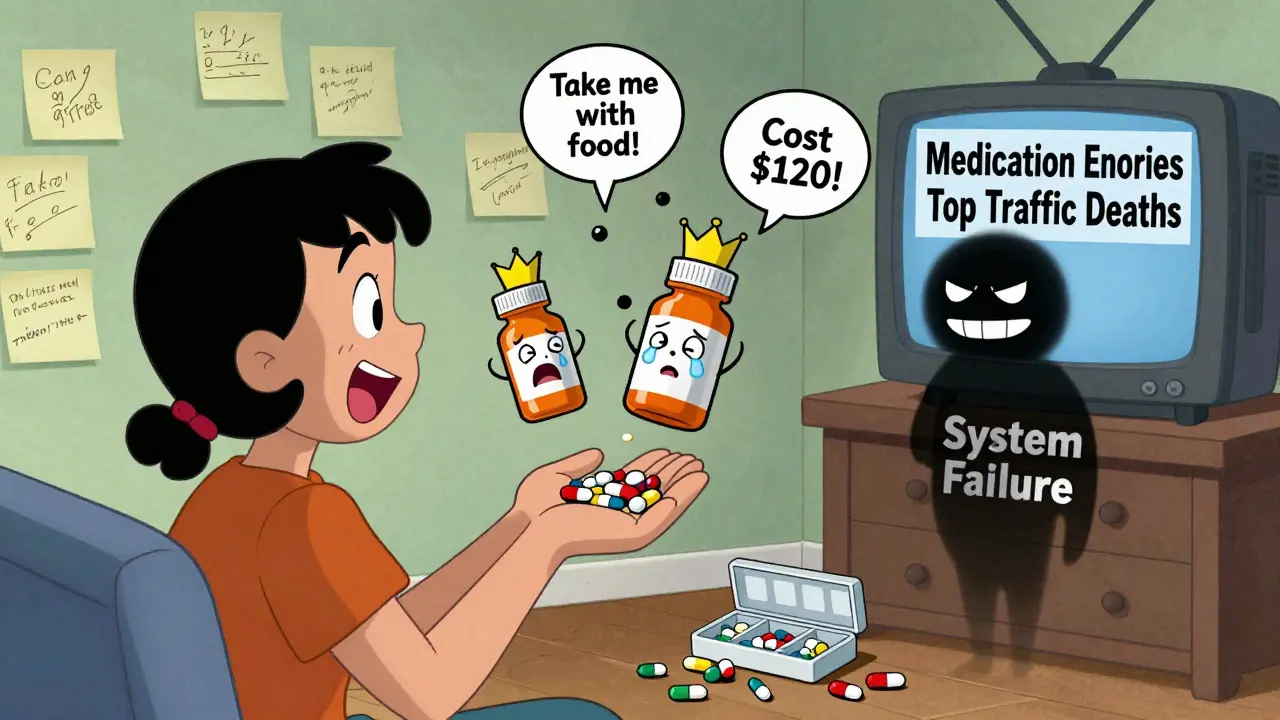
Pharmacists Are the Missing Link
One of the most effective-and underused-solutions is pharmacist-led care. When pharmacists actively manage a patient’s medication regimen, adherence improves by 40%. Patients save $1,200 a year on average. And for every dollar spent on these programs, hospitals get back $13.20 in savings. Yet in rural areas, only 37% of hospitals have 24/7 pharmacist access. In big city hospitals, it’s 89%. That gap isn’t just about money-it’s about policy. Only 38 states require pharmacy technicians to be certified. That means someone without formal training might be filling your prescriptions in some places. The American Public Health Association says we need mandatory national reporting of all medication errors. Right now, only 14% of errors are reported in the U.S. Why? Fear of blame. Lack of reporting tools. A culture that focuses on punishing individuals instead of fixing broken systems.It’s Not About Human Error-It’s About System Failure
Most people assume medication mistakes happen because someone was tired, distracted, or careless. But research shows 89% of errors come from system design-not human failure. A doctor prescribes a drug. The EHR doesn’t flag a dangerous interaction because the alert is buried under 20 others. The pharmacy receives the order. The label prints in tiny font. The patient takes it at home, doesn’t recognize the pill, and doesn’t call because they’re afraid they’ll sound stupid. No one checks. No one follows up. This isn’t negligence. It’s bad design. Successful programs fix the system, not the person. The Mayo Clinic reduced post-discharge errors by 52% by using AI to automatically reconcile medication lists. Geisinger Health boosted adherence to 89% by assigning pharmacists to follow up with patients after discharge. Both programs didn’t rely on staff working harder-they made the system work better.
What’s Being Done-and What’s Not
The U.S. has some of the most advanced medication safety tools in the world. The FDA’s Sentinel Initiative tracks 300 million patient records. CMS tracks 16 medication safety metrics in its Star Ratings program. The Drug Supply Chain Security Act requires full electronic tracking of prescriptions by the end of 2025. But progress is uneven. The Netherlands reduced medication errors by 44% by mandating electronic prescribing across every pharmacy and hospital. The UK’s National Reporting and Learning System cut serious errors by 30% by making reporting simple, anonymous, and mandatory. In the U.S., reporting is voluntary. Training varies by state. Accountability is weak. And while the FDA is investing $45 million in digital safety tools, many clinics still use paper charts.What Needs to Change
We know what works. Now we need to do it everywhere.- Make medication safety a public health metric-track it like cancer survival rates or heart attack outcomes.
- Require national certification for all pharmacy technicians and standardized training for all staff handling meds.
- Enforce interoperability-EHRs, pharmacies, and hospitals must talk to each other. No exceptions.
- Expand pharmacist roles-let them manage chronic meds, follow up with patients, and be part of the care team-not just pill dispensers.
- Fix the user experience-EHRs need simpler alerts, clearer labels, and better design. No more 20 pop-ups before the real warning shows up.
It’s Not Too Late
In Minnesota, preventable medication deaths dropped from 21 in 2022 to 14 in 2024. That’s not luck. It’s focused action. Hospitals started reviewing every error, sharing lessons, and changing workflows. Every $1 invested in medication safety returns $7.50 in savings. That’s a return most businesses would kill for. And the human cost? Priceless. Medication safety isn’t a nice-to-have. It’s the foundation of good healthcare. If we can’t get the pills right, how can we trust anything else?What are the most common medication errors?
The most common errors include wrong dosage, wrong drug (often due to similar names), incorrect timing, missed doses, and drug interactions. These happen during prescribing, dispensing, or administration. Look-alike and sound-alike drug names are responsible for a large share of mistakes, especially in electronic systems where fonts and labels aren’t clear.
How do I know if I’m taking my meds safely?
Keep a written or digital list of all your medications-including doses, times, and why you’re taking them. Ask your pharmacist or doctor to review it at least once a year. If you don’t recognize a pill, call the pharmacy before taking it. Use a pill organizer if you take multiple drugs daily. And never hesitate to ask: “What is this for? What happens if I miss a dose?”
Why aren’t medication errors reported more often?
Most healthcare workers fear blame, punishment, or damage to their reputation. Reporting systems are often complicated, slow, or not anonymous. In the U.S., only about 14% of medication errors are formally reported. This underreporting hides the true scale of the problem and prevents fixes from being made.
Can technology really prevent medication errors?
Yes, but only when used correctly. Barcode scanning cuts administration errors by 86%. Electronic prescribing reduces mistakes by 55%. AI can flag high-risk patients before harm happens. But if the system is clunky, alerts are ignored, or staff aren’t trained, the tech won’t help. The problem isn’t the tools-it’s how they’re integrated into daily work.
What role do pharmacists play in medication safety?
Pharmacists are the last line of defense. They catch prescribing errors, check for drug interactions, explain how to take meds, and follow up with patients. When pharmacists are part of the care team-especially after hospital discharge-adherence improves by 40% and hospital readmissions drop by up to 27%. Yet many patients never speak to one.
How can I help improve medication safety in my care?
Be an active participant. Bring a list of all your meds-prescription, over-the-counter, and supplements-to every appointment. Ask questions if something seems off. Don’t assume a new pill is safe just because your doctor prescribed it. If you’re confused about instructions, call your pharmacy. And if you see a mistake happen, report it-even if it didn’t hurt anyone. That’s how systems improve.


bhushan telavane
December 21, 2025 AT 05:20Man, I’ve seen this in India too-pharmacies giving out the wrong meds because the labels are smudged or the guy behind the counter can’t read English prescriptions. No system, no training, just luck. And people die because they don’t know enough to ask questions.
Nancy Kou
December 22, 2025 AT 16:13This is the quiet crisis no one talks about. My grandma almost died because her blood thinner was mislabeled. The pharmacy didn’t catch it. The doctor didn’t follow up. She’s fine now, but I’ll never trust a prescription again without double-checking every single pill.
Hussien SLeiman
December 23, 2025 AT 16:41Let’s be real-this isn’t a system failure. It’s a failure of personal responsibility. People don’t read labels. They don’t ask questions. They just swallow whatever’s handed to them like it’s candy. And now we’re surprised when things go wrong? Stop blaming the system and start blaming the people who refuse to take ownership of their own health. If you can’t manage five pills a day, maybe you shouldn’t be on them at all.
And don’t even get me started on pharmacists being ‘the missing link.’ They’ve been the missing link since the 1980s. We’ve had barcode scanners since 2005. The tech isn’t the problem. The laziness is.
Why do we keep pretending that healthcare is a service you can outsource? You want safety? Learn your meds. Write them down. Call your pharmacy. Stop expecting someone else to be your babysitter.
The $42 billion cost? That’s not a tragedy-it’s a tax on incompetence. And the fact that people think AI will fix this is just pathetic. You don’t fix human apathy with algorithms. You fix it with accountability.
Aadil Munshi
December 24, 2025 AT 19:05Classic case of systemic rot disguised as individual failure. The real irony? The same people screaming ‘personal responsibility’ are the ones who never had to navigate a $2000 insulin prescription or a 3-hour wait at a pharmacy with a 12-year-old tech filling their meds.
You think it’s laziness? Try being a diabetic in rural Texas with no car, no internet, and a pharmacy that can’t pronounce ‘metformin.’ Then tell me it’s about ‘ownership.’
And yes, pharmacists are the missing link-but only because we’ve turned them into glorified cashiers. In Canada and the UK, they adjust doses, run labs, and prescribe under protocols. Here? They’re stuck behind a counter, yelling ‘do you need a flu shot?’ while 17 scripts pile up.
The Mayo Clinic fix worked because they stopped treating patients like problems to be processed. They treated them like people. And guess what? People respond to being treated like people. Who knew?
Also, ‘look-alike, sound-alike’ drugs? Hydroxyzine vs hydralazine? That’s not a typo. That’s a death sentence waiting for a barcode scan that never happened. Fix the damn interface, not the patient.
And before someone says ‘just use a pill organizer’-try explaining that to someone with dementia who’s on 14 meds and can’t read. Or to a single mom working two jobs who doesn’t have time to alphabetize her pills.
We’re not failing because we’re lazy. We’re failing because we built a system that assumes everyone has the time, money, education, and privilege to navigate it. And that’s not a glitch. That’s the design.
Frank Drewery
December 25, 2025 AT 05:22Thank you for writing this. I work in a clinic and see this every day. One nurse told me she had to stop using the EHR because the alerts were so overwhelming she started ignoring them all. That’s not a patient problem. That’s a system design disaster.
My mom had a bad reaction last year because two meds were mixed up on the label. We caught it because we asked. But not everyone has someone to ask for them.
We need to stop treating safety like an add-on. It’s the foundation. And pharmacists need to be part of the team-not just the last stop before the door.
Danielle Stewart
December 26, 2025 AT 04:07I’m a nurse practitioner and I’ve seen the same patterns over and over. The most dangerous errors aren’t the big ones-they’re the tiny ones. A patient takes a pill at 7 a.m. instead of 10 p.m. because the label says ‘take once daily’ and they assume it means morning. No one ever told them the timing matters.
Simple fixes: printed instructions in plain language. A follow-up call 48 hours after discharge. A pharmacist sitting down with the patient for 10 minutes. These cost pennies but save lives.
Why don’t we do it? Because we’re still stuck in a fee-for-service model that rewards volume, not outcomes. We get paid to prescribe, not to prevent.
It’s not rocket science. It’s just… human.
jessica .
December 27, 2025 AT 00:49THIS IS ALL A BIG GOVERNMENT LIE. The FDA and Big Pharma are hiding the truth-medication errors are being inflated to push mandatory AI and digital tracking so they can control your health data. You think they care about your life? They care about your biometrics. They want to track every pill you take so they can sell your data to insurers. And now they want to make pharmacists ‘care managers’? That’s just the next step toward state-run healthcare. Wake up.
Ryan van Leent
December 27, 2025 AT 07:16Why are we even talking about this? People are dumb. They forget their meds. They don’t read labels. They take stuff with grapefruit juice. It’s not the system’s fault. It’s their fault. Stop making excuses. If you can’t handle your meds, don’t take them. Simple.
Also why are we spending billions on AI when we could just give people pill organizers? I’ve seen these $5 plastic boxes at Walmart. Problem solved. No tech needed. Just common sense.
Sajith Shams
December 27, 2025 AT 23:00Look, I’m from a small town in Bihar. We don’t have EHRs. We don’t have barcode scanners. We have a guy with a clipboard and a drawer full of bottles. And you know what? People still get their meds. They don’t die in droves. Why? Because they trust their local pharmacist. They know him. They’ve known him for 20 years. He remembers their kids’ names. He tells them if the pill looks weird.
The U.S. is over-engineering this. You don’t need AI to fix what’s broken by arrogance. You need human connection. You need someone who gives a damn.
Stop trying to digitize compassion. It doesn’t work that way.
Adrienne Dagg
December 28, 2025 AT 03:36OMG I’m crying rn. My aunt passed last year because of a drug interaction no one caught. She was on 8 meds. No one reviewed them. No one asked. I feel so guilty for not knowing more. This needs to change. 💔
Glen Arreglo
December 29, 2025 AT 07:25India and the U.S. have completely different problems here. In India, it’s lack of access. In the U.S., it’s overcomplication. But both end in the same place: people getting hurt because no one’s looking out for them.
The solution isn’t more tech or more rules. It’s respect. Respect for the patient. Respect for the pharmacist. Respect for the nurse who’s working 12-hour shifts with no break.
We treat healthcare like a factory. It’s not. It’s a relationship. Fix that, and the rest follows.
shivam seo
December 30, 2025 AT 18:55Let’s be honest-this is just woke medicine. We’re spending billions to fix problems created by people who don’t want to take responsibility. The real issue? The decline of personal accountability. We used to teach kids to read labels. Now we expect a robot to do it for them. Pathetic.
And don’t get me started on pharmacists being ‘care managers.’ Next they’ll want them to do your taxes and pick up your dry cleaning. This isn’t healthcare reform. It’s socialism with a stethoscope.
Andrew Kelly
January 1, 2026 AT 12:15Of course the system fails. You’re letting bureaucrats design interfaces. You’re letting insurance companies dictate workflow. You’re letting hospitals cut staff to boost profits. And then you’re shocked when people die?
The real villain here isn’t the nurse. It’s the CEO who got a $12 million bonus last year while cutting pharmacy hours. The real failure isn’t technology-it’s capitalism.
Every dollar spent on marketing statins goes to shareholders. Every dollar spent on fixing medication safety goes to ‘risk management.’ That’s why nothing changes.
Want to fix this? Ban corporate profits in healthcare. Make it a public utility. Then we can talk about barcodes and AI. Until then? We’re just rearranging deck chairs on the Titanic.