
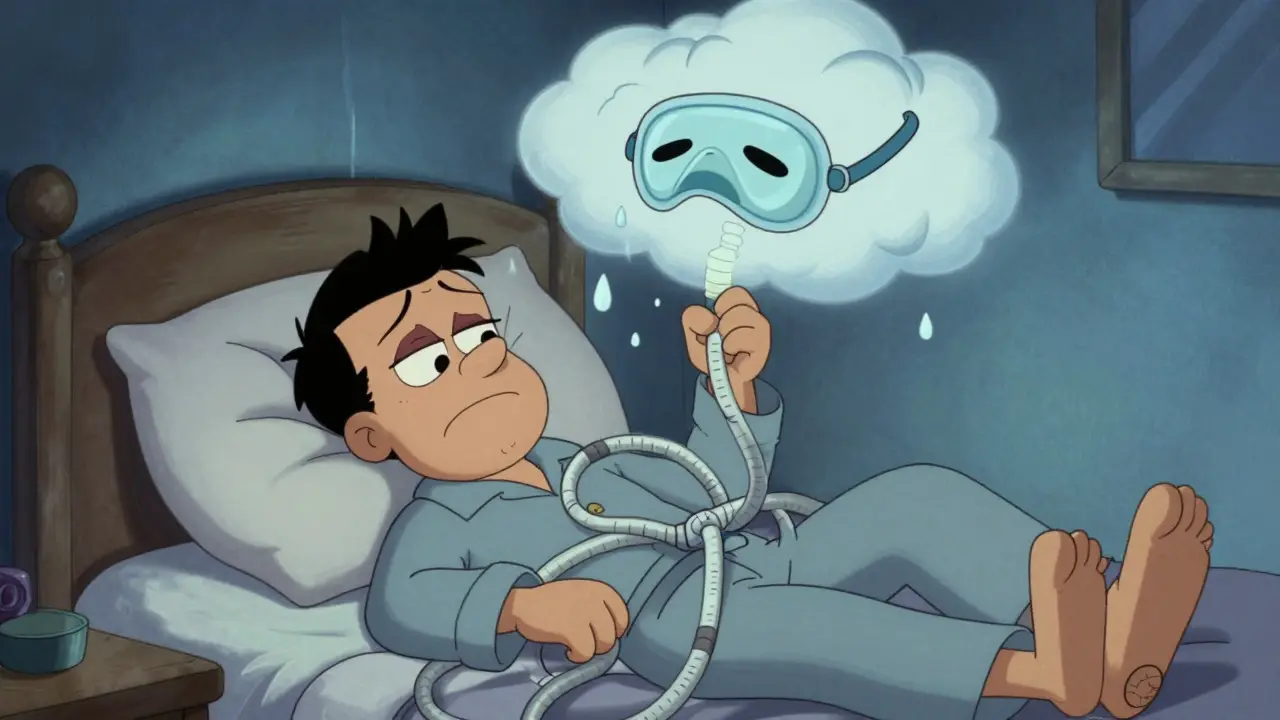
When you’ve tried CPAP for months and still can’t sleep because the mask feels suffocating, the hose tangles in your sheets, or your nose dries out every night, you’re not alone. About 3 in 10 people who start CPAP therapy quit within the first year. For those patients, there’s another option - one that doesn’t involve masks, hoses, or daily adjustments. It’s called upper airway stimulation (UAS), and it’s a small implant that works like a pacemaker for your airway.
How Upper Airway Stimulation Works
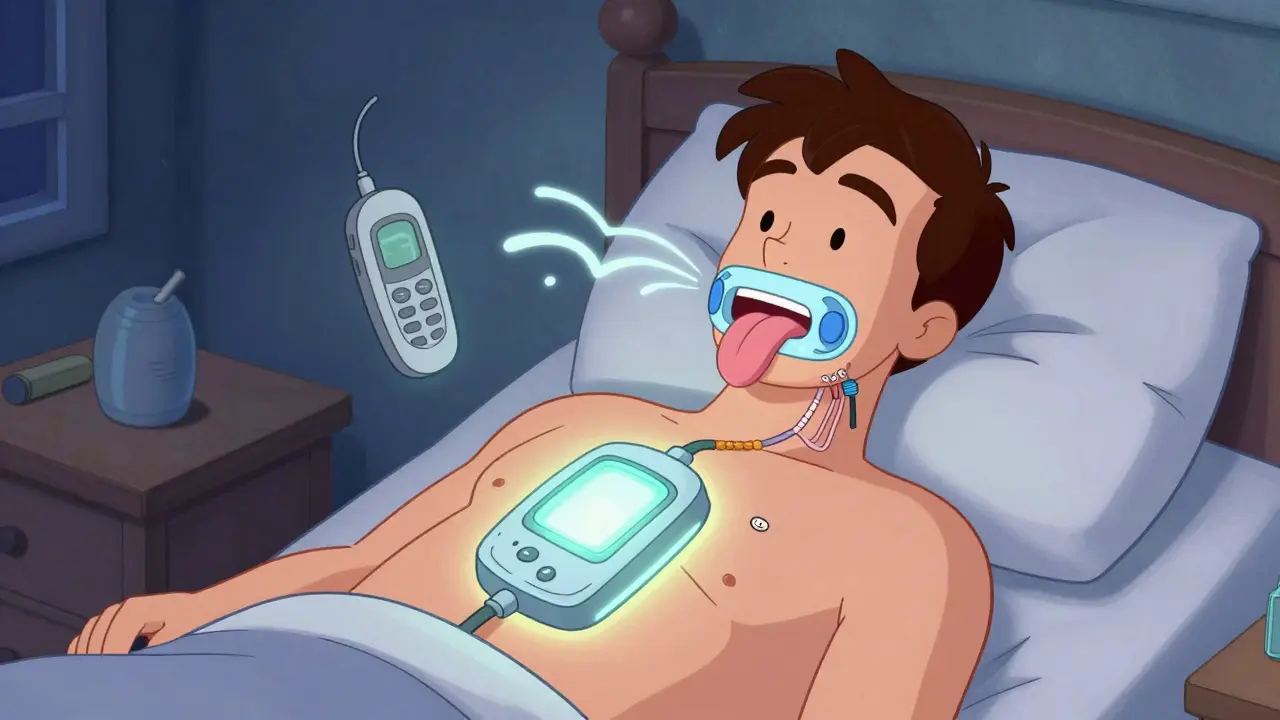
Upper airway stimulation isn’t magic - it’s precision medicine. The system, known as Inspire, is implanted during a single outpatient surgery. It doesn’t push air into your throat like CPAP. Instead, it senses when you’re breathing in and gently stimulates the nerve that controls your tongue. This moves your tongue forward just enough to keep your airway open while you sleep.
The device has three parts: a small generator under your chest skin, a sensing wire that detects your breathing, and a stimulation wire that wraps around the nerve behind your jaw. All of it works together silently. You turn it on with a remote before bed and off when you wake up. No masks. No noise. No hoses.
It only activates during inhalation. That’s important. If it ran all night, your tongue would tire out. But by syncing with your breath, it delivers just enough stimulation to prevent collapse - without feeling like something’s pushing against your throat.
Who Is a Good Candidate?
This isn’t for everyone. The FDA cleared Inspire for adults aged 22 and older with moderate to severe obstructive sleep apnea - specifically, those with an AHI (apnea-hypopnea index) between 15 and 100 events per hour. But there are strict anatomical rules too.
You need to have a BMI under 35 (some centers use 32). If you’re overweight, the device may not work as well. You also can’t have complete blockage or concentric collapse of your soft palate - meaning your airway isn’t fully squashed shut from all sides. A sleep specialist will do a special endoscopy while you’re sedated to check your airway structure. If your tongue and soft palate move forward when stimulated, you’re likely a good fit.
And you must have tried CPAP and failed. Not just struggled with it - actually tried it for weeks or months and decided it’s not sustainable. That’s the gatekeeper. Insurance won’t cover it unless you’ve proven CPAP doesn’t work for you.
What Happens During Surgery?
The procedure takes about two to three hours. You’re under general anesthesia. Three small incisions are made: one under your jaw to access the nerve, one lower in your neck to place the breathing sensor, and one just below your collarbone to tuck the battery-powered generator under your skin.
It’s not a simple needle poke. But it’s less invasive than older surgeries like UPPP (removing tonsils and part of the soft palate). Most people go home the same day. You’ll feel sore for a few days, especially around the neck and chest. But you can usually return to work within a week. No heavy lifting for a month.
Activation doesn’t happen right away. You need at least four weeks to heal. Then you return for your first programming session. A sleep doctor uses a laptop to adjust the stimulation level - just like tuning a radio. Too low, and your airway still collapses. Too high, and your tongue feels twitchy or your jaw aches. It usually takes one or two visits to get it right.
Results That Matter
The data speaks clearly. In the STAR trial - the largest long-term study on UAS - patients saw their AHI drop from an average of 29.3 events per hour to just 9.0 after one year. That’s a 68% reduction. Two-thirds of users hit the goal of cutting their events by half or more.
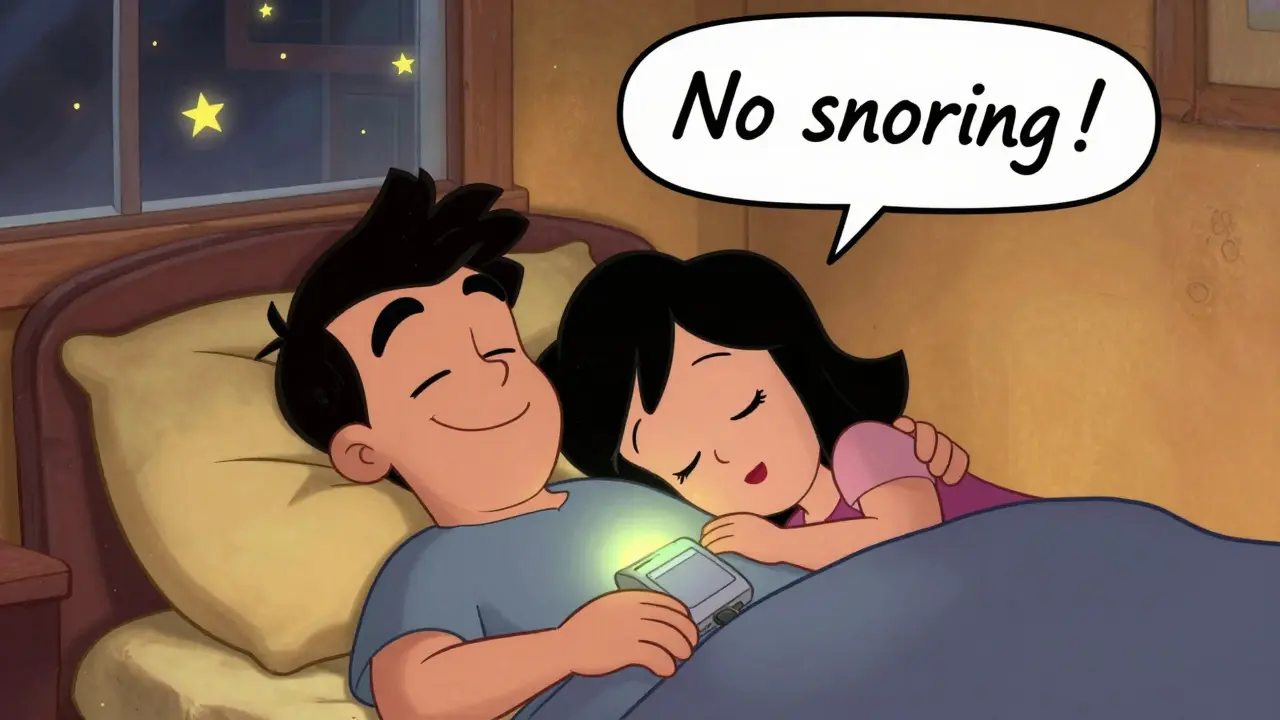
But numbers aren’t everything. What matters more is how you feel. In the same study, 86% of patients said they preferred Inspire over CPAP. Bed partners reported no snoring or only soft snoring in 85% of cases after four years. People started sleeping through the night. They woke up less tired. They stopped needing afternoon naps.
One patient on a sleep forum wrote: “My wife says I haven’t snored in two years. She sleeps better. I do too.” Another said, “I used to dread bedtime. Now I forget I have it on.”
Side Effects and Risks
No surgery is risk-free. But serious complications are rare. Less than 0.5% of patients have major issues like nerve damage or infection. The most common side effect is temporary tongue weakness - about 5% of people feel it for a few weeks after surgery. A few report mild discomfort when the device activates, especially at first. That usually fades.
You might forget to turn it on. That’s not a malfunction - it’s human. Some users set a phone reminder. Others leave the remote on their nightstand next to their toothbrush. It’s a habit, not a chore.
There’s no permanent damage if you stop using it. The device can be turned off or even removed, unlike some other surgeries that cut or reshape tissue permanently.
Cost and Insurance
The total cost - implant, surgery, follow-ups - averages $35,000 to $40,000. That sounds steep. But compare it to CPAP: machines cost $500-$1,000 upfront, then need replacing every 5 years. Masks, tubing, filters, and cleaning supplies add up to $300-$600 a year. Over a decade, CPAP can cost $8,000-$12,000 - and many people still don’t use it consistently.
Insurance coverage has improved dramatically. As of 2025, 95% of Medicare beneficiaries and 85% of private insurers cover Inspire therapy. You’ll still need to prove CPAP failure, but the paperwork process is well-established now. Most centers have dedicated teams to help with pre-authorization.
How It Compares to Other Treatments
Let’s put this in context.
- CPAP: Effective for most, but 30-46% quit due to discomfort.
- Oral appliances: Better for mild cases. Can cause jaw pain or tooth movement over time.
- UPPP surgery: Removes tissue. Painful recovery. Success rate only 40-50%.
- UAS: No tissue removal. Adjustable. 68% AHI reduction. 86% patient satisfaction.
UAS isn’t a cure. But it’s the most effective long-term option for those who can’t use CPAP. It doesn’t fix the root cause of sleep apnea - it bypasses it. And for many, that’s enough.
What’s Next for This Therapy?
The FDA expanded eligibility in 2023 to include patients with BMI up to 40 and AHI up to 100. That opened the door for more people, especially those with severe apnea who were previously excluded.
Researchers are now using AI to predict who will respond best - analyzing 3D scans of airways to find patterns before surgery. Smaller, rechargeable devices are in development. Some companies are testing wireless versions that don’t need external remotes.
Over 200,000 people worldwide have received the implant. The market is growing at over 14% per year. It’s no longer experimental. It’s mainstream.
Final Thoughts
If you’ve given up on CPAP, you might think there’s nothing left. But upper airway stimulation offers real hope. It’s not easy - you need to commit to surgery, recovery, and nightly activation. But for those who do, the payoff is quiet nights, better sleep, and waking up truly rested.
This isn’t about being “cured.” It’s about reclaiming sleep. And for millions of people who’ve lost it, that’s everything.
Is upper airway stimulation the same as a pacemaker?
It works similarly - both are implantable devices that deliver electrical pulses. But a heart pacemaker regulates heartbeat, while upper airway stimulation targets the nerve controlling your tongue to keep your airway open during sleep. The technology is adapted from cardiac devices but designed specifically for breathing.
Can I get an MRI after getting the implant?
Yes, but only under specific conditions. The Inspire device is MRI-conditional, meaning you can have an MRI of your head, neck, or chest if certain safety protocols are followed. You must notify your doctor and the imaging center ahead of time. Full-body MRIs or scans near the implant site are not allowed without special approval.
How long does the battery last?
The generator’s battery lasts about 11 years on average. When it runs low, you’ll get a warning during routine checkups. Replacing the generator is a minor outpatient procedure - same as the original implant, but simpler since the leads stay in place.
Will I feel the stimulation all the time?
No. The stimulation only activates when you breathe in during sleep. You won’t feel it during the day. At night, you might feel a mild tingling or pulling sensation in your tongue at first - like a gentle tug. Most people get used to it within a few weeks and stop noticing it.
Can I travel with the device?
Absolutely. The remote control works like a TV remote - no batteries needed, just a simple button press. Airport security may ask you to show your patient ID card (provided by Inspire), but the device won’t trigger metal detectors. You can fly, drive, and sleep anywhere without restrictions.
Does this treat central sleep apnea?
No. Upper airway stimulation only works for obstructive sleep apnea - where the airway physically collapses. It does nothing for central sleep apnea, which is caused by the brain failing to signal the muscles to breathe. If your sleep study shows more than 25% central apneas, this therapy isn’t recommended.
What if I gain weight after the implant?
Weight gain can reduce the effectiveness of the device. If your BMI climbs above 35, your airway may become more prone to collapse, and the stimulation may not be enough. Your doctor may need to increase the stimulation level, but there’s a limit. Maintaining a healthy weight is still important - even with the implant.

![Buy Generic Claritin (Loratadine) Online Cheap: Safe Canadian Deals, Prices & Alternatives [2025]](/uploads/2025/08/thumbnail-buy-generic-claritin-loratadine-online-cheap-safe-canadian-deals-prices-alternatives.webp)
Mussin Machhour
December 24, 2025 AT 16:27I got the Inspire implant last year after 18 months of CPAP hell-mask leaks, dry throat, nightmares of being suffocated. Now I sleep like a baby. No noise, no hassle. I forget it’s even there until I grab the remote before bed. Best decision I ever made.
Justin James
December 26, 2025 AT 04:57Let me tell you something they don’t want you to know-this whole UAS thing is just a corporate cash grab. The FDA’s been bought off, and the real cause of sleep apnea is 5G towers messing with your brainstem. They’re pushing this implant because Big Pharma doesn’t want you sleeping naturally. Look at the battery life-11 years? That’s a surveillance tool disguised as a medical device. They’re tracking your breathing patterns. I know someone who had his device ‘malfunction’ and suddenly got a bill for $12,000. Coincidence? I think not.
Jason Jasper
December 27, 2025 AT 01:01I was skeptical too. But after reading through the STAR trial data and talking to my ENT, I decided to go for it. The recovery was rough for a week, but nothing like I expected. The tingling at first felt weird, like my tongue was asleep-but now? I don’t even notice it. My wife says I’ve stopped snoring completely. We’ve both been sleeping better. Honestly, if you’ve given up on CPAP, this might be your lifeline.
Winni Victor
December 28, 2025 AT 14:07Ugh, another ‘miracle cure’ for rich people who can’t be bothered to lose 10 pounds. I’ve got a CPAP, I hate it, but I’m not getting a $40k implant just because I like my pillow too much. Also, ‘86% prefer it’? Of course they do-they didn’t have to pay for it. Meanwhile, I’m still using a $120 mask from Amazon and surviving. Maybe stop selling fantasy solutions and start selling accountability?
Zabihullah Saleh
December 29, 2025 AT 09:32There’s something poetic about this-technology that doesn’t force air into you, but listens to your body and responds. It’s not just a device, it’s a conversation between your nervous system and a machine. We’ve spent so long treating sleep apnea like a mechanical problem-when really, it’s a whisper of the body saying, ‘I need space.’ This implant doesn’t scream back. It just whispers back, gently, in rhythm. And somehow, that’s enough.
Lindsay Hensel
December 30, 2025 AT 23:21While the clinical outcomes are compelling, it is imperative to underscore the necessity of rigorous patient selection criteria. The anatomical prerequisites, coupled with documented CPAP intolerance, constitute a non-negotiable foundation for therapeutic success. Without these, outcomes may be suboptimal, and patient expectations may be misaligned with physiological reality.
Katherine Blumhardt
December 31, 2025 AT 19:28i got the device last year and its amazin but my remote died and now i have to wait 3 weeks for a new one?? and the company said they cant send it fast bc its 'medical device' so now i have to sleep without it?? i just want to go to bed without being a zombie!!
Harbans Singh
January 1, 2026 AT 14:47Coming from India, I’ve seen people suffer silently with sleep apnea because they think it’s just ‘snoring’ or ‘tiredness’. My uncle had it for 12 years, never got diagnosed. When I told him about UAS, he thought it was sci-fi. But after seeing the data, he went for it-and now he wakes up without gasping. It’s not just a device; it’s dignity. We need to spread awareness here. This isn’t a luxury-it’s a basic human need: to breathe while sleeping.
Gary Hartung
January 2, 2026 AT 04:13Let’s be honest: this is the new ‘Tesla of sleep’-overpriced, overhyped, and only for those who can afford to turn their bedroom into a medical tech showroom. Meanwhile, I’m over here using a humidifier, nasal strips, and sleeping on my side like a normal human being. Do we really need a pacemaker for our tongue? What’s next-a neural lace to stop us from snoring in meetings? I’m not against innovation, but this feels like medical cosplay.
Sophie Stallkind
January 4, 2026 AT 03:37Thank you for providing such a comprehensive and clinically grounded overview. The data presented, particularly regarding long-term patient satisfaction and AHI reduction, is both statistically significant and clinically meaningful. This therapy represents a paradigm shift in the management of obstructive sleep apnea for those who are truly CPAP-intolerant. I appreciate the balanced discussion of risks, eligibility, and cost-effectiveness over time.