
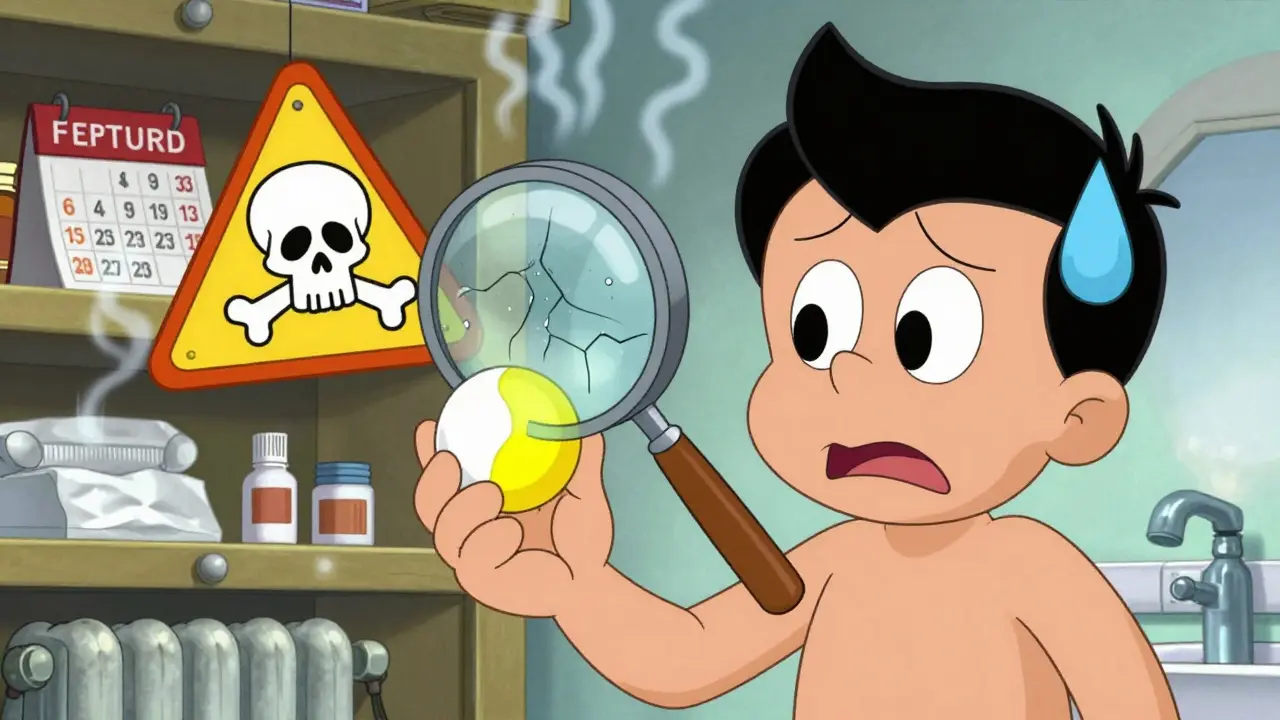
When a pill turns yellow, a cream separates into oily layers, or a liquid turns cloudy, it’s not just a cosmetic issue-it’s a warning. Expired drugs don’t just lose strength; they can physically break down in ways that make them unsafe. You might think, "It’s just a few months past the date," but the truth is, degradation doesn’t wait for calendars. The color, odor, and texture of your medication can tell you more about its safety than the expiration date alone.
What Changes to Look For in Expired Medications
Not all expired drugs are dangerous, but many show clear signs of breakdown. The most common red flags are changes in color, smell, or feel. These aren’t random-they’re predictable results of chemical and physical instability.
For tablets and capsules, watch for:
- Discoloration: White pills turning yellow, brown, or gray. Tetracycline antibiotics often turn dark yellow or brown due to oxidation. Nitroglycerin tablets, which should be white or off-white, can turn yellow-brown-this means they’ve lost potency and may not work in an emergency.
- Cracking or crumbling: If a tablet breaks apart easily or has a chalky texture, moisture or heat has likely damaged the binding agents. This affects how the drug dissolves in your body.
- Caking or clumping: Capsules, especially those with hygroscopic ingredients like amoxicillin, absorb moisture from the air. When this happens, the powder inside sticks together into hard lumps. That’s not normal-it’s degradation.
For creams and ointments:
- Separation: If you see oil floating on top or water pooling at the bottom, the emulsion has broken. Clotrimazole cream or mupirocin ointment that’s separated can’t deliver the right dose.
- Drying or hardening: A cream that’s lost its smooth texture and feels gritty or waxy is no longer stable. This often happens when stored in hot places like a bathroom cabinet.
- Odd odor: A rancid, sour, or chemical smell means fats or active ingredients have oxidized. Fresh ointments should have little to no smell.
For liquids and eye drops:
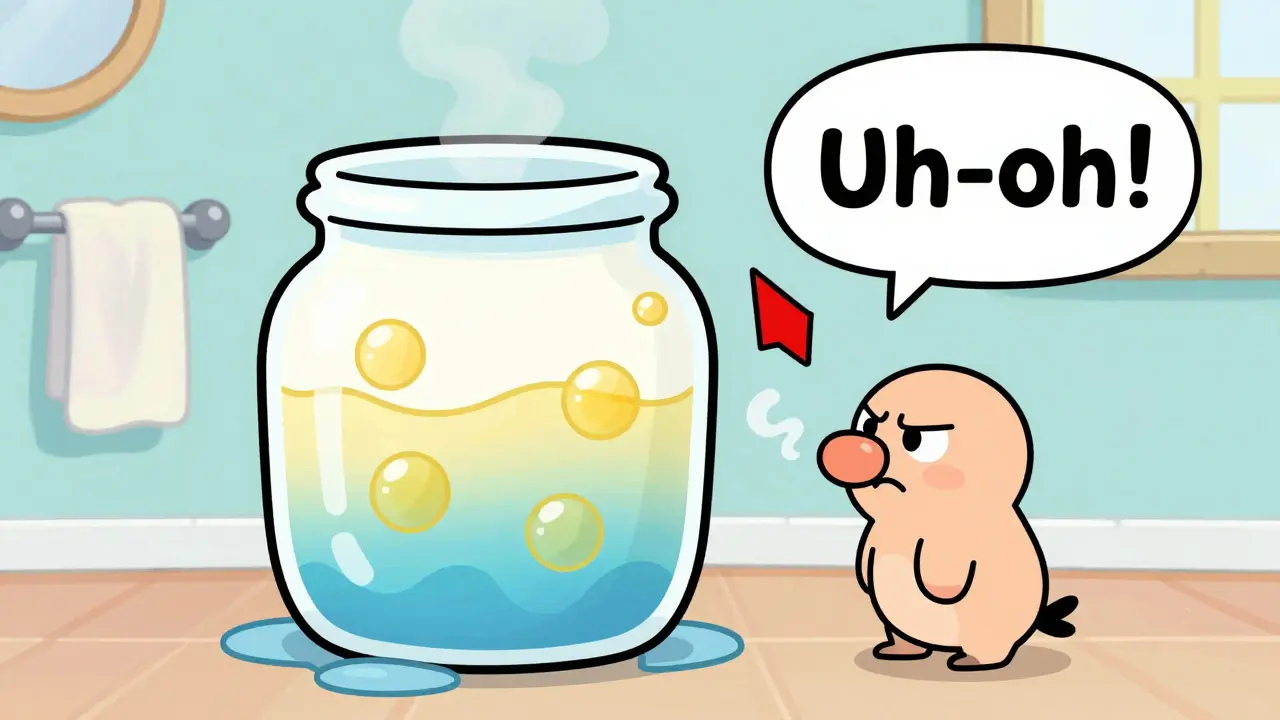
- Cloudiness or particles: Clear solutions that turn hazy or show floating specks are contaminated or degraded. Ciprofloxacin eye drops that look cloudy shouldn’t be used-even if they’re within the expiration date, if stored improperly, they can become dangerous.
- Change in thickness: If a liquid feels thinner or thicker than usual, it’s likely lost its formulation integrity. This changes how your body absorbs it.
Why These Changes Happen
Medications are designed to stay stable under specific conditions. Heat, humidity, light, and air exposure all speed up breakdown. A pill that’s fine in a cool, dry drawer can degrade fast in a hot car or a steamy bathroom.
Chemical reactions like oxidation, hydrolysis, and photodegradation break down active ingredients. For example:
- Light-sensitive drugs like nitroglycerin or certain antibiotics break down when exposed to sunlight-even through clear bottles.
- Moisture-sensitive drugs like amoxicillin or insulin absorb water, causing clumping or chemical changes.
- Temperature-sensitive drugs like thyroid meds or epinephrine can lose potency if stored above 25°C (77°F). Studies show heat above this point can accelerate degradation by 2.3 times.
Even if the drug still looks fine, it might be weaker. Some drugs, like PMZ (phenytoin) injections, can lose effectiveness before any visible change occurs. That’s why physical inspection alone isn’t enough-but it’s the first line of defense.
What Experts Say About Visual Inspection
Research from NASA, the FDA, and university labs shows that visual checks catch the majority of degraded drugs. In one 5-year study of expired medications, 68.3% of samples showed visible changes-mostly discoloration. Another study found that 73.5% of expired solid tablets had noticeable color shifts.
But human eyes aren’t perfect. The National Institute of Justice found that people correctly identify drug discoloration only 65.2% of the time. That’s why institutions like the University of Wisconsin’s RARC program use standardized tools:
- Munsell color charts to compare pill color against known reference shades.
- White background lighting at 500 lux to spot subtle changes.
- Photographic logs to track changes over time.
Some hospitals now use digital systems like Artragen’s ColorTrack, which measures color changes to within ±0.5 CIELAB units-far more precise than the eye. But for most people, simple visual checks are still the most practical first step.
When to Trust Your Eyes-And When Not To
Some drugs naturally change color. For example:
- Iron supplements often darken over time-it’s normal and doesn’t mean they’re unsafe.
- Some antibiotics have a slight yellow tint when fresh.
That’s why comparison matters. Keep the original packaging. Many manufacturers include reference images of what the drug should look like when new. If you’re unsure, compare your pill to a new one from the same batch.
Also, don’t assume a drug is safe just because it looks fine. Some degraded medications show no visible signs but are chemically unstable. That’s why:
- Never use insulin that’s cloudy unless it’s supposed to be (like NPH).
- Never use epinephrine if it’s pink or brown-it should be clear and colorless.
- Never use liquid antibiotics if they smell off, even if the date hasn’t passed.
When in doubt, throw it out. The risk isn’t worth it.
How to Check Your Medications at Home
You don’t need a lab to spot dangerous changes. Here’s a simple 5-step process:
- Take it out of the bottle. Place it on a clean white surface under bright, natural light.
- Look closely. Use a magnifying glass if needed. Check for spots, streaks, or uneven color. Compare it to a new pill from the same prescription.
- Smell it. If it smells sour, musty, or chemical, don’t use it.
- Feel it. Tablets should be firm. Creams should be smooth. Liquids should be clear and consistent.
- Check the storage. Was it left in a hot car? In a bathroom? If yes, even if it looks fine, it’s safer to replace it.
Keep a small logbook or use your phone to take photos of pills and creams every few months. This helps you spot slow changes over time.
What to Do If You Find a Problem
If you spot any of these changes:
- Stop using it immediately. Even if you’re out of refills, don’t risk it.
- Return it to the pharmacy. Most pharmacies will replace expired or degraded medications, even if you didn’t buy them there.
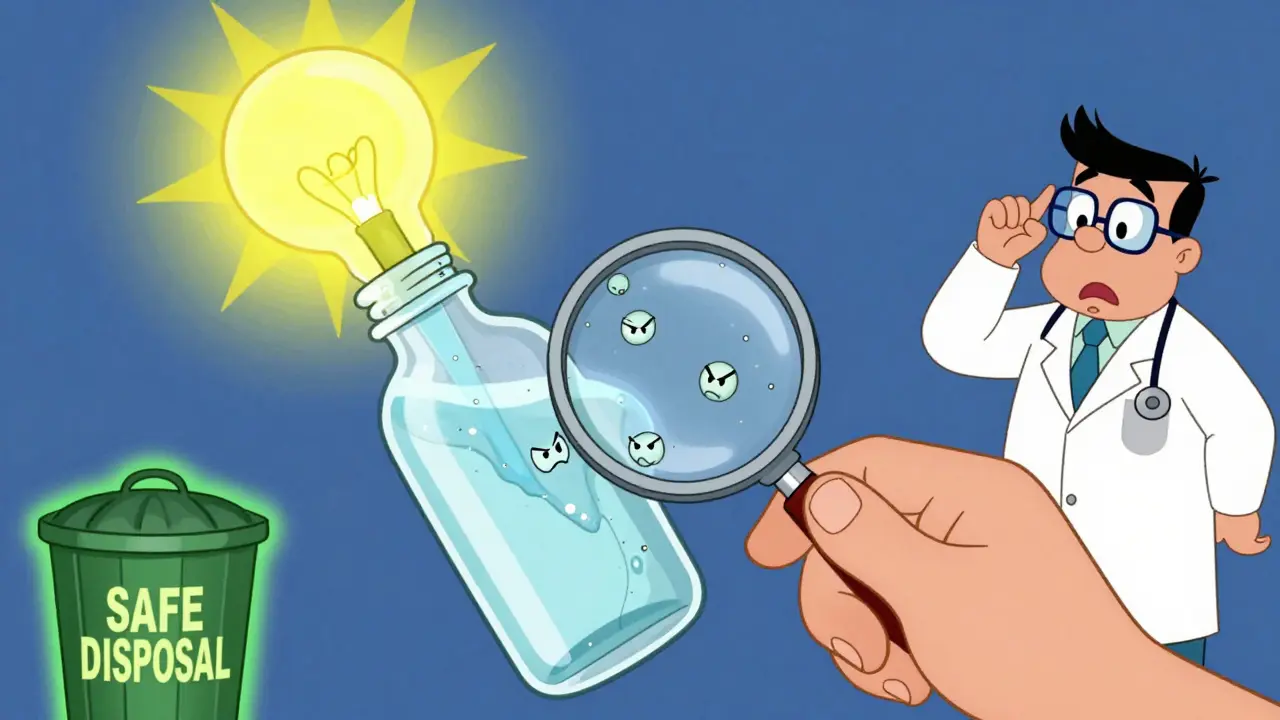
- Don’t flush or trash it carelessly. Use a drug take-back program or follow FDA guidelines for safe disposal.
- Report it. If you think the drug was improperly stored by the pharmacy or manufacturer, report it to the FDA’s MedWatch program.
Pharmacists see this all the time. They’re trained to spot these changes. Don’t feel embarrassed to ask: "Does this look right?"
What’s Changing in the Industry
The future of drug safety is moving beyond human eyes. Portable Raman spectrometers, which can identify chemical composition in seconds, are becoming affordable for clinics and even home use. Pfizer’s Visual Stability AI, currently in trials, can predict degradation from microscopic texture changes with 94.3% accuracy.
But for now, visual inspection remains the most accessible tool-especially in places without labs or reliable power. The WHO still calls it the most practical method for identifying degraded medicines worldwide.
What’s clear: relying only on expiration dates is outdated. The real safety net is learning to read your medicine-not just the label.
Frequently Asked Questions
Can expired drugs become toxic?
Yes, in rare cases. While most expired drugs just lose potency, some degrade into harmful compounds. Tetracycline antibiotics, for example, can break down into substances that damage the kidneys. Epinephrine that turns pink or brown can cause dangerous reactions. Always discard drugs that show unusual color changes, especially darkening or unusual particles.
Is it safe to use a pill that’s slightly discolored if it’s only a week past the date?
No. The expiration date isn’t arbitrary-it’s based on stability testing under real-world conditions. A pill that’s discolored, even a week after expiration, has likely degraded. That’s especially true for heart medications, antibiotics, or insulin. Don’t gamble with your health.
Why do some pills change color faster than others?
It depends on the chemical structure. Drugs with unstable bonds-like tetracyclines, nitroglycerin, or certain antidepressants-are more sensitive to light, heat, and oxygen. Formulations with moisture-sensitive ingredients (like amoxicillin) degrade faster in humid environments. Always store medications in a cool, dry place, away from windows.
Can I trust the expiration date on generic drugs?
Yes, if they’re from a reputable manufacturer. Generic drugs must meet the same FDA stability standards as brand-name versions. But storage conditions matter more than the brand. A generic drug left in a hot car will degrade faster than a brand-name one stored properly.
What’s the best way to store medications long-term?
Keep them in their original containers, in a cool, dry place like a bedroom drawer-not the bathroom or kitchen. Avoid direct sunlight. Some medications, like insulin or liquid antibiotics, need refrigeration. Always check the label. Temperature swings are the #1 cause of physical degradation.


Rajni Jain
December 26, 2025 AT 13:38i used to keep my antibiotics in the bathroom 'cause it was convenient... until my amoxicillin turned into a sticky mess. now i store everything in a sealed container in my bedroom drawer. never again. your body doesn't care if you're 'too busy' to be careful.
Natasha Sandra
December 27, 2025 AT 22:30OMG YES 💯 I once took a yellowed nitroglycerin pill because I 'didn't have time' to go to the pharmacy... and I swear I felt like my heart was gonna explode. 🤯 Don't be me. Throw it out. Seriously. 🚫💊
Erwin Asilom
December 29, 2025 AT 20:34The distinction between chemical degradation and physical instability is critical. Oxidation of tetracycline derivatives produces anhydrotetracycline, a nephrotoxin. The FDA’s stability guidelines are not arbitrary-they’re rooted in accelerated aging studies under ICH Q1A(R2) protocols. Visual inspection is a useful heuristic, but not a substitute for laboratory analysis.
Sumler Luu
December 30, 2025 AT 01:04I work at a clinic and we see this all the time-people bringing in pills that look like they’ve been through a desert. We always offer free disposal and replacements. No judgment. Just safety. If you’re unsure, just ask. We’ve all been there.
roger dalomba
December 30, 2025 AT 23:50Wow. A 10-page essay on how to look at a pill. Next up: How to breathe without suffocating.
Sophia Daniels
December 31, 2025 AT 00:55Let me guess-you're the kind of person who still thinks 'expiration date' means 'suggested use-by for the weak.' 🤡 I've seen people take expired insulin like it's a TikTok challenge. Spoiler: your kidneys don't care about your 'trust issues' with pharmacies. If it looks like something crawled out of a swamp and died, DON'T. PUT. IT. IN. YOUR. BODY. 🇺🇸
Nikki Brown
December 31, 2025 AT 01:47You people are so reckless. I store all my meds in a climate-controlled safe with silica gel packets and UV-blocking film. And you're just... tossing them in the bathroom? 😔 I feel bad for your future selves. Also, you should be ashamed.
Peter sullen
December 31, 2025 AT 16:45While I appreciate the comprehensive overview, I would like to respectfully suggest that the integration of digital tracking systems-such as blockchain-based lot verification and IoT-enabled storage containers-may serve as a more robust, scalable, and auditable framework for ensuring pharmaceutical integrity, particularly in decentralized healthcare environments. The reliance on subjective visual cues, while historically pragmatic, is inherently non-reproducible and subject to cognitive bias.