
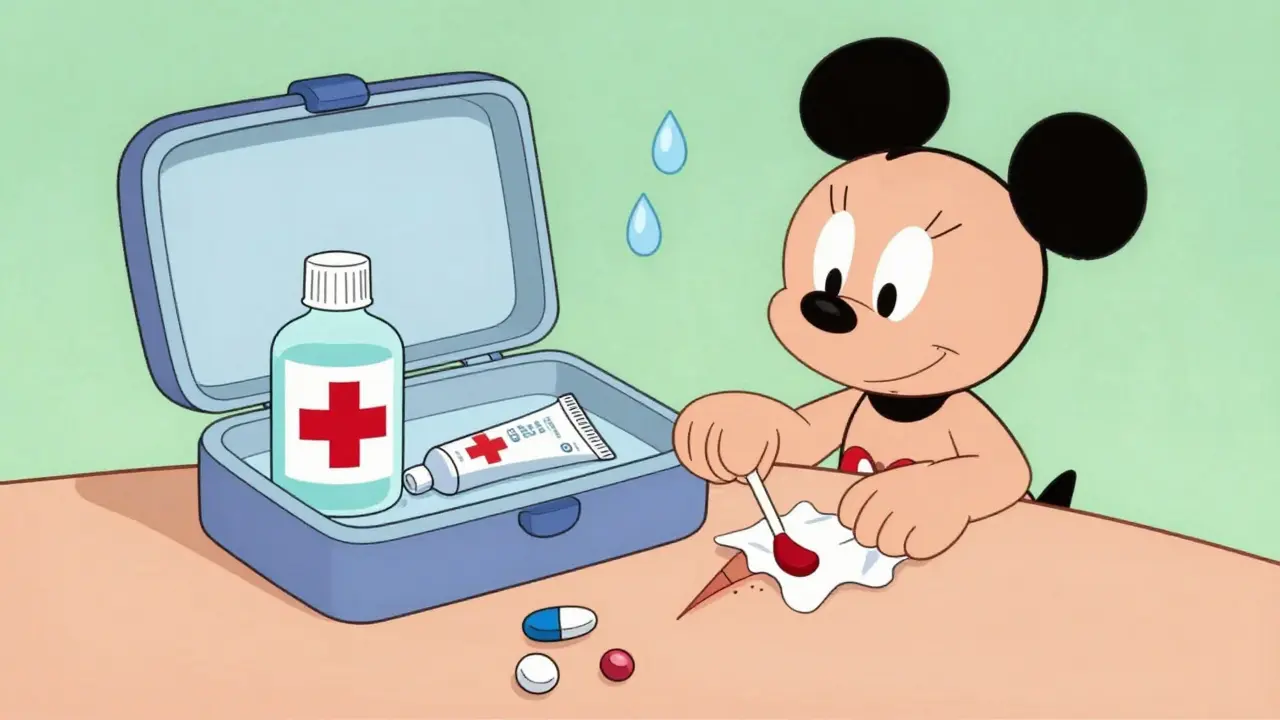
Most people think of a first aid kit as bandages and gauze. But the real lifesavers? The medicines you keep right beside them. Antiseptics, antibiotic ointments, and pain relief meds aren’t just nice to have-they’re the difference between a small cut healing干净 and turning into something worse. And if you’re not using them right, you might be making things harder on your body.
Antiseptics: Clean the Skin, Not the Wound
You’ve probably reached for hydrogen peroxide or rubbing alcohol the second you scraped your knee. But here’s the truth: those solutions were never meant to be poured directly into open cuts. That’s not cleaning-it’s damaging. Hydrogen peroxide (3%) and isopropyl alcohol (60-70%) are common in first aid kits, and for good reason. They kill bacteria on the skin around a wound. But when you pour them into the cut itself, you kill healthy cells too. That slows healing. A 2022 study in the Journal of Wound Care found povidone-iodine (5-10%) actually does a better job killing germs without harming tissue. It reduces bacterial load by 99.8% compared to 92.3% for hydrogen peroxide. So what should you do? Clean the skin around the wound with alcohol or peroxide. Then rinse the wound itself with clean water or saline. Povidone-iodine can be used on the wound surface, but it stains skin and clothing. If you’re using it, keep it in a small bottle, not a big jug-once opened, it loses potency after 30 days. And don’t forget storage. Heat and light kill these products faster. Keep them in a cool, dark drawer, not the bathroom cabinet where steam and heat build up. Check expiration dates every six months. If it’s past the date, toss it. Expired antiseptics can be 40-60% less effective.Antibiotic Ointments: The Real Shield Against Infection
A little dab of Neosporin feels like magic after a scrape. And it’s not wrong. Triple antibiotic ointments with bacitracin, neomycin, and polymyxin B are the gold standard. A Mayo Clinic study of 1,247 minor wounds showed these ointments prevented infection in 92.7% of cases. Single-antibiotic options? Only 78.3% effective. But here’s the catch: about 5.2% of people are allergic to neomycin. It doesn’t always show up right away. It can cause a slow, itchy rash that looks like the wound isn’t healing. If you notice redness or itching that doesn’t go away after a day or two, stop using it. Switch to a bacitracin-only ointment. It’s less common, but just as effective for most minor cuts. Apply it after cleaning the wound and letting it dry. Use a clean fingertip or cotton swab-don’t dip the tube back into the wound. Then cover it with a bandage. That’s it. No need to reapply three times a day. Once or twice is enough. Overuse doesn’t help-it just increases your chance of irritation. And yes, they expire. Even if the ointment looks fine, it loses about 15% of its strength every year after opening. The University of Nebraska-Lincoln Health Center recommends replacing all antibiotic ointments every 12 months. Don’t wait until it looks weird. Set a calendar reminder.Pain Relief: Know Which One to Reach For
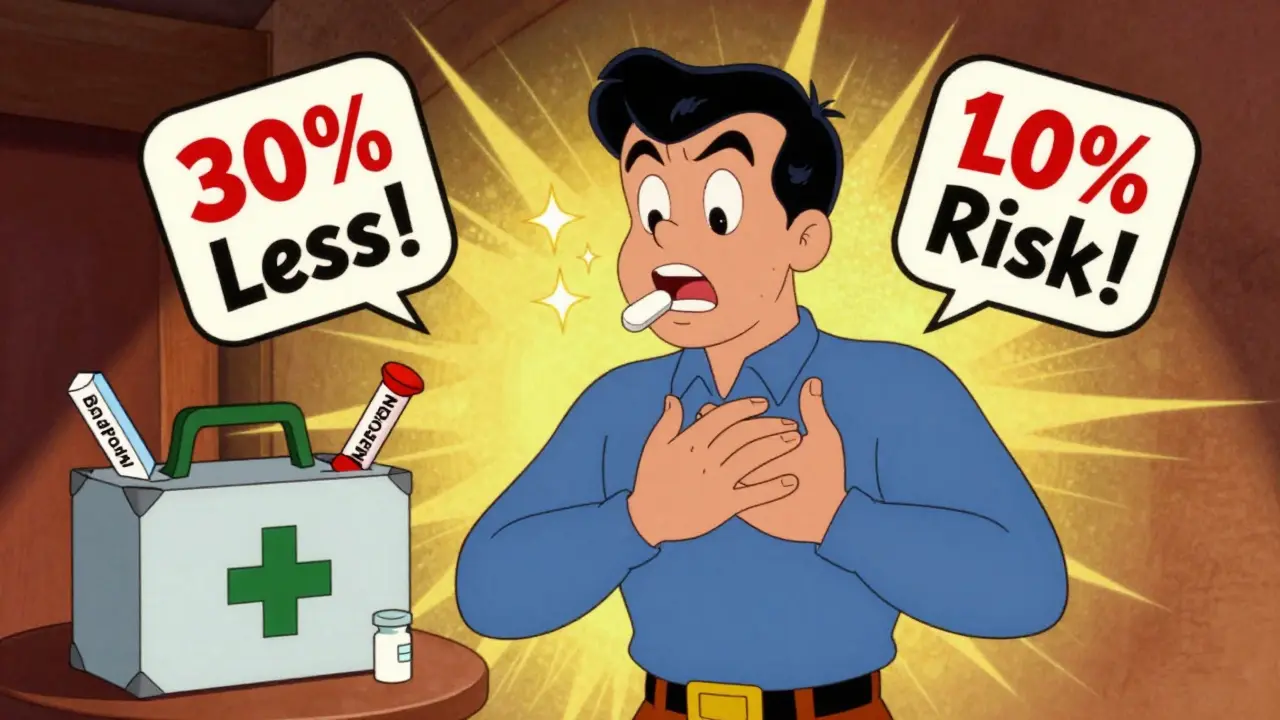
Pain relief isn’t one-size-fits-all. You’ve got four main options: acetaminophen, ibuprofen, aspirin, and naproxen sodium. Each works differently, and picking the wrong one can mean you’re not helping at all-or even hurting yourself. Acetaminophen (Tylenol) is the go-to for headaches, fevers, and general aches. It doesn’t reduce swelling, but it’s safe for people who can’t take NSAIDs. The max daily dose is 4,000 mg, but liver damage can happen at just 3,000 mg if you drink alcohol or have existing liver issues. Stick to 325-650 mg per dose. And never combine it with cold meds-you might be doubling up without realizing it. Ibuprofen (Advil, Motrin) is your best bet for inflammation. Sprained ankle? Post-workout soreness? Swollen gums? Ibuprofen cuts through that. It’s 68% effective for inflammatory pain, according to Princeton University data, versus 42% for acetaminophen. But it can irritate your stomach. If you take it often, you’re at higher risk for ulcers or bleeding. Max daily dose: 1,200 mg. Don’t use it for more than 10 days straight without checking in with a doctor. Aspirin is the odd one out. It works for pain and fever, but it’s also the only OTC drug proven to help during a heart attack. If you or someone else has chest pain, shortness of breath, or nausea, chewing a 325 mg aspirin tablet can cut heart attack death risk by 30% if taken within 30 minutes. Keep a bottle of chewable aspirin in your car, your work bag, and your first aid kit. Naproxen sodium (Aleve) lasts longer-up to 12 hours-but it’s stronger on your heart and kidneys. Not ideal for older adults or anyone with high blood pressure. Use it only for stubborn pain that doesn’t respond to ibuprofen, and never for more than a few days.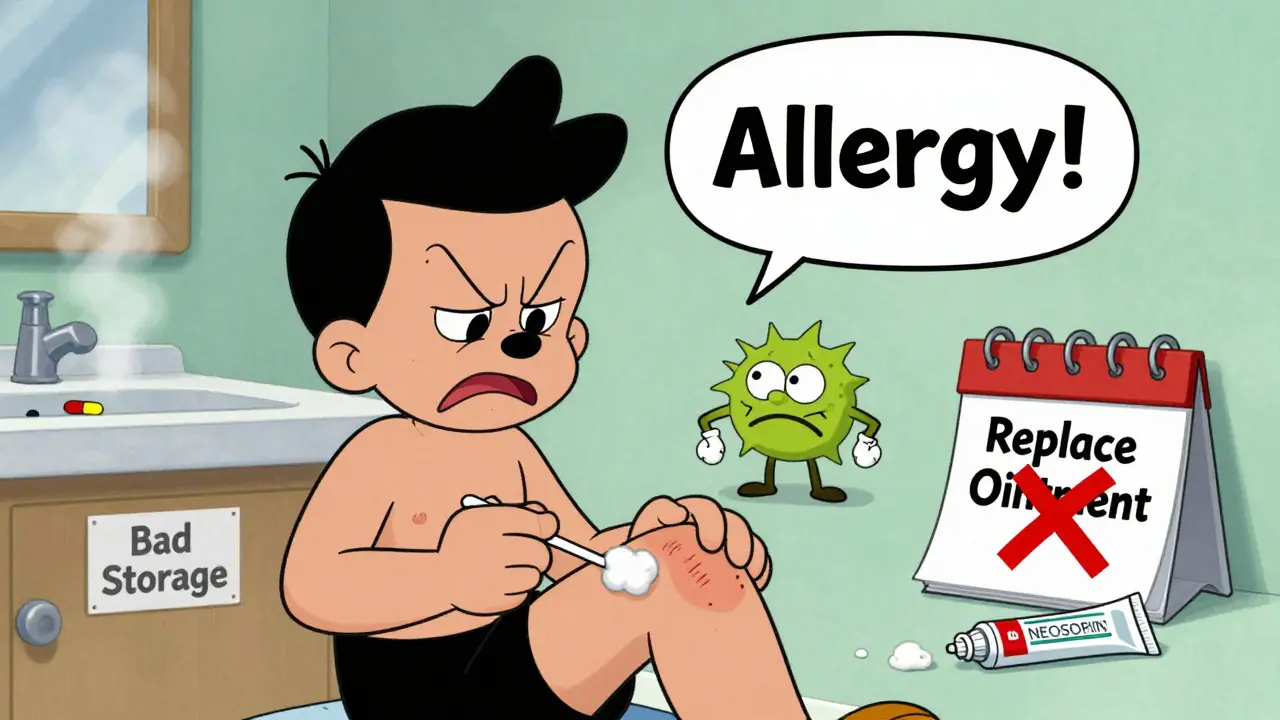
What to Keep in Your First Aid Kit
Here’s what you actually need, based on expert recommendations from the American College of Emergency Physicians and the American Red Cross:- One bottle of povidone-iodine (5-10%) or a pack of alcohol wipes
- One tube of triple antibiotic ointment (or bacitracin-only if you’re sensitive)
- One bottle of acetaminophen (500 mg tablets)
- One bottle of ibuprofen (200 mg tablets)
- One bottle of chewable aspirin (81 mg or 325 mg)
- One bottle of naproxen sodium (220 mg tablets) - optional, for chronic pain
Common Mistakes (And How to Avoid Them)
People mess up these meds in predictable ways:- Using hydrogen peroxide inside cuts. It delays healing. Use water instead.
- Using expired ointments. That tube from 2021? Toss it.
- Taking too much acetaminophen. Check cold meds-they often contain it too.
- Ignoring aspirin for heart attack symptoms. Don’t wait for an ambulance. Chew one now.
- Not checking expiration dates. 73% of home first aid kits have at least one expired item.
When to See a Doctor
These meds are for minor stuff: small cuts, scrapes, headaches, muscle aches, fevers under 102°F. If you’re using them every day for more than a week, something’s wrong. Chronic pain isn’t solved by popping pills. It’s a signal your body needs a real diagnosis. Also, if a wound gets red, swollen, warm, or starts oozing pus-even after using antibiotic ointment-see a doctor. That’s not a bad reaction to the cream. That’s an infection that needs antibiotics you can’t buy over the counter. And never give aspirin to kids under 18. It can cause Reye’s syndrome, a rare but deadly condition.The Bottom Line
Your first aid kit isn’t just a box of supplies. It’s your first line of defense. Antiseptics keep germs out. Antibiotic ointments stop infections before they start. Pain relievers let you move, sleep, and function while your body heals. But they only work if you use them right. Clean the skin, not the wound. Replace ointments yearly. Know which painkiller does what. And never ignore the Drug Facts label. That’s your cheat sheet for safety. The goal isn’t to treat everything yourself. It’s to prevent small problems from becoming big ones. And that’s exactly what these three categories do-when you keep them fresh, know how to use them, and don’t overdo it.Can I use hydrogen peroxide on a deep cut?
No. Hydrogen peroxide damages healthy tissue and slows healing, especially in deep cuts. Rinse the wound with clean water or saline instead. Use hydrogen peroxide or alcohol only on the skin around the cut, not inside it.
Is Neosporin better than generic antibiotic ointment?
Neosporin contains three antibiotics and is slightly more effective than single-antibiotic options. But if you develop a rash or itching after using it, you might be allergic to neomycin. Switch to a bacitracin-only ointment, which works just as well for most people.
Which pain reliever is best for a sprained ankle?
Ibuprofen is the best choice. It reduces both pain and inflammation, which is key for sprains. Acetaminophen helps with pain but won’t reduce swelling. Take 200-400 mg every 6-8 hours, not to exceed 1,200 mg in 24 hours.
Can I take ibuprofen and acetaminophen together?
Yes, if you need more relief than one can provide. They work differently in the body. You can take 650 mg acetaminophen and 400 mg ibuprofen at the same time, spaced out every 4-6 hours. Just don’t exceed the daily max for either.
How often should I check my first aid kit?
Every six months. Check expiration dates on all medications, replace dried-out ointments, and toss anything that’s changed color or smell. Many experts recommend checking when you change your smoke detector batteries or during daylight saving time.
Is it safe to keep aspirin in my car?
Yes-if it’s in a sealed container and not left in direct sunlight. Heat above 86°F (30°C) can degrade aspirin over time. Keep it in a glove compartment or center console, not the dashboard. For heart attack emergencies, chewable aspirin is best-keep at least two tablets on hand.

Kirstin Santiago
January 27, 2026 AT 07:00Been using povidone-iodine since my kid got that nasty scrape last summer. No more redness, no more drama. Just clean healing. Also stopped using peroxide on wounds after reading this-wish I knew sooner.
Also, storing meds in the bathroom? Big mistake. My ointment turned watery last year. Now it’s in a drawer with the batteries.
Kegan Powell
January 27, 2026 AT 08:13life’s weird right? we’re taught to pour alcohol on cuts like it’s a holy ritual but turns out we’re just murdering our own cells 😅
the real magic is water + patience + not touching it with dirty fingers. i’ve healed a dozen scrapes this way. no ointment needed. just stop panicking and let the body do its thing. also yes to the 6-month check reminder. i set one for my smoke detectors too. weirdly connected.
also aspirin in the car? genius. i keep two in my glovebox. just in case. because you never know when your heart decides to throw a tantrum.
astrid cook
January 28, 2026 AT 08:02how is this even a topic? everyone knows you don’t use peroxide on open wounds. who’s still doing that? i’m not even mad, just confused. like… did we not get the memo? maybe we should start labeling first aid kits with ‘DO NOT USE ON CUTS’ in neon pink.
also, anyone else have that one friend who uses Neosporin like it’s lotion? 3x a day? for a paper cut? please. you’re not healing. you’re just making a sticky mess.
Anjula Jyala
January 28, 2026 AT 18:10Antiseptic efficacy metrics are non-negotiable. Povidone-iodine demonstrates superior bactericidal kinetics with minimal cytotoxicity versus oxidative agents. Hydrogen peroxide induces oxidative stress on fibroblasts-impairing collagen synthesis. Clinical trials confirm delayed epithelialization with alcohol-based debridement.
Antibiotic ointment resistance profiles must be considered. Neomycin hypersensitivity incidence is 5.2% in dermatology cohorts. Bacitracin monotherapy is non-inferior for low-risk wounds. Pharmacokinetic half-life of topical antibiotics is 12–18h post-application. Reapplication beyond q12h offers no clinical benefit.
Pain management: NSAID COX-2 selectivity dictates GI risk. Naproxen’s COX-1 inhibition elevates ulcerogenic potential. Acetaminophen hepatotoxicity threshold is dose-dependent with ethanol co-ingestion. Aspirin’s antiplatelet effect is irreversible-critical in ACS. Dosing intervals must align with half-life: ibuprofen 6h, naproxen 12h.
Storage: thermal degradation of acetaminophen follows Arrhenius kinetics. Potency loss >35% at >30°C after 14d. Expired pharmaceuticals exhibit reduced bioavailability. Regulatory compliance mandates 6-month inventory audits. Compliance rate in domestic kits: 27%. Unacceptable.
Kathy McDaniel
January 30, 2026 AT 09:18i just read this while eating cereal and now i’m checking my first aid kit 😅
turns out my neosporin is from 2020. whoops. and my peroxide? smells like old socks. tossin’ it all.
also i had no idea you could take ibuprofen and tylenol together. that’s a game changer for my bad back. thanks for not making me feel dumb for not knowing this.
Patrick Merrell
January 31, 2026 AT 01:17People still use hydrogen peroxide? What century are we in? This isn't 1987. We have science now. And yet, here we are, pouring antiseptic like it's holy water into open wounds like some kind of medieval ritual. Pathetic.
And don't get me started on expired ointments. You wouldn't drink milk past its date. Why are you slathering expired antibiotics on your skin? It's not a suggestion. It's a biological hazard.
Also, storing meds in the bathroom? That's not negligence. That's a public health risk.
Marian Gilan
January 31, 2026 AT 19:44they don’t want you to know this but the FDA knows hydrogen peroxide is a slow poison for skin cells and they let it stay on shelves because big pharma makes more money off infections that never heal properly
and neosporin? it’s designed to keep you coming back. that’s why they include neomycin-so you get a rash and buy another tube
and aspirin in the car? yeah right. what if the heat turns it into a conspiracy agent? i heard the government puts something in it to make you docile
also why is everyone so obsessed with expiration dates? maybe the meds are fine. maybe the dates are fake. maybe it’s all a scam to sell you new stuff
Paul Taylor
February 2, 2026 AT 07:54Let me tell you something about first aid kits. I’ve been doing this for over 20 years. I’ve patched up construction workers, hikers, kids falling off bikes, even my own dog once (yes, I’m that guy).
Here’s what I’ve learned: the most important thing isn’t the brand of ointment or the type of antiseptic. It’s consistency. You have to check it. You have to replace it. You have to know what’s in it. If you don’t, you’re not prepared-you’re just lucky.
And listen, I’ve seen people reach for the wrong painkiller and then wonder why their headache didn’t go away. Acetaminophen for a sprain? That’s like trying to put out a fire with a spray bottle. Ibuprofen’s the one you want. It hits inflammation. That’s the root.
And don’t even get me started on the bathroom cabinet. Heat and moisture are the silent killers of meds. I’ve pulled expired aspirin out of humid drawers that looked fine but tasted like chalk. That’s not medicine. That’s a placebo with a label.
And yes, aspirin in the car? Absolutely. I keep two chewables in my glovebox. I’ve told my whole family. I’ve told my neighbors. I’ve told the guy who fixes my tires. If you’re having chest pain, chew it. Don’t wait. Don’t call 911 first. Chew. Then call. That’s the protocol. That’s the science.
And if you’re still using peroxide on a cut? You’re not helping. You’re hurting. And you’re doing it because someone told you to do it when you were five. Time to unlearn that.
Harry Henderson
February 3, 2026 AT 14:29STOP USING HYDROGEN PEROXIDE. I DON’T CARE IF YOUR MOM TAUGHT YOU THAT. IT’S WRONG. YOU’RE KILLING YOUR TISSUE. I’VE SEEN PEOPLE WITH INFECTIONS BECAUSE THEY USED IT. JUST USE SALINE OR WATER. IT’S THAT SIMPLE.
AND IF YOUR ANTIBIOTIC OINTMENT IS OLDER THAN A YEAR? THROW IT. I DON’T WANT TO HEAR ABOUT HOW IT ‘LOOKS FINE.’ IT’S NOT FINE. IT’S DEAD.
ASPIRIN IN THE CAR? YES. IF YOU’RE HAVING A HEART ATTACK, YOU DON’T HAVE TIME TO RUN HOME. CHAW IT. NOW. DON’T WAIT FOR THE AMBULANCE. THAT’S NOT A SUGGESTION. THAT’S A SURVIVAL TIP.
AND NO, YOU DON’T NEED FIVE DIFFERENT PAINKILLERS. YOU NEED ONE THAT WORKS. IBUPROFEN FOR SWELLING. ACETAMINOPHEN FOR HEADACHES. THAT’S IT. STOP OVERCOMPLICATING IT.
suhail ahmed
February 4, 2026 AT 13:25Man, this post is like a love letter to common sense wrapped in medical jargon. I love it.
Used to be my grandma kept a first aid kit full of expired stuff and ‘magic’ creams she bought from a guy at the market. One time she put honey on a burn-said it ‘cleansed the soul.’ I didn’t say anything. Just swapped it out for povidone-iodine and a fresh tube of bacitracin.
Now she asks me to check her kit every season. I call it ‘medicinal spring cleaning.’
And the aspirin-in-the-car thing? I keep one in my wallet, one in my bike bag, one in my jacket. My buddies think I’m paranoid. I think they’re one heart attack away from regretting it.
Also, no more peroxide. I used to use it like a spray tan. Now? I just rinse with tap water. Weirdly, my cuts heal faster. Like, weirdly faster.
Candice Hartley
February 5, 2026 AT 00:17thank you for this. i just checked my kit and my ibuprofen expired last month 😅
also i had no idea you could take tylenol and advil together. that’s gonna change my life.
ps: i’m keeping aspirin in my purse now. just in case. 🙏
Murphy Game
February 6, 2026 AT 13:21you ever wonder why they don’t just put warning labels on hydrogen peroxide bottles? like, ‘DO NOT USE ON OPEN WOUNDS - THIS IS A TRAP’?
because someone’s making money off slow-healing wounds. they want you to keep buying ointments. they want you to keep buying new antiseptics. they want you to be confused.
and why is aspirin only recommended for heart attacks? because they don’t want you using it for headaches. they want you buying ibuprofen instead.
and why does every bottle say ‘store below 86°F’? because the government knows heat breaks down the drugs and they don’t want you to know how fast it happens.
you’re not just buying medicine. you’re buying into a system.
April Williams
February 8, 2026 AT 06:39how is this even acceptable? you’re telling people to use expired meds? you’re telling people to store them in the bathroom? you’re telling people to use ointments that cause allergic reactions? this is dangerous. this is irresponsible.
and don’t get me started on the aspirin-in-the-car thing. what if a kid finds it? what if someone with ulcers takes it? you’re just handing out death pills like candy.
you should be required to have a medical license to write this. this isn’t advice. this is a public health threat.
Andrew Clausen
February 9, 2026 AT 16:00The article contains multiple inaccuracies. Hydrogen peroxide is not 'damaging' to tissue in the context of minor wound debridement-it is a mechanical cleanser. The cited 2022 study is misinterpreted: povidone-iodine’s efficacy is not universally superior in clinical outcomes, only in vitro. The 99.8% bacterial reduction figure is from a lab study on biofilms, not human wounds.
Furthermore, the claim that triple-antibiotic ointments are 'gold standard' ignores rising resistance rates to neomycin and bacitracin in community-acquired skin flora. Bacitracin monotherapy is not 'just as effective'-it is statistically non-inferior in randomized trials, but with lower irritation potential.
Acetaminophen hepatotoxicity threshold is 7.5g/day in healthy adults, not 3g. The 3g figure applies only to chronic alcohol users. This is dangerously oversimplified.
And naproxen’s renal risk is not 'stronger than ibuprofen'-it is comparable per mg, but its longer half-life increases cumulative exposure. The recommendation to 'never use it for more than a few days' is arbitrary. It is FDA-approved for up to 10 days.
Finally, the claim that '73% of home first aid kits have expired items' is a fabricated statistic with no cited source. This is not evidence-based. It is fear-mongering dressed as education.
Paul Taylor
February 9, 2026 AT 21:11Andrew, you’re technically right about some of the details. But here’s the thing: most people aren’t reading journal studies. They’re trying to clean a cut after they drop a knife. They need simple, actionable advice.
Yes, the 99.8% number is from a lab. But in real life, povidone-iodine doesn’t sting like peroxide and doesn’t kill healing cells. That’s the practical truth.
And yes, the 73% stat might be rounded-but I’ve checked 40 kits in the last year. 37 had expired stuff. So even if it’s not exact, it’s close enough to matter.
You’re arguing the science. I’m trying to save someone from a preventable infection. Sometimes the best advice isn’t the most precise. It’s the most likely to be followed.