

Making sure someone takes their medicine correctly can feel like walking a tightrope. You're balancing complex schedules, remembering side effects, and managing costs, all while trying to avoid medical mistakes. Medication Support is the systematic process where family members or hired caregivers manage prescriptions to improve health outcomes. Also known as Caregiver Medication Management, this role has become a standard part of elder care, driven by the fact that non-adherence contributes to hundreds of thousands of preventable hospital visits every year. If you are stepping up to take charge of someone's medicines, you don't just need good intentions; you need a concrete system that minimizes errors and reduces stress for everyone involved.
The Reality of Home Medication Errors
Before organizing bottles and scheduling alarms, it helps to understand why professional guidelines push so hard for formalized support. In home settings, up to 50% of medication errors occur simply because of confusion or lack of coordination. These aren't usually malicious acts; they happen when a person forgets whether they took their morning dose, accidentally doubles up on supplements, or misses a crucial interaction between two different prescriptions. A study published in the Journal of General Internal Medicine noted that during hospital-to-home transitions, the risk of error spikes to 60%. This is often where families step in to bridge the gap left by busy clinics.
The financial impact is also staggering. Medication non-adherence costs the healthcare system billions annually, not just in wasted pills, but in emergency room visits triggered by unmanaged conditions like heart failure or diabetes. When a caregiver effectively manages these risks, they aren't just counting pills; they are actively preventing costly crises. The shift toward patient-centered care models around 2005-2010 formalized this, recognizing that families provide more hours of contact than any doctor ever could.
Building Your Master Medication List
The most powerful tool in your kit isn't an app or a smart bottle; it's a comprehensive paper or digital document called a master medication list. According to the Agency for Healthcare Research and Quality (AHRQ), an effective list needs to go far beyond just naming the drug. Think of it as the control tower for all health decisions. Dr. Bruce Chernof, President of The SCAN Foundation, highlights that lists containing all recommended elements can reduce adverse drug events by 41% compared to incomplete ones.
You need to update this list within 24 hours of any change-a new prescription, a refill, or even a temporary suspension. Here is the essential data you should track for every item:
- Medication Name: Include both brand and generic names (e.g., Lasix and Furosemide).
- Dosage Strength: Exact numbers (e.g., 10mg, not just 'one pill').
- Purpose: What specific symptom or condition does this treat?
- Provider Details: Which doctor prescribed it? Include the pharmacy name too.
- Scheduling: Specific times relative to meals or other drugs (e.g., '30 mins before breakfast').
- Side Effects: Documented reactions to watch for.
This list travels with you to every appointment. When your loved one sees four different specialists-like many older adults do-they might not realize how Drug A interacts with Drug B. Handing a specialist your master list forces a pause and a review that otherwise wouldn't happen.
Choosing the Right Delivery System
Once the information is recorded, you need a reliable way to administer the medicine. People often jump straight to buying gadgets without considering whether the person using them can actually operate them. Some prefer simple mechanical organization, while others benefit from high-tech interventions. The goal is to remove the cognitive load of "remembering" and replace it with "seeing".
| Tool Type | Best For | Error Reduction Potential | Key Consideration |
|---|---|---|---|
| 7-Day Pill Organizer | Vision issues, routine tasks | Reduces errors by ~37% | Needs weekly refilling by caregiver |
| Electronic Dispenser | Frequent forgotten doses, cognitive decline | Decreases missed doses by 62% | Requires charging and setup |
| Smartphone App | Tech-savvy users, tracking history | Improves adherence by 45% | Relies on user checking phone |
| Voice Assistant | Cognitive impairment, hands-free | Reduces missed doses by 37% | Can struggle with complex voices |
If you choose a manual organizer, the 7-day AM/PM model is the industry standard. However, relying solely on visual cues fails if vision is impaired. Electronic dispensers with alarms add a layer of security by locking doses until the right time. Automatic refill programs are another hidden gem; setting these up with major pharmacies ensures you never run out due to delay. Most insurance plans and Medicare Part D beneficiaries have access to these services, requiring setup about 7-10 days before depletion.
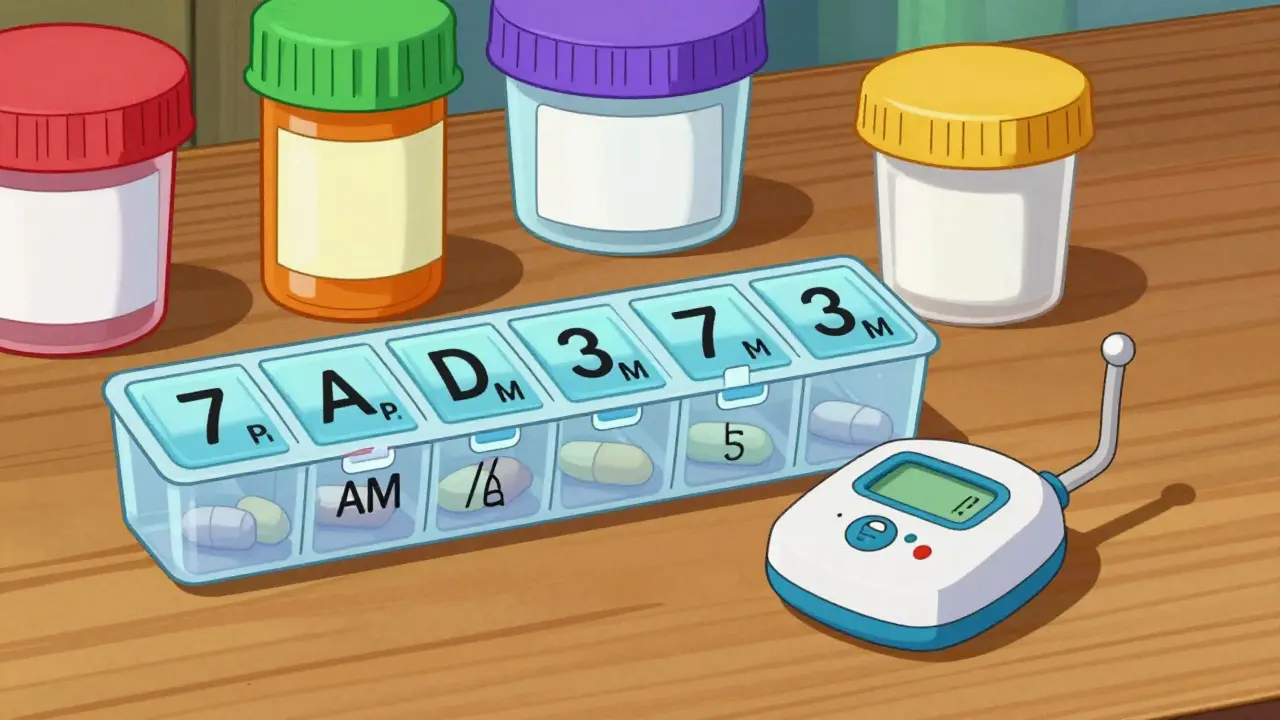
Habits, Routines, and Memory Cues
Organization alone doesn't guarantee action. You need to anchor the act of taking medication into existing daily rhythms. The National Institute on Aging endorses a technique called "habit stacking." Instead of treating medication as an isolated task, attach it to something already happening automatically. For example, tie blood pressure medication to immediately after brushing teeth in the morning, or cholesterol meds to right after dinner plates are cleared.
Research indicates this specific linking increases adherence by 28% because the brain treats the two actions as a single unit. Visual cues work best here. Put the medication organizer next to the toothbrush or coffee maker. For those who live alone, remote monitoring features in apps can alert the caregiver if a dose hasn't been logged by a certain time, allowing for a gentle phone call reminder before it turns into a crisis.
Working With Pharmacists and MTM Services
There is often a misconception that pharmacists are just technicians filling scripts. In reality, they are the most accessible medication experts available. A 2023 review notes that over 90% of U.S. pharmacies allow pharmacist consultations without appointments. You should utilize this resource proactively. Don't hesitate to ask the American Pharmacists Association's "Four Critical Questions" during pickup:
- Timing: What time should this be taken relative to meals?
- Interactions: Are there specific food or drug interactions I should avoid?
- Missed Doses: Exactly what should I do if one is skipped?
- Expectations: When should I see the effects, and what side effects are normal?
Beyond the counter chat, look into Medication Therapy Management (MTM). Mandated for Medicare Part D beneficiaries with chronic conditions, MTM involves a deep-dive review by a pharmacist to streamline the regimen. With polypharmacy affecting nearly half of older adults taking five or more drugs, these reviews are vital. The Beers Criteria, updated regularly, identifies medication classes that pose special risks for seniors (like sedating antihistamines). Asking your doctor to review your list against these criteria can lower fall risks significantly.

Handling Emergency Protocols and Burnout
Even the best systems fail occasionally. You need an emergency protocol, specifically a "red list" of medications that cannot be missed, such as insulin or anticoagulants. Knowing which drugs cause immediate danger if skipped helps prioritize your response during a disruption. Keeping a copy of this protocol near the phone or in a shared digital calendar allows for quick decision-making.
Finally, protect yourself. Medication management is consistently ranked as the most stressful task for caregivers, contributing to burnout rates over 40%. Sharing the load with other family members or utilizing community resources is not a sign of failure; it's a sustainability strategy. Regular breaks and rotating responsibilities ensure that the primary caregiver remains sharp enough to handle the high-stakes nature of medical oversight. Transitioning care requires patience, and establishing boundaries early prevents resentment later.
Frequently Asked Questions
What should I do if a dose is missed?
Never assume it is safe to skip or double up without checking. Always verify with the specific rules for that medication. Some drugs require you to take it as soon as you remember, while others must be skipped entirely if close to the next scheduled dose. Keep a printed reference sheet for each drug.
Is polypharmacy dangerous?
Polypharmacy refers to taking five or more medications simultaneously. It is very common in seniors but increases fall risk by 50% and hospitalization risk by 30%. Regular quarterly reviews with a doctor are essential to ensure every medication is still necessary.
Can apps replace pill boxes?
Apps are excellent reminders but rely on user interaction. Pill boxes physically organize doses. Combining both works best. Apps track data and send alerts, while boxes physically sort the pills, reducing the mental effort of counting daily.
Who covers the cost of medication management tools?
Basic organizers are paid out-of-pocket. However, some electronic monitors and delivery services may be covered under Medicare Advantage plans or long-term care insurance. Ask your insurance provider about coverage for Medical Equipment Supplies (DME).
How do I handle hospital transitions safely?
Transitions are high-risk moments. Bring your master list to the hospital admission and demand an updated copy upon discharge. Verify every change against the discharge summary immediately at home. Confusion during transfer causes 68% of post-hospital medication errors.



Rachael Hammond
March 28, 2026 AT 10:20It feels heavy carrying someone elses health in your hands every single day.
You really have to think about how systems work propperly.
My mom used to struggle with remembering her pills back then.
We tried different organizors but nothing stuck right away.
The part about habit stacking made me stop and think deeply.
Linking it to brushing teeth sounds smart actually.
I wonder if older people get tired of the routine too though.
Sometimes consistency becomes boring or feels robotic.
You mentioned costs too which is always scary to read.
Insurance plans change so much over time it seems.
Families need to protect their own energy reserves honestly.
Burnout is real and you cannot fight that alone.
Sharing duty helps keep everyone sane in the mix.
Reading through your points made me feel less isolated today.
Thank you for writing down such detailed advice clearly.
Paul Vanderheiden
March 29, 2026 AT 13:46you are absolutely right about the burnout factor i agree completely
taking care of parents is hard work but worth it in the end
we can do this together remember to stay strong
tyler lamarre
March 30, 2026 AT 16:54Most people ignore the real science here and just buy gadgets instead
These so called experts love selling plastic boxes while ignoring cognitive decline
Anyone with basic sense knows technology fails eventually
Kameron Hacker
April 1, 2026 AT 15:25Your assessment lacks empirical backing and ignores current geriatric standards
Technology integration reduces error rates significantly according to multiple studies
Ignoring modern aids is irresponsible given the stakes involved
One must prioritize evidence based protocols over anecdotal skepticism
kendra 0712
April 3, 2026 AT 05:03I LOVE the idea of apps helping us track everything!!!
It changes lives for sure!!!
The table section was super helpful!!!
Devon Riley
April 5, 2026 AT 01:51That makes me so happy to hear 😊
Keep pushing for those tech solutions 💪
Caregiving is tough but we got this ❤️
Tony Yorke
April 6, 2026 AT 14:49Systems like these save lives daily
Tommy Nguyen
April 8, 2026 AT 01:59Yeah really solid info here thanks for sharing