
Medication Side Effect Comparison Tool
Medication Category Selection
Select a medication category to see sexual side effect rates and management options.
Medication Comparison
Your Options
Based on your selection, here are recommended next steps:
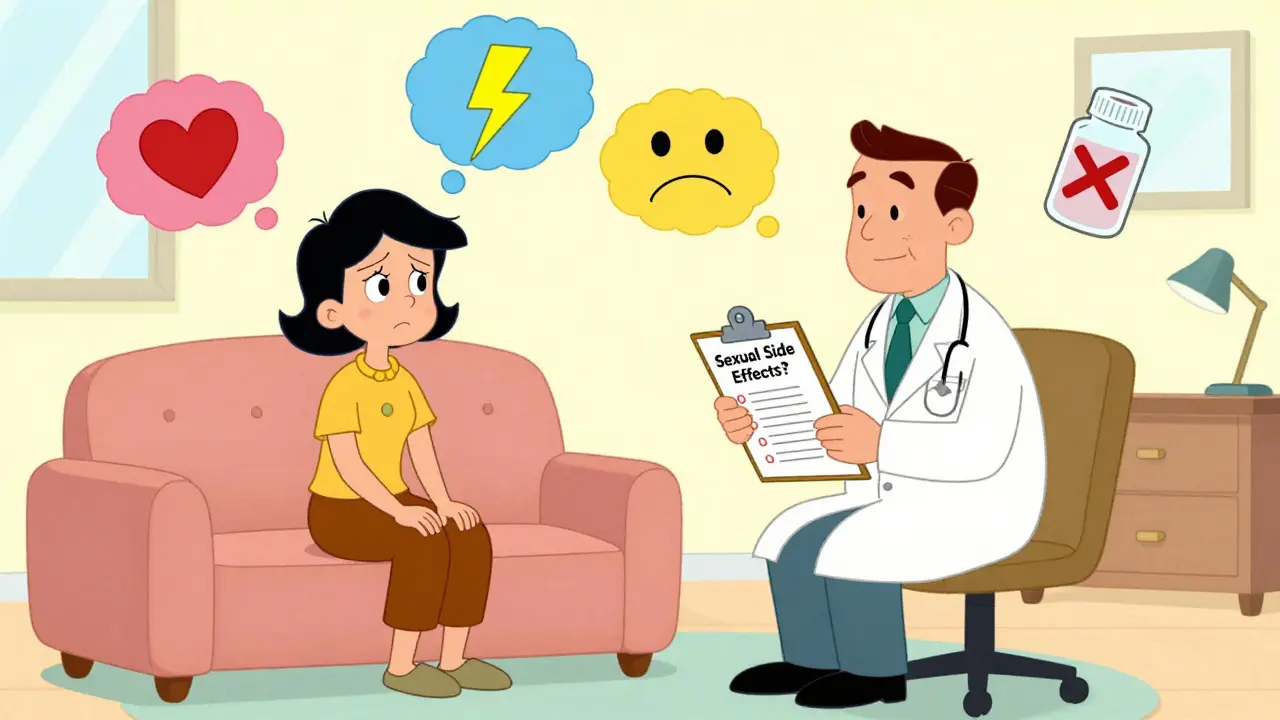
When you start a new medication for depression, anxiety, or another mental health condition, you’re likely focused on how it will help you feel better. But for many people, a hidden side effect quietly undermines their progress: sexual dysfunction. It’s not rare. In fact, sexual side effects affect between 58% and 70% of people taking common antidepressants like SSRIs. Yet, most patients never hear about this risk before they start the medication. And even when they do, they often stay silent out of shame or the belief that nothing can be done.
Why Sexual Side Effects Are More Common Than You Think
It’s not just antidepressants. Antipsychotics, blood pressure meds, and even some hormonal treatments can cause sexual problems. But the biggest culprits are SSRIs-medications like fluoxetine, sertraline, and paroxetine. These drugs increase serotonin in the brain, which helps lift mood-but serotonin also plays a role in sexual response. Too much of it can shut down desire, make it hard to get or keep an erection, delay or block orgasm, or even cause painful sex. For men, the most common issues are low libido (62% of cases), erectile dysfunction (48%), and delayed or absent orgasm (up to 50%). For women, the top complaints are lack of interest (57%), trouble reaching orgasm (at least 30%), and pain during sex (38%). These aren’t just inconveniences. They strain relationships, lower self-esteem, and make people feel broken-even when their mental health is improving. Here’s the twist: up to half of people with untreated depression already have sexual problems before they even start medication. That makes it hard to tell if the issue is the illness or the drug. That’s why it’s critical to talk about sexual function before you begin treatment.What No One Tells You About Medication Changes
Many people assume they have to live with sexual side effects because their doctor never mentioned alternatives. But switching medications isn’t a failure-it’s a smart adjustment. Some antidepressants are far less likely to cause sexual problems. Bupropion (Wellbutrin) and mirtazapine (Remeron) have sexual side effect rates as low as 5-10%, compared to 50-70% with SSRIs. Switching from an SSRI to one of these can improve sexual function in 65-70% of cases. For people on antipsychotics, high prolactin levels can kill libido and cause breast changes or erectile issues. Switching to aripiprazole (Abilify) can fix this in 75% of cases. And if you’re on a medication that works well for your mood but messes with your sex life, you don’t have to quit it entirely. Dose reduction helps in 25-30% of people. Some people even use “drug holidays”-skipping the pill for 2-3 days before planned intimacy. That works for about 40% of users, but it’s risky if you’re on a short-acting drug like paroxetine, which can cause withdrawal symptoms.What Actually Works: Real Solutions Beyond Pills
Pills aren’t the only answer. For men with erectile problems, PDE5 inhibitors like sildenafil (Viagra) help about 55-60% of the time. But they rarely fix low desire or orgasm issues. And they’re not magic bullets-many people use them wrong, expecting instant results without understanding timing or dosage. Counseling helps people use them effectively. For women, there are fewer approved medications, but non-drug strategies can make a big difference. Sexual scheduling-planning intimacy for times when the medication’s effects are lowest-works for 35% of couples. Couples therapy, especially when relationship tension has built up, improves outcomes in half the cases. Talking openly with your partner about what’s changed, what you miss, and what you’d like to try again can rebuild intimacy faster than any pill.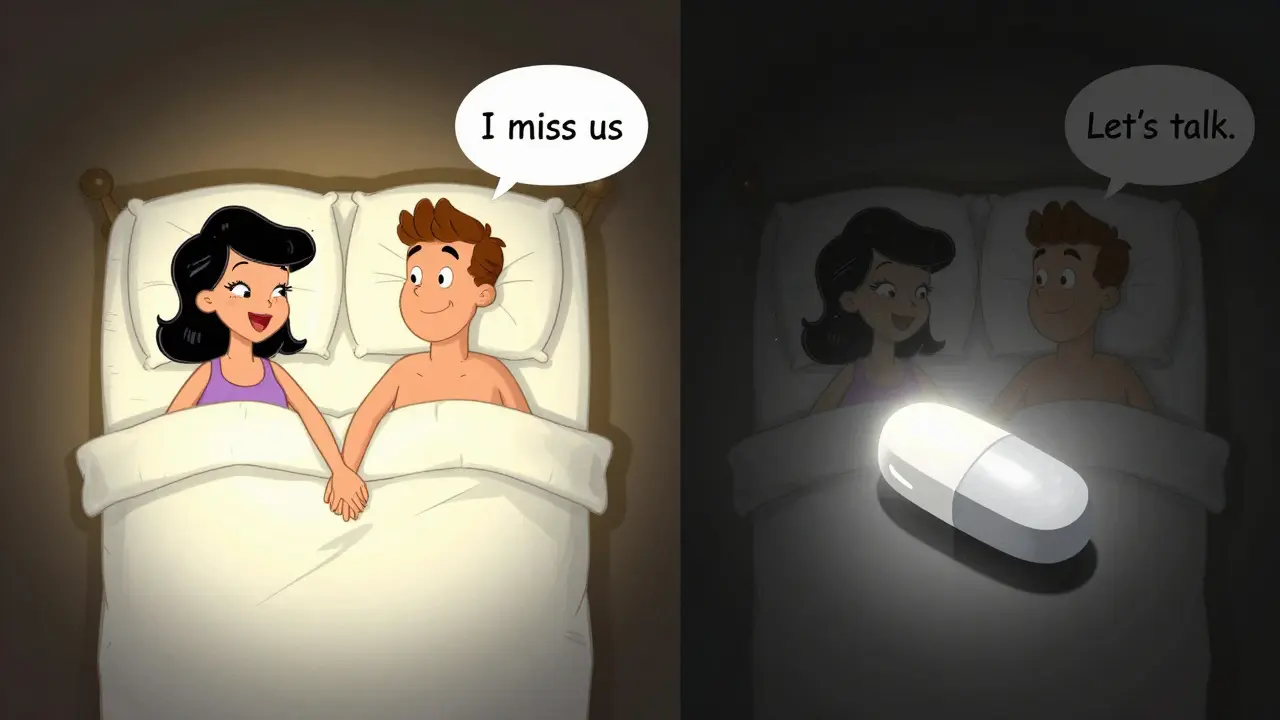
Why Talking to Your Doctor Matters-And Why So Few Do
Despite how common these side effects are, most patients never bring them up. A 2022 NAMI survey found that 73% of people waited an average of 4.2 months before telling their provider. Why? Embarrassment. Fear of being judged. Belief that it’s normal. Or worse-being told, “It’s just part of getting better.” But when doctors do bring it up, outcomes change. Patients whose providers discussed sexual side effects before starting medication were 82% more likely to report high satisfaction with treatment. Those who didn’t? Only 47%. That’s a huge gap. Experts now say the best practice is to ask about sexual function at every visit-especially at the 2-, 4-, and 6-week marks after starting a new drug. Tools like the Arizona Sexual Experience Scale (ASEX) take less than 10 minutes to complete and give real data, not vague feelings. Pharmacists can help too. Many now offer sexual health counseling as part of medication reviews.What You Can Do Right Now
You don’t have to wait for your next appointment to take action. Here’s what works:- Before starting a new medication: Ask, “What are the chances this will affect my sex life?”
- If you’re already on a drug and having issues: Don’t wait. Say, “I’ve noticed changes in my sex drive or performance. Can we talk about options?”
- Track your symptoms: Note when problems started, what’s changed, and whether they’re worse at certain times of day or after meals.
- Ask about alternatives: “Is there another medication with fewer sexual side effects that would still help my depression/anxiety?”
- Bring your partner: If you’re comfortable, invite them to the conversation. Their perspective matters.
The Bigger Picture: Why This Isn’t Just a Personal Problem
This isn’t just about individual discomfort. Sexual side effects are a leading cause of people stopping their medication. A 2003 national survey found 41.7% of men and 15.4% of women quit psychiatric drugs because of sexual problems. That means thousands of people relapse-not because the treatment didn’t work, but because they were never given the tools to manage a predictable side effect. Health systems are starting to catch on. Since 2020, the FDA requires clearer warnings about sexual side effects in medication guides. In 2023, 62% of major U.S. health systems began screening for these issues as part of routine care. Apps like MoodFX now let users track mood and sexual function together. Clinical trials are testing new drugs designed to block sexual side effects without reducing antidepressant benefits. But progress is uneven. Women’s sexual health is still under-researched-only 12% of clinical trials on sexual dysfunction focus on women. LGBTQ+ patients report lower rates of discussion with providers. Insurance rarely covers sex therapy. And many doctors still feel uncomfortable bringing it up.You’re Not Alone. And You Don’t Have to Suffer in Silence
One patient on HealthUnlocked shared: “My doctor switched me to bupropion after I mentioned sexual problems at our 6-week check-in. My sex life improved within two weeks. I’ve stayed on treatment for 18 months now.” That’s the kind of outcome that’s possible when you speak up-and when your provider listens. Sexual side effects aren’t a sign of weakness. They’re a biological response to a chemical change. And like any side effect, they can be managed. The goal isn’t to avoid medication. It’s to find the treatment that heals your mind without breaking your intimacy. That’s possible. But only if you talk about it.Do all antidepressants cause sexual side effects?
No. While SSRIs like sertraline and fluoxetine cause sexual side effects in 50-70% of users, other antidepressants like bupropion (Wellbutrin) and mirtazapine (Remeron) have much lower rates-around 5-10%. The risk depends on the drug’s mechanism, not the condition it treats.
Can I just stop taking my medication if sex life is affected?
Stopping suddenly can cause withdrawal symptoms or a return of depression or anxiety. Instead, talk to your provider. There are safer options: dose adjustments, switching medications, or adding a complementary treatment. Never stop without medical guidance.
How long do sexual side effects last after stopping a medication?
For most people, sexual function returns within weeks after stopping the drug. But in rare cases-especially with long-term SSRI use-symptoms can persist for months or longer. This is called Post-SSRI Sexual Dysfunction (PSSD), and while uncommon, it’s real. If symptoms don’t improve after 2-3 months of stopping, see a specialist in sexual medicine.
Is it normal to feel embarrassed talking about this with my doctor?
Yes, many people feel this way-but it’s a barrier to care. Doctors are trained to handle these conversations. The more you bring it up, the easier it gets. You’re not being awkward-you’re helping your provider give you better care. Studies show patients who speak up have better outcomes.
Can my pharmacist help with sexual side effects?
Yes. Pharmacists are often the most accessible healthcare providers and can explain side effect risks, suggest alternatives, and help you understand how to use medications like Viagra safely. Many now offer sexual health counseling as part of medication reviews, especially after starting a new antidepressant.
Are there any new treatments on the horizon?
Yes. A phase 3 clinical trial (NCT04891234) is testing a new drug that blocks a specific serotonin receptor (5-HT2C) to reverse sexual side effects without reducing antidepressant benefits. Results are expected in mid-2024. Other research is exploring non-hormonal treatments for women and digital tools to track sexual function alongside mood.
What should I do if my doctor dismisses my concerns?
If your provider ignores or minimizes your concerns, ask for a referral to a psychiatrist who specializes in sexual side effects or a sexual medicine specialist. You can also request a second opinion. Your sexual health matters as much as your mental health. Don’t settle for a provider who treats it as an afterthought.


Beth Templeton
January 5, 2026 AT 23:21So let me get this straight - we’re now medicating depression but trading it for a dead libido? Cool. Guess I’ll just stop taking my pills and go back to crying in the shower. At least then I’m not a walking zombie with no erection or interest in sex. 🤷♀️
Cam Jane
January 6, 2026 AT 16:08Y’all need to hear this: if your doctor didn’t mention sexual side effects BEFORE prescribing, they’re not doing their job. I switched from sertraline to bupropion after 6 months of nothing but frustration - and my sex life came back within 2 weeks. No magic, just the right med. You deserve to feel good in your body AND your mind. Talk to your provider. Don’t wait. You’re not broken - the drug just wasn’t the right fit. 💪
Ashley S
January 8, 2026 AT 02:16Why do we even need to talk about this? Like, can’t we just all be happy with our meds and shut up? Sex is overrated anyway. 😒
Wesley Pereira
January 9, 2026 AT 07:38As a guy who’s been on SSRIs for 5 years, I can confirm: the ‘drug holiday’ thing works if you’re on a long half-life med like fluoxetine. But paroxetine? Don’t even think about it. Withdrawal feels like your brain is being rewired by a drunk intern. Also - PDE5 inhibitors don’t fix low desire. They just make your dick work while your soul stays dead. Sad.
Joann Absi
January 10, 2026 AT 18:59OMG I CANNOT BELIEVE THIS IS STILL A THING 😭 Like, why is our medical system so obsessed with ‘fixing mood’ but ignores the fact that sex is part of being HUMAN?? I had to beg my psychiatrist to even acknowledge this - she said ‘maybe you’re just not attracted to your partner anymore.’ I was like… ma’am I’ve been with my wife for 12 years and we used to have sex 3x a week. Now? I can’t even get hard after 2 months of sertraline. This isn’t relationship advice. This is a PHARMACEUTICAL SIDE EFFECT. 🙏 #StopIgnoringSexualHealth
Gabrielle Panchev
January 11, 2026 AT 08:24It’s fascinating, isn’t it, how we’ve created a pharmaceutical paradigm that prioritizes neurochemical equilibrium over embodied human experience - and then wonder why people disengage from treatment? The serotonin hypothesis, while useful, reduces intimacy to a receptor binding problem, ignoring the phenomenological weight of desire, touch, and emotional reciprocity. We’re not just treating depression - we’re chemically sterilizing the very things that make life worth living. And yet, no one talks about the existential loneliness that follows when your body no longer responds to pleasure. Is this progress? Or is it a quiet, chemical genocide of sensuality?
Dana Termini
January 11, 2026 AT 19:49I appreciate how thorough this is. I’ve been on mirtazapine for a year and my sex drive is actually better than before I started meds. I wish more people knew about alternatives. Also - couples therapy helped more than any pill. Talking openly with my partner about what changed, even just once a week, made us feel closer than ever. Not perfect, but real.
Isaac Jules
January 13, 2026 AT 01:58LOL you people are so dramatic. It’s just sex. You think your depression is the only thing that matters? Try being poor, or homeless, or having cancer. A little libido loss is a small price to pay for not killing yourself. Stop whining and be grateful you even have meds. 🤡
Pavan Vora
January 13, 2026 AT 16:48From India, I can say: here, no one talks about this. My cousin’s wife stopped her antidepressant because she couldn’t orgasm - and her family blamed her for being ‘too modern’. Doctors here don’t ask. Patients don’t speak. We need more awareness. Maybe one day, even in small towns, people will understand: mental health includes sexual health. 🙏
Susan Arlene
January 15, 2026 AT 13:07Been on fluoxetine for 8 years. Sex life? Gone. But my anxiety? Also gone. So I guess I win? Not really. But I’m alive. And that’s something. I’ve learned to find joy in other things - walks, music, cooking. Maybe intimacy isn’t just about sex. Maybe it’s just showing up for each other, even when your body doesn’t cooperate. Not ideal. But real.
Mukesh Pareek
January 17, 2026 AT 05:12SSRIs are just another form of capitalist control. The pharmaceutical-industrial complex profits from your suffering - first by creating the problem (depression), then by selling you a solution that disables your pleasure. You’re not broken. The system is. Wake up. Stop taking the pills. Go off-grid. Meditate. Eat real food. Your libido will return. Or not. But at least you’ll be free.
Katelyn Slack
January 17, 2026 AT 14:40just wanted to say thank you for writing this. i was too ashamed to tell my doctor for months. finally did last week and she switched me to bupropion. it’s only been 10 days but i already feel like myself again. not just mentally - physically too. you’re not alone. i promise.