
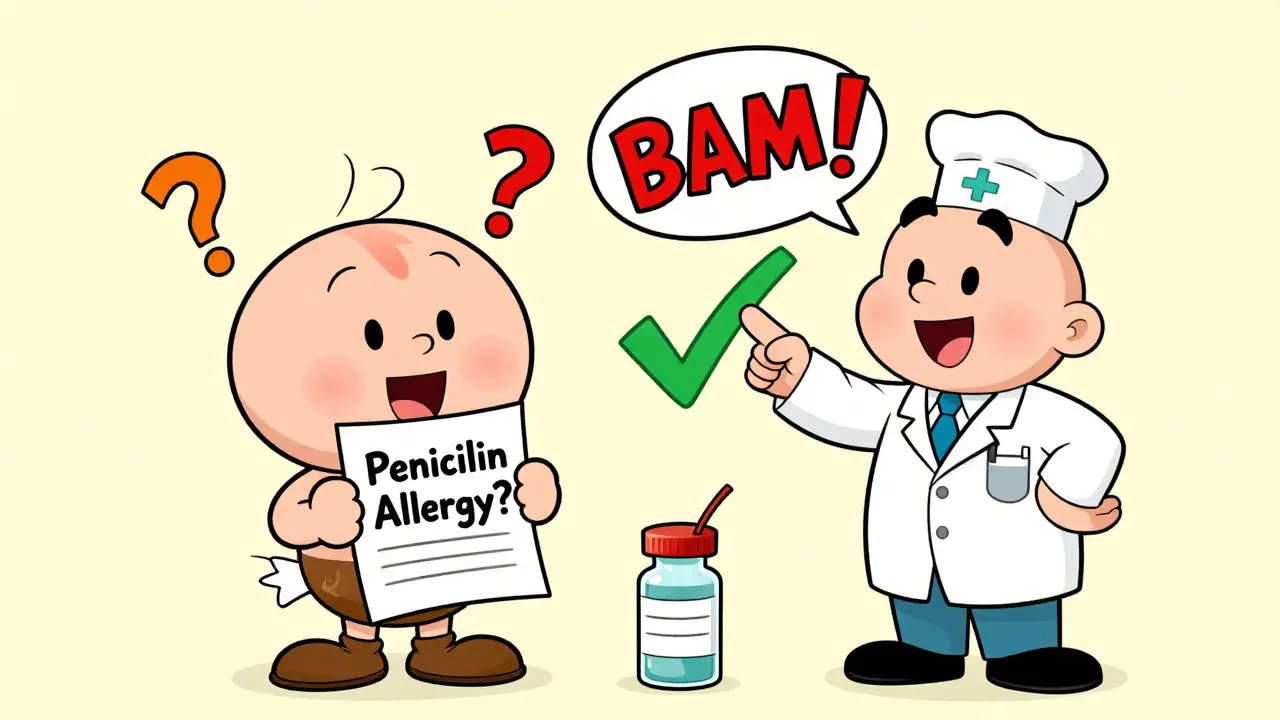
Many people think they’re allergic to penicillin because they got a rash as a kid. But here’s the truth: 90-95% of people labeled as penicillin-allergic aren’t actually allergic. That mislabeling isn’t just inconvenient-it’s dangerous. It leads to stronger, more expensive antibiotics being used when they’re not needed, which increases the risk of deadly infections like C. diff and fuels antibiotic resistance. If you’ve been told you’re allergic to a drug, it’s time to understand what that really means-and how to find safer, more effective options.
What Is a True Drug Allergy?
A true drug allergy is your immune system overreacting to a medication, treating it like a virus or toxin. This isn’t just a side effect like nausea or dizziness. It’s a biological response that can range from a mild rash to anaphylaxis-a life-threatening drop in blood pressure and airway swelling. Symptoms usually show up within minutes to hours after taking the drug. Common signs include hives, swelling of the face or throat, wheezing, vomiting, or a sudden drop in blood pressure.But here’s the catch: most reactions people call "allergies" aren’t allergies at all. A rash without breathing trouble or swelling? That’s often a viral rash or a non-allergic side effect. Studies show only about 10% of people who say they’re allergic to penicillin actually have an IgE-mediated immune reaction-the kind that triggers real allergic responses. The rest? They were misdiagnosed, or their reaction was mild and forgotten over time.
Why Mislabeling Costs Lives and Money
When you’re labeled allergic to penicillin, doctors avoid it-even if you’re not truly allergic. Instead, they turn to alternatives like vancomycin, clindamycin, or fluoroquinolones. These drugs are broader-spectrum, meaning they kill more types of bacteria, including good ones. That’s why patients with mislabeled penicillin allergies have a 40% higher chance of getting a C. diff infection. That’s not just uncomfortable-it can mean weeks in the hospital.The financial toll is just as bad. Penicillin costs about $4 for a 10-day course. A typical alternative like azithromycin runs $26. In the U.S. alone, mislabeled penicillin allergies add $1.2 billion to healthcare costs every year. And it’s not just money. People with these mislabels spend 30% longer in the hospital. That’s not just a burden on the system-it’s a burden on you.
Common Drug Allergies and Cross-Reactivity Risks
Penicillin is the most common drug allergy people report. But it’s not the only one. Sulfa drugs, NSAIDs like ibuprofen, and certain chemotherapy agents also trigger immune reactions. The big myth? That if you’re allergic to penicillin, you can’t take cephalosporins like ceftriaxone. That used to be true-but science has moved on.Modern research shows the cross-reactivity risk between penicillin and third-generation cephalosporins is less than 1%. That’s lower than the risk of being struck by lightning. For most people, it’s safe. The same goes for carbapenems like meropenem-only a tiny fraction of penicillin-allergic patients react to them.
But there are exceptions. If you had a severe reaction-like anaphylaxis, swelling of the tongue, or trouble breathing-you need to be more cautious. And if you’re allergic to one beta-lactam (like amoxicillin), you might still react to another in the same class. That’s why proper testing matters.
How to Know If You’re Really Allergic
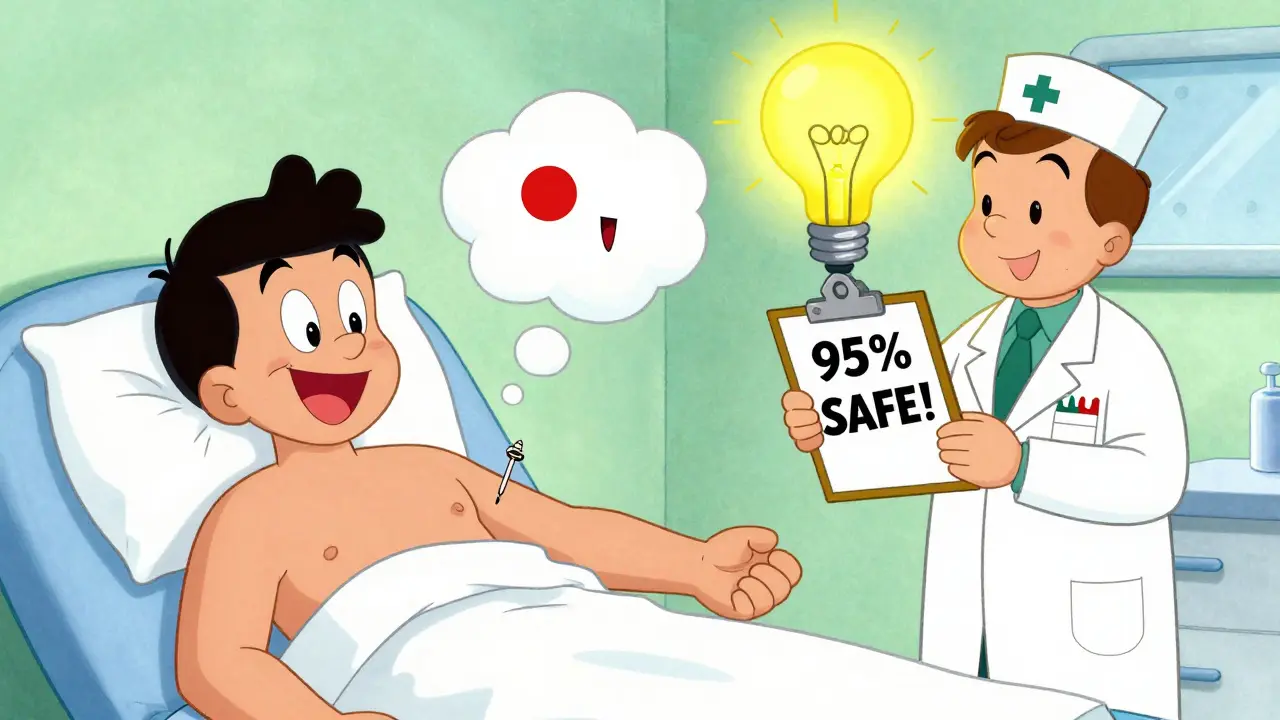
The only way to know for sure is testing. Skin testing is the gold standard. It involves a tiny prick with a solution containing penicillin breakdown products-like benzylpenicilloyl polylysine-and a small injection of benzylpenicillin G. If your skin reacts with redness or swelling, you might be allergic. If not, you get an oral challenge: a small dose of amoxicillin under supervision. In 95% of cases, people who’ve been told they’re allergic pass this test.Don’t wait for an emergency. If you’ve been told you’re allergic to penicillin or another drug, ask your doctor about a referral to an allergist. This isn’t just for people with severe reactions. Even if your reaction was a rash years ago, testing can clear you for safer, cheaper, more effective treatments.
Safe Alternatives When You Really Are Allergic
If testing confirms a true allergy, you need alternatives. But not all alternatives are equal. Here’s what works when penicillin is off the table:- Macrolides like azithromycin or clarithromycin: Good for respiratory and skin infections. But they’re pricier and can cause stomach upset.
- Tetracyclines like doxycycline: Effective for acne, Lyme disease, and some lung infections. Avoid in kids under 8 and pregnant women.
- Fluoroquinolones like levofloxacin: Powerful, but linked to tendon damage and nerve issues. Reserved for serious infections.
- Vancomycin or clindamycin: Used for serious skin or blood infections. Higher risk of C. diff.
For syphilis, especially in pregnancy or neurosyphilis, penicillin is the only cure. If you’re allergic, you’ll need desensitization. That’s not optional-it’s life-saving.
What Is Drug Desensitization?
Desensitization is when you’re given tiny, increasing doses of a drug you’re allergic to-over hours or days-until your body can handle a full dose. It’s not a cure. It’s a temporary workaround. But for conditions like syphilis, cancer treatment, or certain infections, it’s the only way forward.This is done in a hospital under strict supervision. You’ll be monitored for blood pressure, breathing, and skin reactions. Success rates? Over 80% for penicillin. And once you’ve completed the process, you can take the drug safely-for that treatment course. But you’ll need to repeat it if you need the drug again later.
How to Protect Yourself
If you have a confirmed allergy, here’s how to stay safe:- Carry a wallet card listing your exact allergy, reaction, and date. Don’t just say "penicillin allergy." Say "anaphylaxis after amoxicillin, April 2018." Specifics save lives.
- Update your records every time you see a new doctor. If you’ve been cleared by an allergist, bring your test results.
- Wear a medical alert bracelet if you’ve had a severe reaction.
- Know your options. Ask your pharmacist: "Is there a cheaper, safer alternative?" Don’t assume the first choice is the best.
What’s Changing in 2025
The tide is turning. The CDC’s 2022 guidelines now support skin testing in outpatient clinics-not just hospitals. The American Academy of Allergy, Asthma & Immunology launched "Choose Penicillin" in 2023, with pilot programs cutting unnecessary antibiotic use by 65% in 12 hospitals. By 2027, half of all penicillin allergy evaluations are expected to happen in primary care offices, not just allergy clinics.Electronic health records are finally being updated to require detailed allergy documentation: drug name, reaction, date, route, and dose. That’s a big deal. Right now, 43% of allergy info is missing or wrong during hospital transfers. That’s changing.
What to Do Next
If you’ve been told you’re allergic to a drug:- Check your records. What exactly was the reaction? Was it a rash? Swelling? Trouble breathing?
- Ask your doctor: "Could this have been a side effect, not an allergy?"
- If you’re unsure, ask for a referral to an allergist. Testing takes less than an hour.
- If you’ve been cleared, make sure your primary care provider and pharmacy have your updated records.
- If you’re pregnant, have syphilis, or need antibiotics for a serious infection, don’t delay-get tested. Your life may depend on it.
Being labeled allergic to a drug doesn’t mean you’re stuck with worse options forever. Most people can safely take the drugs they’ve been avoiding. And when you do, you’re not just saving money-you’re protecting yourself from dangerous infections and helping fight antibiotic resistance.
Can you outgrow a penicillin allergy?
Yes, many people outgrow penicillin allergies. Studies show that 80% of people who had a reaction as a child lose their allergy within 10 years. The immune system changes over time, and what once triggered a reaction may no longer do so. Testing is the only way to know for sure.
Is a rash always a sign of a drug allergy?
No. Many rashes that appear after taking antibiotics are caused by viruses, not the drug. In fact, only about 10% of reported penicillin "allergies" involve a true IgE-mediated immune response. A rash without swelling, breathing trouble, or vomiting is often just a side effect or unrelated viral rash.
Can I take cephalosporins if I’m allergic to penicillin?
For most people, yes. The risk of cross-reactivity between penicillin and third-generation cephalosporins like ceftriaxone is less than 1%. This is far lower than what was believed 20 years ago. If your reaction was mild, your doctor may feel comfortable prescribing it. For severe reactions, testing is still recommended.
How accurate is penicillin skin testing?
Penicillin skin testing is over 95% accurate at ruling out a true allergy. If the test is negative, an oral challenge with amoxicillin is usually done to confirm. Together, these tests have a 99% success rate in identifying people who can safely take penicillin.
What if I need penicillin but can’t get tested?
If you have a life-threatening infection like syphilis or endocarditis and can’t get tested, desensitization is the next step. It’s done in a hospital under close monitoring. While it’s not ideal, it’s safer than using ineffective or riskier antibiotics. Never avoid necessary treatment because of an unconfirmed allergy.
Can I trust my allergy label if it’s from childhood?
Not without confirmation. Childhood rashes are often mislabeled as allergies. Many were caused by viruses like mononucleosis or roseola, not the antibiotic. Even if you had symptoms, your immune system may have changed. Testing is the only reliable way to know if the allergy still exists.




Prasanthi Kontemukkala
December 27, 2025 AT 09:29My mom was told she was allergic to penicillin as a kid because of a rash-turned out it was just roseola. She got tested last year and now takes amoxicillin for every infection. Saved her thousands and kept her out of the hospital. Why don’t more people know this?
Alex Ragen
December 28, 2025 AT 19:30One must, in the spirit of epistemological humility, interrogate the very ontological foundations of the ‘allergy label’-is it not, in fact, a social construct perpetuated by the pharmaceutical-industrial complex? The IgE-mediated response, while statistically significant, is but a flicker in the vast cathedral of human immunological phenomenology. We are, all of us, merely navigating a labyrinth of misdiagnoses, clad in the thin robes of medical dogma.
Angela Spagnolo
December 28, 2025 AT 22:44i’ve been told i’m allergic to penicillin since i was 6… but i’ve taken it like 3 times since then and never had a problem? i think my doc just wrote it down because i cried during the shot?? idk. i’m gonna ask my pharmacist next time. i think i might not be allergic??
Sarah Holmes
December 30, 2025 AT 21:57It is an egregious, almost criminal negligence on the part of the medical establishment to allow such widespread misinformation to persist. People are dying-not from penicillin, but from the ignorance of physicians who refuse to update their archaic protocols. This is not ‘mislabeling’-it is systemic malpractice. I demand accountability. I demand reform. I demand that every primary care provider be mandated to undergo allergist training before prescribing antibiotics.
Joanne Smith
December 31, 2025 AT 14:18So let me get this straight: you’re telling me I’ve been paying $26 for azithromycin for my sinus infections because some doctor scribbled ‘penicillin allergy’ on my chart in 2005 after I got a rash from a cold? And now you want me to pay $0 to get tested and maybe save my life? Oh, sweet merciful heavens. Can we get a national campaign with a catchy jingle? ‘Penicillin: It’s Not Your Enemy (Probably).’
Lori Anne Franklin
January 2, 2026 AT 01:33my brother got desensitized for syphilis last year-scary as hell but it worked. they gave him tiny doses over 8 hours and he didn’t even break out. now he’s fine. i’m gonna make my mom get tested too. she’s been avoiding all antibiotics for 30 years. what a waste.
Bryan Woods
January 2, 2026 AT 19:40Thank you for this comprehensive overview. The data presented regarding C. diff incidence and cost differentials is particularly compelling. It is imperative that healthcare providers prioritize allergist referrals for patients with historical penicillin labels, particularly in light of evolving clinical guidelines. The potential for improved patient outcomes and reduced antimicrobial resistance is substantial.
wendy parrales fong
January 3, 2026 AT 13:58if you think you’re allergic to penicillin, just get tested. it’s like 20 minutes. you might be shocked. i was. i thought i was allergic too-turns out i just got a rash from being sick. now i take the cheap stuff. my wallet and my gut thank me.