
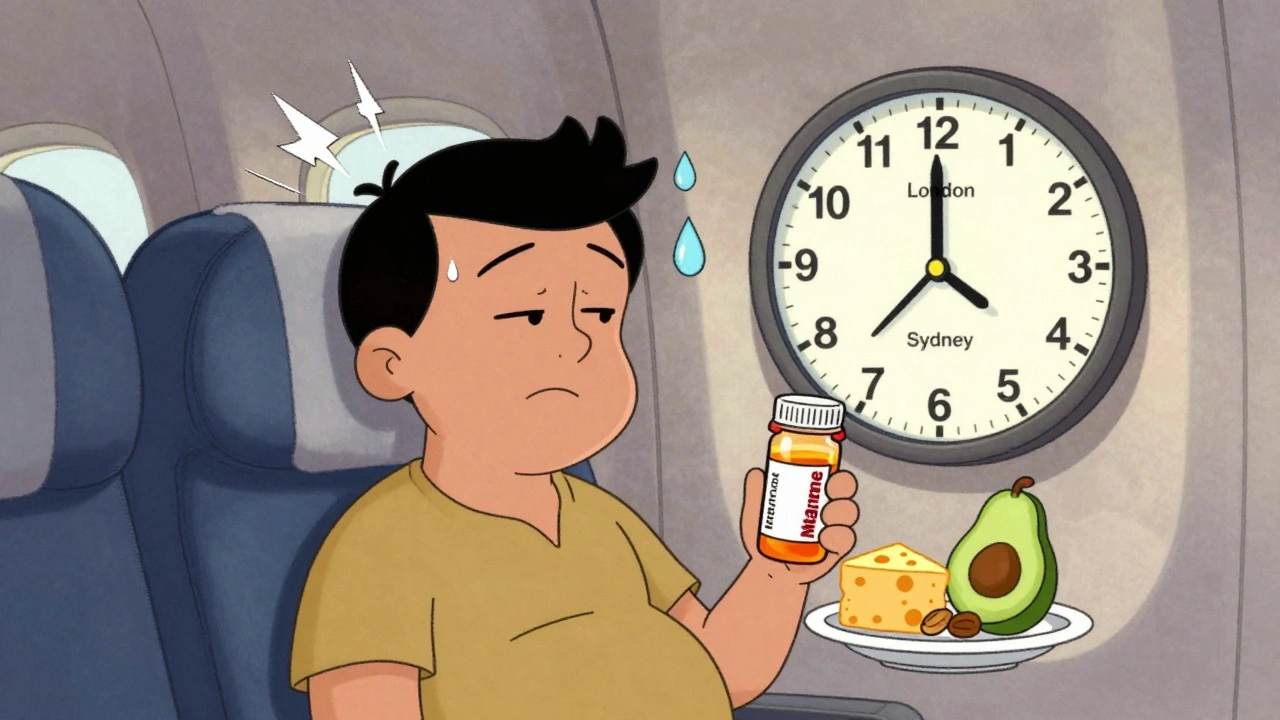
When you're flying across multiple time zones, your body doesn't just get jet lag-it can also mess up your medication schedule. If you're taking antimalarials like Malarone or antiretrovirals for HIV, getting the timing wrong isn't just inconvenient. It can lead to treatment failure, drug resistance, or even serious illness. The truth? Most people don't realize how precise these schedules need to be. And antibiotics? They're rarely the issue here. The real concern is antimalarials and HIV meds-those are the ones that demand strict timing, especially when you're crossing seven or eight time zones in one flight.
Why Timing Matters More Than You Think
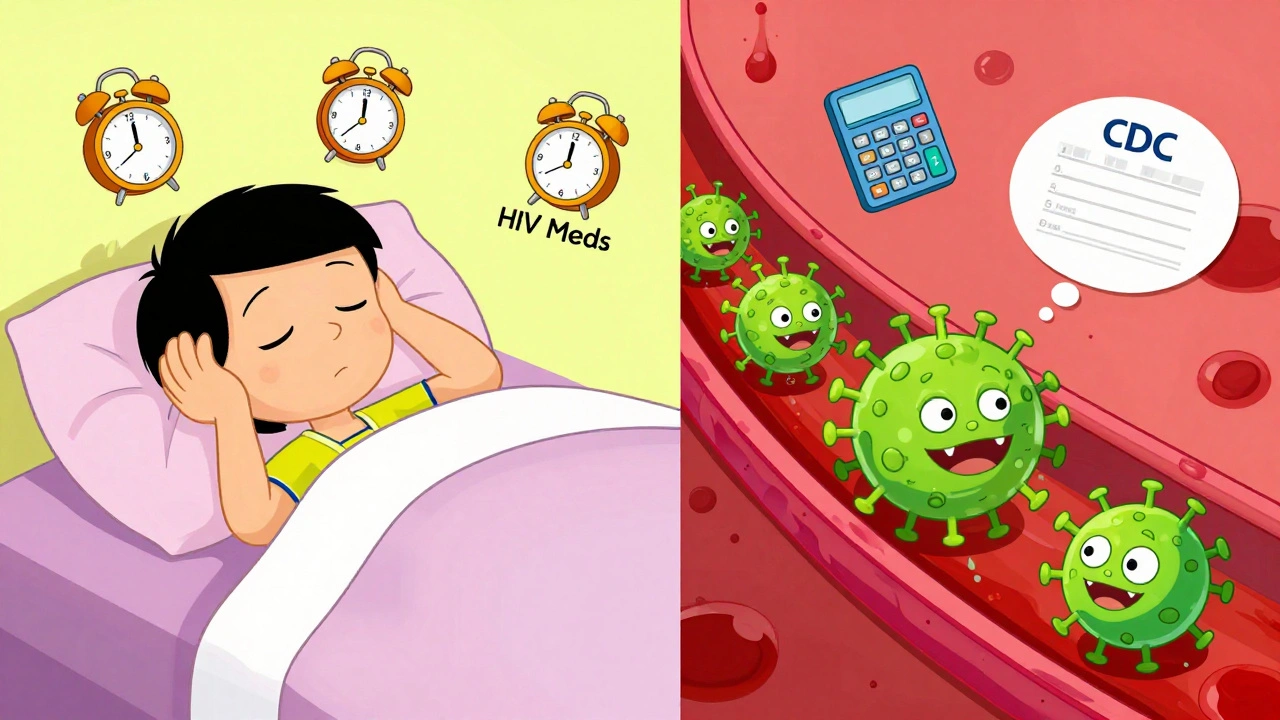
It's not about being punctual. It's about keeping drug levels steady in your blood. For antimalarials, if you miss a dose or take it at the wrong time, you could be unprotected against malaria. For HIV meds, even a few hours off can let the virus rebound. A 2022 survey of 1,450 people on antiretroviral therapy found that 23% had missed or messed up a dose during travel-and 7.8% saw their viral load spike. That’s not rare. That’s common.
Take Malarone (atovaquone-proguanil). It needs to be taken with food-preferably fatty food-to work right. One traveler on Reddit took it on an empty stomach after a long flight, vomited within 20 minutes, and had to extend their prophylaxis by four extra weeks. That’s not a mistake you want to repeat.
And it’s not just about forgetting. Jet lag disrupts your hunger cues, your sleep, your sense of time. You land in Bangkok at 3 a.m., your body says it’s midnight, but your pill is due at 8 a.m. local time. Do you wait? Do you take it now? What if you’re not hungry? What if you’re too tired to eat?
Antimalarials: The Big Three and How to Handle Them
There are three main antimalarials used for prevention, and each has its own rules.
- Malarone (atovaquone-proguanil): Take daily, starting 1-2 days before entering a malaria zone. Keep taking it daily while you're there, and for 7 days after you leave. It’s forgiving-up to 12 hours late is usually okay for prevention-but if you’re treating malaria (not just preventing it), that window shrinks to 8 hours. And yes, you need food. No food? No protection.
- Chloroquine: Used in some regions where malaria isn’t resistant. Take once a week, starting 1-2 weeks before travel. You can stick to your home time zone schedule for weeks without issue. Just take it on the same day of the week, same time, no matter where you are.
- Mefloquine: Also weekly. Super flexible for scheduling. But here’s the catch: 1 in 8 people get serious side effects-nightmares, anxiety, dizziness. It’s not worth the risk for most travelers anymore.
Then there’s artemether-lumefantrine, used for treatment, not prevention. This one’s a nightmare to time across time zones. You take four tablets right away, then another four eight hours later, then four twice a day for the next two days. And every dose needs fat. No fat? The drug doesn’t absorb. You’re basically unprotected. If you’re flying from New York to Nairobi and land at 2 a.m., you’re not eating a fatty meal at 10 a.m. your home time. You’re exhausted, hungry, and confused. This is where planning fails.
Antiretrovirals: Precision Over Convenience
If you’re on HIV meds, your schedule is tighter than a drum. Some drugs can handle a 12-hour shift. Others? Four hours is the max.
Here’s how it breaks down:
| Drug Class | Example Medication | Forgiveness Window |
|---|---|---|
| Integrase Inhibitors | Dolutegravir | Up to 12 hours |
| Integrase Inhibitors | Raltegravir | Up to 8 hours |
| NRTIs | Tenofovir/Emtricitabine | Up to 6 hours |
| Protease Inhibitors | Atazanavir, Darunavir | 4-6 hours |
So if you’re on dolutegravir and flying from Vancouver to Tokyo (16-hour time difference), you don’t need to panic. You can shift your dose by 2 hours a day for three days before you leave. But if you’re on atazanavir? That 4-hour window means you need to be precise. No sleeping through alarms. No skipping doses because you’re tired.
The CDC recommends starting to adjust your schedule 72 hours before departure if you’re crossing more than 8 time zones. Shift your dose 1-2 hours earlier or later each day-depending on direction. Going east? Move your dose earlier. Going west? Later. Don’t try to jump more than 2 hours a day. Your body needs time to adjust, or you’ll feel worse than jet lag.
Real-World Scenarios: What Actually Goes Wrong
Let’s say you’re flying from London to Sydney. That’s 11 time zones. You take Malarone at 8 a.m. London time. When you land, it’s 10 p.m. Sydney time. Do you take it now? Or wait until 8 a.m. Sydney time?
If you wait, you’re going 30+ hours without a dose. Too risky.
If you take it at 10 p.m., you’re taking it on an empty stomach after a 22-hour flight. You might vomit. Or you might not absorb it.
Here’s what works: Take it at 8 a.m. London time the day before you leave. Then, when you land, take your next dose at 8 a.m. Sydney time-no matter how tired you are. That’s a 22-hour gap. It’s longer than recommended, but it’s safer than skipping. Then resume your normal schedule.
Another traveler, 'HIV_Wanderer' on Lonely Planet forums, missed a dose on a 16-hour flight from London to Sydney. He set four alarms. Slept through them all. Six weeks later, his viral load jumped to 1,200 copies/mL. He had to restart his treatment plan. He wasn’t reckless. He was exhausted. That’s the real enemy.
Tools That Actually Help
Don’t rely on your phone’s alarm. It dies. It gets silenced. You forget it’s there.
- Medisafe: This app has a 4.7/5 rating on iOS with over 12,000 reviews. It sends alarms, tracks doses, and even tells you if you’re at risk for missing a dose based on your flight. You can input your exact medication, time zone changes, and meals. It even syncs with your calendar.
- CDC Malaria Prophylaxis Timing Calculator: Launched in February 2024, this free tool asks for your flight details, medication, and destination. It spits out a personalized dosing schedule. No math. No guesswork.
- Printed Schedule: Ask your doctor for a printed plan. Write down: “Take 1 pill at 8 a.m. local time daily. Must eat with food. Do not skip.” Keep it in your wallet. Show it to a flight attendant if you need help.
And here’s a pro tip: Take your first dose in the destination time zone before you even leave. If you’re flying to Bangkok, take your Malarone at 8 a.m. Bangkok time the night before you leave. That way, you’re already synced. No confusion on the plane.
What to Do If You Miss a Dose
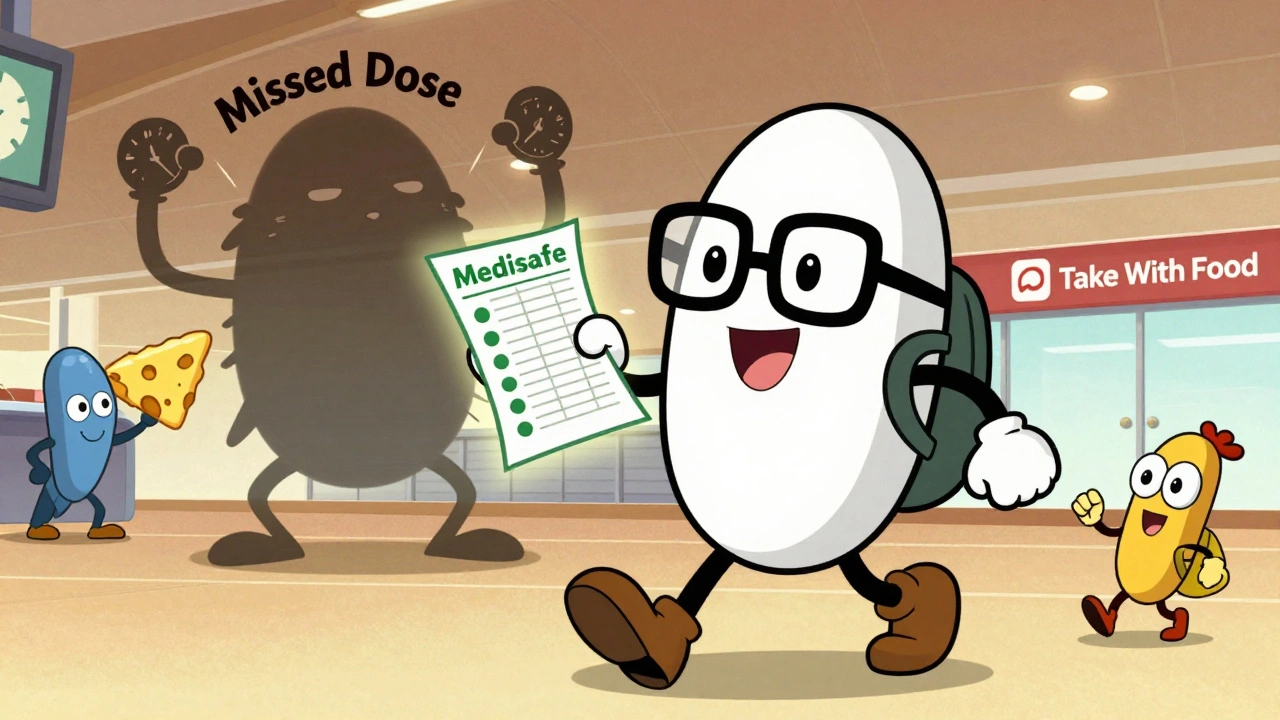
Don’t panic. But don’t ignore it.
- Malarone (prophylaxis): Take the missed dose as soon as you remember. Then go back to your regular schedule. If you’re more than 24 hours late, take the missed dose and continue for 4 more weeks after you leave the malaria zone.
- Malarone (treatment): If you miss a dose by more than 8 hours, contact a doctor. You may need to restart the full course.
- HIV meds: If you’re within your forgiveness window (check your drug’s chart), take it. If you’re outside it, take it anyway. Then call your doctor. Don’t double up. Don’t skip the next dose.
The CDC is clear: “After a missed dose occurring at a time when exposure to malaria is possible, atovaquone-proguanil must be continued for a minimum of 4 more weeks after resuming the medication.” That’s not optional. That’s life-saving.
Final Advice: Plan Like a Pro
Here’s your checklist:
- Check if your destination has malaria. Use the CDC Yellow Book or WHO maps.
- Know your medication’s forgiveness window. Ask your doctor. Write it down.
- Start adjusting your dose 72 hours before departure if crossing more than 8 time zones.
- Use Medisafe or the CDC calculator. Don’t guess.
- Carry a printed schedule with your name, medication, and dosing times.
- Always take antimalarials with food-preferably fatty food.
- If you miss a dose, act fast. Don’t wait.
Traveling with meds isn’t about being perfect. It’s about being prepared. The difference between a safe trip and a medical emergency isn’t luck. It’s planning.
Can I take antimalarials without food?
No. Drugs like Malarone and artemether-lumefantrine need fat to be absorbed properly. Taking them on an empty stomach can reduce effectiveness by up to 70%. Always take them with a meal or milk. If you’re on a flight with no food service, bring nuts, cheese, or a protein bar.
What if I’m on HIV meds and my flight is longer than 18 hours?
Long flights (like Singapore Airlines SQ22 from Newark to Singapore) are exactly why timing plans exist. If your drug has a 12-hour forgiveness window (like dolutegravir), you’re fine. If it’s 4-6 hours (like protease inhibitors), take your dose right before boarding, then again as soon as you land-even if it’s only 10 hours later. Don’t wait for your normal time. The goal is to avoid gaps longer than your drug’s tolerance.
Are there new medications that make this easier?
Yes. Long-acting injectables like cabotegravir/rilpivirine for HIV are now available in 17 countries. You get one shot every two months-no daily pills. But availability is still limited. For antimalarials, there’s no new injectable yet, but the CDC’s new timing calculator (2024) makes planning far easier than before.
Can I switch to a different antimalarial if my schedule is too hard?
Yes. If you’re struggling with daily dosing, ask your doctor about chloroquine (weekly) or doxycycline (daily, but easier to time). Mefloquine is weekly too, but has serious side effects. Don’t pick based on convenience alone-your destination’s malaria resistance matters. Your doctor can match the drug to your route and risk.
Do I need to tell my doctor I’m traveling?
Absolutely. Many doctors assume you’ll figure it out. But if you’re on HIV meds, your viral load, drug resistance, and tolerance all matter. For antimalarials, your health history, allergies, and destination determine the best choice. A pre-travel visit isn’t optional-it’s essential.




Dematteo Lasonya
December 5, 2025 AT 23:55Just got back from Bali and this hit home. Took Malarone on an empty stomach after a 14-hour flight and threw up by 7 a.m. local time. Ended up buying peanut butter packets from the airport shop just to swallow the next pill. Never again.
Gillian Watson
December 7, 2025 AT 15:58I used the CDC calculator before my trip to Kenya and it saved me. Printed the schedule, stuck it in my passport holder, and showed it to the flight attendant when I asked for a banana with my meal. They were confused but helpful. Small things matter.
Jessica Baydowicz
December 7, 2025 AT 21:10Yessss this is the kind of info no one tells you until you’re sweating through a 3 a.m. layover wondering if your body’s gonna revolt. You’re not being paranoid-you’re being smart. High five to anyone who plans ahead. 🙌
Rudy Van den Boogaert
December 8, 2025 AT 04:35I’m on dolutegravir and flew from Chicago to Tokyo. I shifted my dose by an hour each day for three days before leaving. Took the pill right before boarding, then again when I landed. No issues. My viral load’s still undetectable. Planning isn’t optional-it’s survival.
Also, bring snacks. Not just any snacks. Nuts. Cheese. Avocado. Fat is your friend.
Jordan Wall
December 9, 2025 AT 13:08Wow. So we’re now treating travelers like lab rats with pharmacokinetic schedules? 🤡 Next they’ll be requiring us to wear GPS trackers so the pharma bros can monitor compliance. This is what happens when Big Pharma turns medicine into a spreadsheet.
Also, ‘fatty food’? Are we back in the 1980s? I’m not eating buttered toast at 2 a.m. in Bangkok just to satisfy a pill’s ego.
Gareth Storer
December 10, 2025 AT 02:23So let me get this straight-you’re telling me I can’t just take my meds when I feel like it anymore? What’s next? Mandatory meditation before swallowing a pill? 😏
My uncle took malaria pills for 3 years in the ’90s and never missed one. He’s still alive. So I’ll just wing it. Thanks, science.
Pavan Kankala
December 10, 2025 AT 08:00This is all a distraction. Malaria’s not real. It’s a WHO scam to sell drugs. And HIV meds? Big Pharma’s way of keeping people dependent. You think your ‘viral load’ matters? Nah. Your body heals itself if you stop the poison. I’ve been off meds for 7 years. Still breathing. Still traveling. Still winning.
Martyn Stuart
December 11, 2025 AT 08:12Important note: If you’re on protease inhibitors, and your flight is longer than 12 hours, and you’re crossing more than 8 time zones, and you’re unable to eat fat due to nausea or dietary restrictions-please, please, please consult your pharmacist before departure. There are alternative formulations, and some pharmacies can provide liquid versions for emergency use. Don’t assume the rules are absolute. There’s nuance.
Also: Medisafe is great, but it doesn’t know if your phone dies. Always have a backup. Paper. Pen. Handwritten. Like your life depends on it-because it does.
Shofner Lehto
December 12, 2025 AT 03:54I’m a nurse and I’ve seen too many people skip doses because they ‘didn’t feel sick.’ The virus doesn’t care how you feel. It’s not a suggestion. It’s a biological requirement. This post? Spot on. Print it. Laminate it. Tape it to your mirror.
Libby Rees
December 13, 2025 AT 22:51It’s interesting how we treat medication timing like a science experiment when it’s really just about human rhythm. Our bodies don’t live on clocks-they live on hunger, sleep, and light. Maybe the real solution isn’t more apps, but better integration of medicine into natural cycles.
Still, the advice here is solid. I’d add: if you’re flying east, try to sleep during the flight. If you’re flying west, stay awake. Align your body’s rhythm with the destination, even if it’s uncomfortable.
Elizabeth Crutchfield
December 15, 2025 AT 03:50i used to forget my pills all the time till i started putting them in my toothbrush holder. now i cant forget them cause i brush my teeth every day. dumb but it works.
Ben Choy
December 16, 2025 AT 14:47Just wanted to say thank you for this. I’m on tenofovir/emtricitabine and had a panic attack before my trip to Vietnam because I thought I’d mess it up. Used the CDC calculator, printed the schedule, and took a small jar of peanut butter with me. Took my pill at 8 a.m. local time every day-even on the plane. No issues. You’re right: it’s not about being perfect. It’s about being prepared.
Also, if you’re on HIV meds and traveling, tell someone you trust your schedule. My roommate set a reminder for me on her phone too. That extra layer saved me.
Rudy Van den Boogaert
December 17, 2025 AT 03:05^^^ This. I did the same thing. Told my travel buddy. Had them check in with me after every meal. We made it a game: ‘Who remembered their pill first?’ Turns out, accountability beats alarms.
John Filby
December 19, 2025 AT 00:23What about long-acting injectables for malaria? I heard there’s something in trials. Would be a game-changer. No more daily pills, no more food rules. Just one shot before you go. Anyone know if it’s coming to the US soon?