
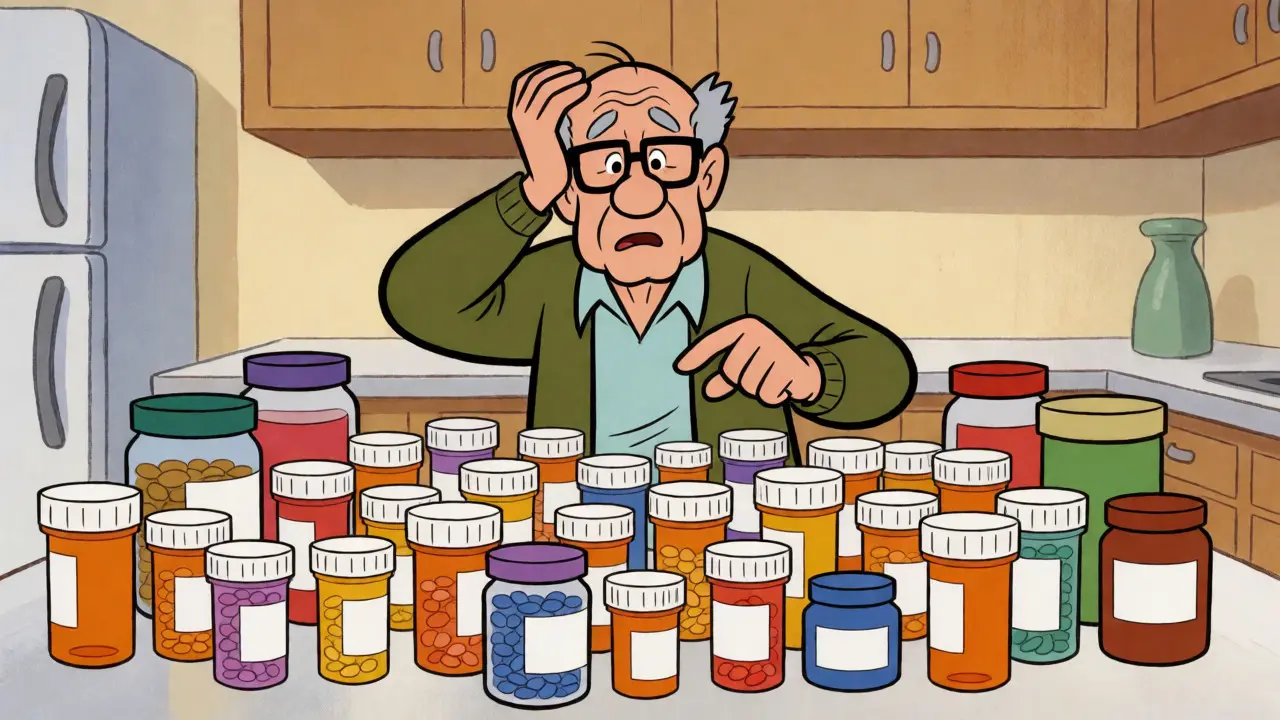
You walk into the doctor's office with a list of symptoms and leave with three new prescriptions. By the time you get home, you're staring at a pile of bottles, wondering which one goes with breakfast and if the red pill clashes with your blood thinner. If this sounds familiar, you aren't alone. According to the CDC, nearly 90% of adults over 65 take at least two prescription drugs daily, and about 15% juggle five or more. This complexity isn't just annoying; it's dangerous. Adverse drug events cause roughly 15-20% of hospital admissions for seniors. The good news? You can fix most of these issues by changing how you talk to your healthcare team.
Why Medication Talks Go Wrong
Most communication breakdowns happen because doctors are rushed and patients are overwhelmed. A typical appointment lasts 15 minutes. That’s not enough time to discuss chronic conditions, new symptoms, and a growing medication list. When providers feel pressed for time, they often skip detailed explanations. Seniors, in turn, might hesitate to ask questions for fear of sounding difficult or forgetting what they wanted to say once they’re in the room.
The result is polypharmacy, a term used when someone takes multiple medications that may interact negatively or become unnecessary as health changes. A 2022 study in the Journal of the American Geriatrics Society found that poor communication directly contributes to preventable hospitalizations. But structured conversations reduce readmissions by 22%, according to Dr. Christine Ritchie from UCSF. It’s not about being pushy; it’s about being prepared.
Prepare Before You Walk In
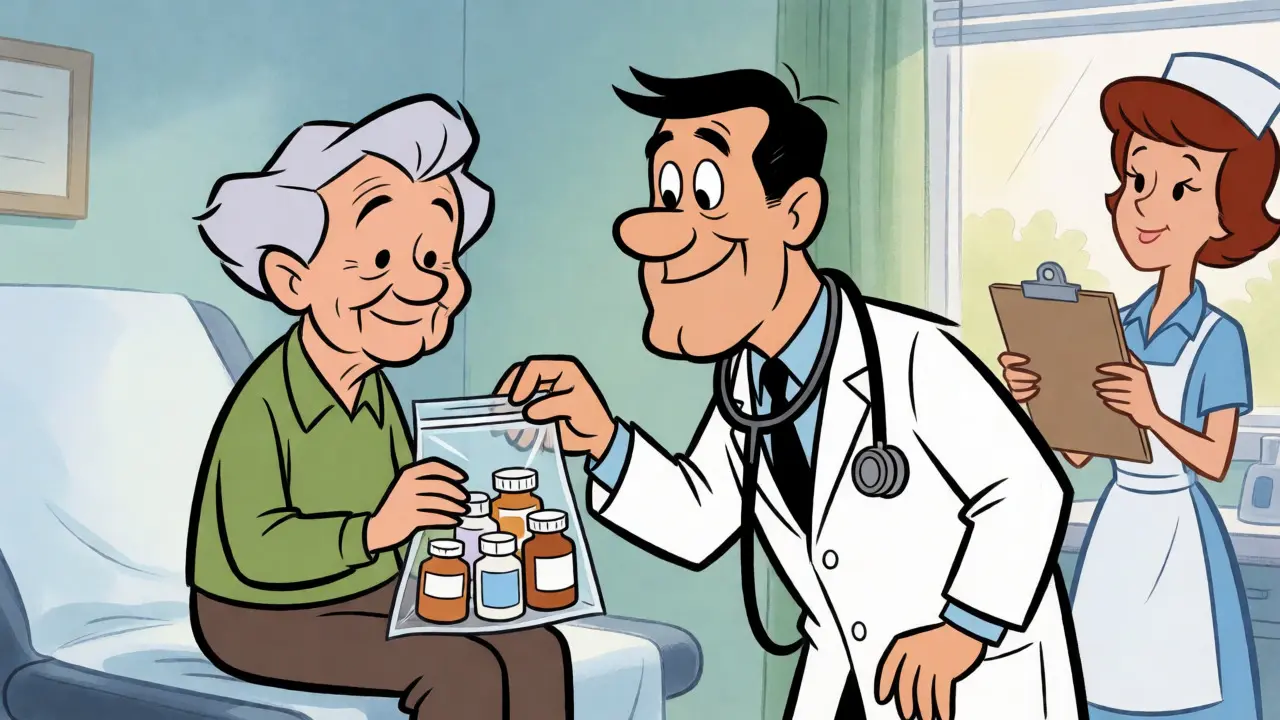
Don’t rely on memory. Your brain isn’t a pharmacy database, and stress makes recall worse. The Health in Aging Foundation recommends bringing a physical bag with every single item you take. Yes, all of them. This includes:
- Prescription medications (even samples)
- Over-the-counter drugs like aspirin or ibuprofen
- Vitamins, minerals, and herbal supplements
- Creams, drops, and inhalers
Bringing the actual bottles, not just a list, catches errors in 25% of cases. Sometimes, the label says "take twice daily," but the bottle contains pills meant for once daily. Seeing the physical object helps the provider spot discrepancies instantly.
Also, bring a notebook. Write down your top three concerns before you go. Doctors respond better to specific questions than vague worries. Instead of saying "I feel off," write "I’ve been dizzy since starting the new blood pressure med." Prioritize. If you have ten issues, tell the doctor: "I’d like to focus on my dizziness today, and we can save the knee pain for next visit." This respects their time and ensures you get answers on the urgent stuff.
Ask These Four Critical Questions
When discussing a new or existing medication, avoid yes/no questions. They lead to short answers. Use open-ended queries that force a discussion. Greater Good Health suggests four key questions every senior should have ready:
- "What does this medication actually do for me?" Don’t accept "It’s for your heart." Ask for specifics. Does it lower risk? Reduce pain? Prevent a stroke? Knowing the goal helps you decide if the side effects are worth it.
- "What are the most common side effects I should watch for?" Focus on practical signs. Will it make you sleepy? Dry out your mouth? Cause constipation? Knowing what to expect reduces anxiety and helps you distinguish between normal reactions and emergencies.
- "Does this clash with anything else I’m taking?" Show them your full bag. Interactions between prescription drugs and supplements like St. John’s Wort or Ginkgo Biloba are common and often overlooked.
- "What happens if I miss a dose?" Some meds require doubling up; others need skipping. Getting this wrong can be dangerous. Clarify the rule immediately.
If you don’t understand the answer, use the "teach-back" method. Say, "Just so I’m sure I got this right, you want me to take this pill only after eating, and if I miss it, I shouldn’t double up tomorrow. Is that correct?" The American Medical Association notes this technique boosts adherence rates by 31%.
Understand the Beers Criteria
Your doctor likely knows the Beers Criteria a list of potentially inappropriate medications for older adults published by the American Geriatrics Society. First released in 1991 and updated regularly, this guide flags drugs that pose higher risks for people aged 65+. For example, certain sleep aids and antihistamines can increase fall risk or cause confusion in seniors.
You don’t need to memorize the list, but you should know it exists. If a provider prescribes a medication flagged in the Beers Criteria, ask: "I noticed this is on the Beers list for older adults. Why is this the best choice for me specifically?" Often, there’s a good reason-like a lack of alternatives-but asking ensures they considered safer options first. As of the 2023 update, the criteria identify 30 medication classes with heightened risks. Being aware turns you from a passive recipient into an active partner in care.
Involve Your Caregiver or Advocate
Going it alone is hard. Hearing loss, vision issues, or simple cognitive fatigue can make processing medical info tough. Bringing a trusted friend, family member, or professional caregiver changes the dynamic. Home Instead reports that seniors with engaged advocates experience 18% fewer adverse drug events.
A companion serves three roles:
- The Recorder: They write down instructions while you listen.
- The Questioner: They ask the things you forgot or were too shy to ask.
- The Witness: They verify that the plan matches what was discussed.
Make sure your advocate knows your goals. Are you trying to cut back on pills? Do you prioritize independence over longevity? Share these values upfront. A caregiver who understands your preference for "less pills, even if slightly less effective" will help steer the conversation accordingly.
Simplify Your Routine at Home
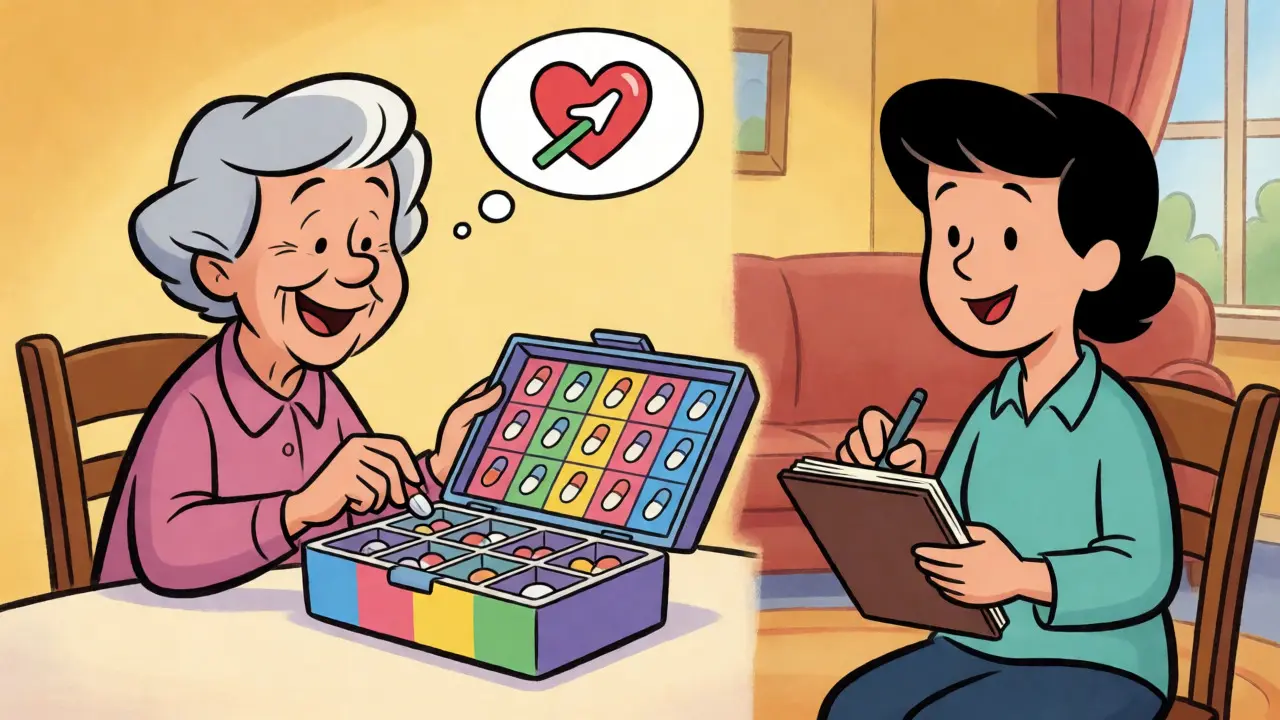
Great advice fails if you can’t follow it. Adherence rates drop to 50% for seniors on multiple meds. Fix this by aligning doses with daily habits. Link medication times to non-negotiable routines, like brushing teeth or having coffee. CritiCare Plus suggests using tools to bridge the gap between intention and action:
| Tool Type | Best For | Key Benefit |
|---|---|---|
| Pill Organizers | Daily routine consistency | Visual confirmation of taken doses |
| Smartphone Apps (e.g., Medisafe) | Tech-comfortable users | Reminders and interaction alerts |
| Electronic Dispensers | High-frequency dosing needs | Automated locking and alerting |
| Pharmacy Sync Programs | Refill coordination | All meds arrive on one day monthly |
Consider medication synchronization. Many pharmacies now offer programs where all refills are adjusted to occur on the same day each month. This eliminates the "oh, I forgot to pick up the other one" problem. The National Community Pharmacists Association reports that participants show 28% higher adherence rates.
Review Regularly, Not Just When Sick
Medication reviews shouldn’t wait for a crisis. Schedule periodic check-ins specifically for medication management. The Caregiver Action Network emphasizes that regular reviews reduce polypharmacy by 27%. During these visits, ask: "Is there anything I can stop taking?"
As you age, metabolism slows. Drugs stay in your system longer. A dose that worked fine at 60 might be too strong at 75. Also, some meds are prescribed to treat side effects of other meds-a cycle known as "prescribing cascades." For instance, if a blood pressure med causes ankle swelling, and you’re given a diuretic for the swelling, you might not need either if the original dose is lowered. Catching this requires proactive dialogue.
In January 2024, Medicare implemented new requirements for beneficiaries taking eight or more medications, mandating comprehensive therapy management reviews. Check if you qualify. Even if you don’t, ask your pharmacist for a free consultation. Pharmacists are often underutilized resources for medication safety checks.
Frequently Asked Questions
Should I bring over-the-counter drugs to my doctor's appointment?
Yes, absolutely. Over-the-counter medications, vitamins, and herbal supplements can interact with prescription drugs. For example, high doses of Vitamin K can interfere with blood thinners like warfarin. Bring the actual bottles or a complete written list including dosages and frequency.
What is polypharmacy and why is it risky for seniors?
Polypharmacy refers to the use of multiple medications, typically five or more, by a single patient. For seniors, it increases the risk of adverse drug interactions, falls, confusion, and hospitalization. Metabolic changes with age mean drugs affect the body differently, making complex regimens harder to manage safely.
How can I remember to take my medications correctly?
Link medication times to established daily routines, such as meals or hygiene tasks. Use tools like weekly pill organizers, smartphone reminder apps, or electronic dispensers. Pharmacy medication synchronization programs can also simplify the process by coordinating all refill dates.
What are the Beers Criteria?
The Beers Criteria is a guideline developed by the American Geriatrics Society that lists medications potentially inappropriate for older adults due to increased risk of side effects or interactions. It helps providers choose safer alternatives for patients aged 65 and older.
Can I ask my doctor to prescribe fewer medications?
Yes. It is appropriate to ask, "Are all these medications still necessary?" or "Can we try reducing the dose?" Regular medication reviews can identify drugs that are no longer needed or whose risks outweigh benefits, helping to simplify your regimen.



Christopher Ornelas
September 4, 2026 AT 18:37Actually, the article misses the most critical point: insurance formularies. Doctors often prescribe what's covered, not necessarily what's best for polypharmacy reduction. I've seen this countless times in my own family's medical history. It is a systemic failure, not just a communication one.
Aditya Tiwari
September 6, 2026 AT 11:24This is exactly why our healthcare system here in India is superior!!! We do not have these ridiculous barriers!! Our doctors spend time with patients because they care about the soul of the patient, not just the billing code!!! You Americans are so lost in your paperwork that you forget how to heal!!! It is pathetic really!!! The West has forgotten the art of medicine!!!
Stephanie Adams
September 7, 2026 AT 20:45Love this breakdown. 🌿 Bringing the actual bottles is such a game changer. My mom used to just say "the blue ones" and it drove her pharmacist crazy. Once she started dumping them all in a bag, the interactions popped up instantly. Super practical advice.
Jeffrey Allan
September 9, 2026 AT 12:22Lol, "bring a notebook." Nobody does this. Everyone is on their phone now. Also, the Beers Criteria stuff is old news. Real issue is doctors don't check renal function before dosing. :(
Josie Parry
September 10, 2026 AT 07:27The existential weight of swallowing a pill... 🤔
We trust molecules we cannot see to alter the very fabric of our consciousness and bodily autonomy. Is it truly preparation, or merely a ritual of control against the inevitable entropy of aging? The bottle is a talisman.
📝💊✨
Ankur Saini
September 12, 2026 AT 02:08great post. i always bring list but never bottles. will try this next visit. thanks for sharing.
Sayan Kanjilal
September 12, 2026 AT 03:28I feel so drained just reading this. The sheer exhaustion of managing five different pills at three different times... it eats away at your spirit. You sit there, staring at the counter, wondering if today is the day the dizziness takes you down. It’s not just medication; it’s a heavy, suffocating burden that steals your joy moment by moment. I’m tired, so incredibly tired of being a pharmacy experiment.
danica negs
September 12, 2026 AT 16:25It is frankly appalling that we even need an article like this. We should expect competent care without having to perform like a medical student. However, since we must, I insist that every senior brings a written log of symptoms. Vague complaints are unacceptable. If you don't document, you don't matter. It is a moral failing to be vague when lives are at stake.
Henrietta Freeman
September 12, 2026 AT 16:39You think it's just bad communication? Wake up. 🧐 They WANT you on multiple meds. It keeps the pharmaceutical stocks high. Why do you think the Beers criteria are ignored? It's profit over people. The "teach-back" method is just another way to make sure you can't complain later. 😶🌫️ Don't be sheep.
Daniel Beckett
September 13, 2026 AT 18:59I want to encourage everyone reading this to take small steps toward better health management. It can feel overwhelming at first, especially when you are dealing with multiple prescriptions and potential side effects, but remember that you are the captain of your own ship. By preparing ahead of time and asking those specific questions mentioned in the article, you empower yourself and your healthcare providers to work together more effectively. Every little bit of organization helps reduce stress and improves outcomes. Keep fighting the good fight, stay positive, and know that your efforts are making a real difference in your quality of life. You’ve got this!