
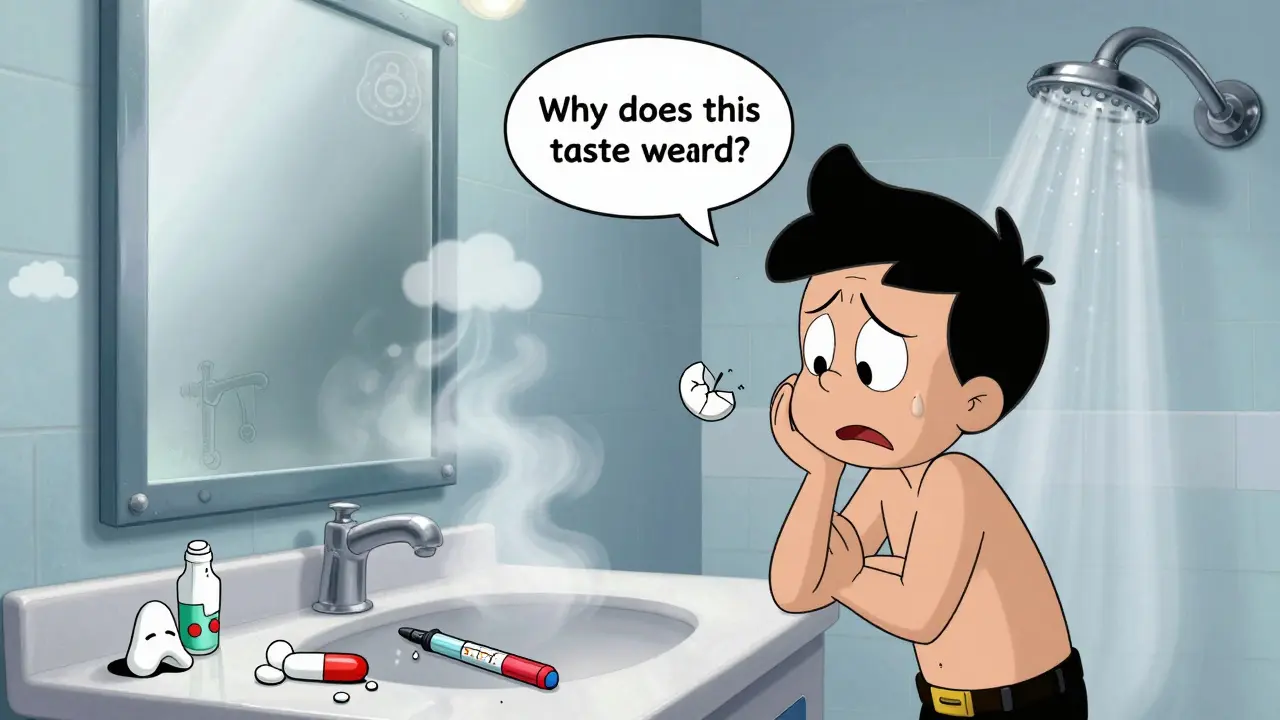
Every year, millions of people in the U.S. and Canada keep their medications in the bathroom-right next to the toothpaste and shampoo. It seems convenient. The cabinet is there. The light is on. You brush your teeth twice a day, so why not grab your pills then too? But here’s the truth: storing medications in the bathroom isn’t just a bad habit-it’s a silent risk to your health.
The Bathroom Is a Drug Killer
Your bathroom isn’t a clean, dry closet. It’s a steamy, humid, temperature-fluctuating environment. Think about it: you take a hot shower, the mirror fogs up, moisture clings to everything. Then you turn on the fan, and suddenly it’s cold again. This cycle repeats daily. For most household items, that’s fine. For pills, patches, liquids, and inhalers? It’s catastrophic. According to the FDA and multiple pharmacy experts, the ideal storage temperature for most medications is between 59°F and 77°F (15°C-25°C). Your bathroom? It regularly hits 90°F during a shower and hits 80-100% humidity. That’s not just uncomfortable-it’s chemically destructive. Tablets absorb moisture. When they do, they start to break down. This process is called hydrolysis. It doesn’t make your pill look weird-it just makes it weaker. You might still swallow it. Your body might still absorb it. But it won’t work the way it should. A study in Circulation found that 30.2% of patients who stored their blood pressure meds in the bathroom had inconsistent control of their condition. That’s not a coincidence. That’s science.Some Medications Die Faster Than Others
Not all drugs are equally affected, but some are especially fragile. Nitroglycerin, used for heart attacks, loses potency within weeks if exposed to humidity. Insulin, a protein-based treatment for diabetes, starts to clump and degrade above 86°F. If you leave your insulin pen on the bathroom counter, it might look fine-but it won’t lower your blood sugar like it should. Birth control pills? They’re not immune either. FDA stability testing shows humidity can reduce the effectiveness of hormonal contraceptives by up to 35%. That’s not a small drop. That’s the difference between protection and unplanned pregnancy. Even test strips-like those for blood glucose-are affected. A 2021 study in the Journal of Diabetes Science and Technology found that 68% of test strips stored in humid bathrooms gave inaccurate readings. That means someone might think their blood sugar is normal when it’s dangerously high. That’s not a guess. That’s a life-threatening error.It’s Not Just About Potency-It’s About Safety
There’s another danger you might not think about: access. Bathroom cabinets are rarely locked. Kids climb on counters. Teens rummage through drawers. Pets jump up. The CDC reports that 70% of prescription opioids misused by teens and young adults come from home medicine cabinets-and bathrooms are the most common location. In one documented case, a 12-year-old in Vancouver found his grandfather’s painkiller in the bathroom cabinet, took one tablet, and ended up in the emergency room. He didn’t mean to. He just saw it there. That’s not rare. A 2022 NIH study found that 80% of U.S. households stored medications in easily accessible places. Among homes with children, 63% kept high-risk drugs within reach. And it’s not just kids. Visitors, house cleaners, even family members with addiction issues can access unsecured pills. The American Academy of Pediatrics says all medications should be stored in locked cabinets. But how many of us actually do that? Most don’t.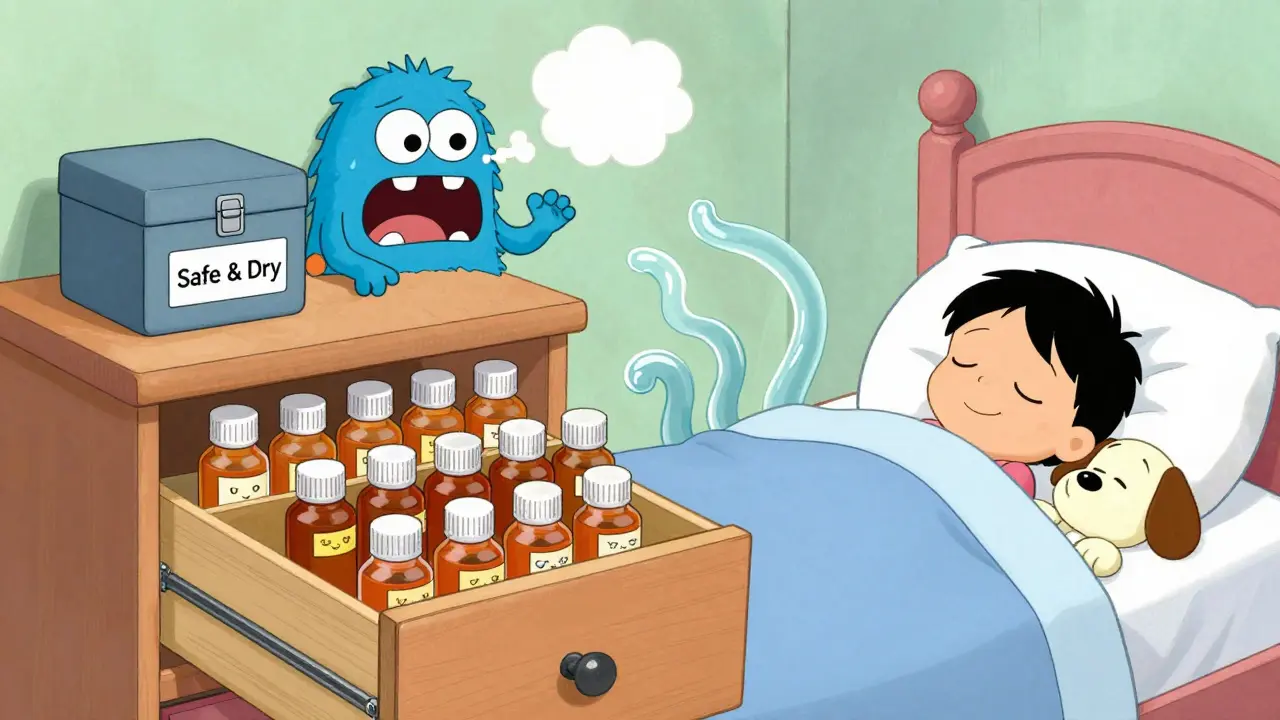
What Happens When Medications Lose Their Power?
You might think, “If it still looks like a pill, it’s probably fine.” But that’s a dangerous assumption. Antibiotics stored in humid environments can degrade unevenly. One pill might still work. The next one might be half-dead. That’s how antibiotic resistance starts. The World Health Organization calls this a global crisis. When you take a weakened antibiotic, you don’t kill all the bacteria. You just make them stronger. And then they come back. Warfarin, a blood thinner, is another example. If it degrades, it can cause dangerous clots-or uncontrolled bleeding. WELLFOR’s 2023 analysis found multiple cases where patients had strokes or internal bleeding because their warfarin had lost potency due to bathroom storage. Even over-the-counter drugs aren’t safe. Antihistamines like diphenhydramine (Benadryl) can become ineffective. One ER review found that 12% of severe allergic reaction cases involved patients who had taken expired or degraded antihistamines stored in the bathroom.Where Should You Store Medications Instead?
The answer is simple: a cool, dry, dark place-away from windows, heat sources, and moisture. A bedroom dresser drawer. A closet shelf. A cabinet in the hallway. Anywhere the temperature stays steady. The average home interior fluctuates by only 2-3°F daily. That’s perfect. Use an airtight container if you want extra protection. Some pharmacies now include humidity-indicating desiccant packets in pill bottles-those little white packets you throw away? Keep them. They’re there for a reason. If you need to refrigerate medication-like insulin or some antibiotics-use a dedicated fridge, not the one in your kitchen. Kitchen fridges open and close constantly. Temperature swings happen. Pharmaceutical refrigerators are designed to stay steady between 36°F and 46°F (2°C-8°C).What About Expired or Unused Medications?
Don’t flush them. Don’t toss them in the trash. Don’t leave them in the bathroom cabinet to “just sit there.” The NIH estimates that over $98 million worth of unused medication sits in U.S. homes. That’s not just waste-it’s pollution. Medications flushed down the toilet or thrown in the trash end up in waterways, harming fish, wildlife, and even drinking water supplies. The safest way to dispose of old meds? Take them to a pharmacy drop-off. Many pharmacies in Canada and the U.S. offer free, secure disposal bins. If that’s not available, mix pills with coffee grounds or cat litter, seal them in a container, and throw them in the trash. Never leave them in a clear bag where someone might dig through.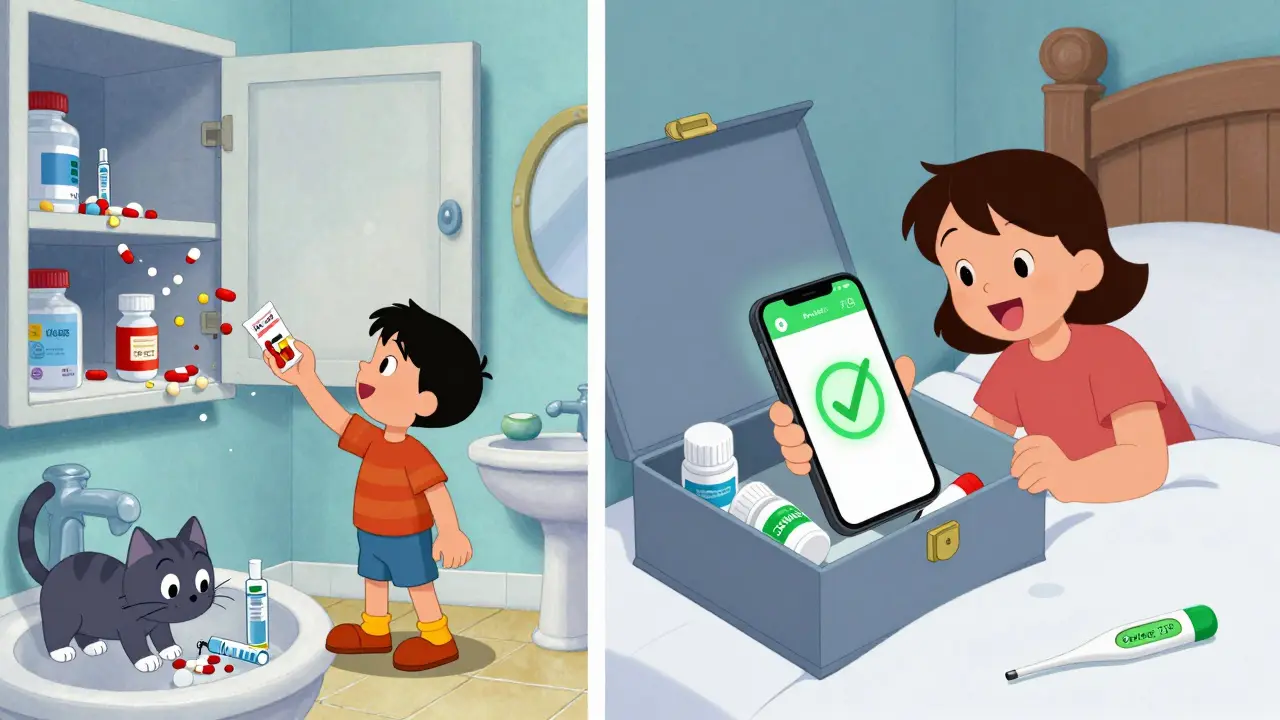
Why Do People Still Store Pills in the Bathroom?
It’s history. In the early 1900s, medicine cabinets were installed in bathrooms because they were the only enclosed storage spaces in most homes. That tradition stuck. Even today, 68% of Americans still store meds in the bathroom, according to a 2023 survey by First Databank. But we’re not living in 1923. We know more. We have better packaging. We have humidity sensors. We have apps that remind you to check your meds. In fact, a 2023 study in the Journal of the American Pharmacists Association showed that people who used medication apps with storage reminders improved their storage habits by 47%. Pharmaceutical companies are catching on too. 73% of prescription bottles now include storage instructions. 58% come with moisture-absorbing packets. 32 major drugmakers now use temperature-sensitive labels that change color if the pill got too hot or too damp.What Should You Do Today?
1. Go to your bathroom medicine cabinet. Open it. Look at what’s inside. 2. Check the labels on your medications. Do they say “Store at room temperature”? That’s usually fine-but not if the room is steamy. 3. Take out every pill, patch, liquid, and inhaler. 4. Move them to a dry, cool, dark place-a drawer in your bedroom, a shelf in your closet. 5. Lock it if you have kids, teens, or pets. 6. Check expiration dates. If it’s old, take it to a pharmacy drop-off. 7. Don’t refill until you’ve moved the old ones out. This isn’t about being perfect. It’s about being smart. Your medications are designed to work. But they need the right environment. The bathroom isn’t it.Final Thought
You wouldn’t leave a battery in the shower to charge. You wouldn’t store your phone in the humid corner near the tub. So why treat your medicine any differently? Your health depends on these pills working exactly as they should. Don’t risk it. Move them out of the bathroom. Your body will thank you.Can I store my medications in the kitchen cabinet instead?
It depends. Kitchen cabinets near the stove or oven are too hot. Cabinets above the sink are too humid. A cabinet on an interior wall, away from appliances and windows, is usually fine. If it’s cool, dry, and dark, it’s better than the bathroom. But avoid areas that get hot during cooking or steam from the sink.
What if I don’t have a closet or bedroom drawer?
Use a locked plastic storage box or a small lockbox. You can buy inexpensive ones online or at pharmacies. Place it on a high shelf in a hallway, laundry room, or even under the bed. The goal is to keep it away from moisture, heat, and access by children or pets. Even a closed shoebox on a shelf works better than the bathroom.
Do all medications need to be refrigerated?
No. Only about 12% of prescription medications require refrigeration-mostly insulin, some antibiotics, and certain biologics. Always check the label. If it doesn’t say “refrigerate,” keep it at room temperature in a dry place. Storing non-refrigerated drugs in the fridge can cause condensation, which damages them.
How can I tell if my medication has gone bad?
Look for changes: tablets that are cracked, discolored, or sticky; capsules that are soft or leaking; liquids that are cloudy or have particles; patches that are no longer sticky. If it smells strange or doesn’t work like it used to, stop using it. Take it to a pharmacy for disposal. Don’t guess-when in doubt, replace it.
Is it safe to keep medications in a car?
No. Cars get extremely hot in summer and freezing in winter. A car dashboard can hit 140°F on a sunny day. That’s enough to destroy insulin, epinephrine, and many other drugs. Never leave medications in your car, even for a few hours.


Carla McKinney
February 13, 2026 AT 18:18The bathroom isn't just bad for meds-it's a biohazard zone. Moisture doesn't just degrade pills, it encourages fungal growth on capsules and creates micro-environments where chemical reactions accelerate. I've seen insulin vials with visible condensation inside the cap. That's not 'expired'-that's contaminated. And no, 'it still looks fine' is not a valid metric. The FDA's stability protocols exist for a reason, and most people treat them like urban legends.
Also, the idea that 'everyone's always done it' is the worst kind of lazy reasoning. We used to store milk on the porch. We used to smoke in hospitals. Progress isn't optional.
Ojus Save
February 15, 2026 AT 05:25so i just moved my pills from the bathroom to the kitchen shelf above the fridge… hope that’s cool? lol
Rachidi Toupé GAGNON
February 16, 2026 AT 01:21Boom. Mic drop. 🎯
I used to keep my blood pressure meds next to the toothbrush. Now? Locked box in the nightstand. My BP has been stable for 11 months straight. No joke. Your body notices when you treat it like a priority-not an afterthought.
Also, that little white packet? DON’T THROW IT AWAY. Tuck it back in. It’s basically a tiny superhero. 🦸♂️
Jim Johnson
February 17, 2026 AT 06:21Yessss! This is the kind of info no one tells you until it’s too late. I didn’t know humidity could mess with birth control-that’s wild.
Just moved my whole stash to a drawer in my bedroom. Took 2 minutes. Total game changer. Seriously, if you’re reading this and still keeping meds in the bathroom… do it. Right now. Your future self will high-five you.
And yeah, lock it if you’ve got kids or pets. Better safe than sorry. I’ve seen too many horror stories.
Vamsi Krishna
February 17, 2026 AT 22:31You say bathroom storage is dangerous but have you considered the psychological safety of having meds accessible? For many elderly or chronically ill, the bathroom is the only consistent ritual space they have. Removing meds disrupts routine, which can be more harmful than humidity.
Also, if your insulin is degrading, maybe your doctor isn't doing their job. Why not fix the system instead of blaming the patient for using the only cabinet they know?
And let’s be real-most people don’t have extra drawers. Your advice sounds great on paper but ignores real living conditions.
Sophia Nelson
February 19, 2026 AT 04:56Wow. What a dramatic panic post. My pills are fine. I’ve been storing them in the bathroom for 15 years. No issues. You’re overcomplicating life.
Steve DESTIVELLE
February 20, 2026 AT 05:00Consider the epistemological framework of pharmaceutical storage
The bathroom as a site of bodily ritual-showering brushing washing-is not merely a spatial container but a symbolic nexus of hygiene and self-care
To relocate medication from this sacred space is to sever the symbolic link between daily ritual and therapeutic adherence
Modern medicine assumes rational actors with climate-controlled homes
But what of the single mother in a studio apartment with no closet
What of the student living above a laundromat where humidity is constant
The solution is not individual compliance
The solution is systemic reform
Pharmaceutical companies must design humidity-resistant packaging
Public housing must include climate-appropriate storage
Until then
Stop shaming
Start solving
athmaja biju
February 22, 2026 AT 03:50India has been storing medicines in bathrooms for centuries. We don’t have fancy cabinets. We don’t have air-conditioned homes. We have faith. And we have tradition. You westerners overthink everything. Your pills are not fragile. Your bodies are. Your fear is not science. It’s marketing.
My grandmother took her diabetes pills from the bathroom shelf for 40 years. She lived to 92. What’s your excuse?